
The concept of integrating manned helicopters with unmanned aerial vehicles, known as Manned-Unmanned Teaming (MUM-T), has fundamentally transformed the operational paradigm for modern army aviation. This synergy, where the manned platform serves as an intelligent command node and the unmanned systems act as extended “eyes” and “fists,” creates a force multiplier effect. It significantly enhances situational awareness, extends operational reach, increases stand-off distances, and ultimately improves both mission effectiveness and platform survivability. For decades, the U.S. Army has been at the forefront of developing, testing, and fielding MUM-T capabilities, providing a comprehensive blueprint for the integration of military UAV assets into complex aerial tasks.
The mathematical representation of enhanced mission effectiveness through MUM-T can be conceptualized by considering the expanded sensor and weapon footprint. Let $A_s$ represent the effective area coverage rate of a solo manned helicopter’s sensors, and $T_{detect}$ its average time to detect a target. When teamed with $n$ military UAV platforms, the collective coverage area and search rate increase significantly. A simplified model for the probability of detecting a target within a given area $A_{op}$ over time $t$ for the team can be expressed as:
$$P_{detect}(t) = 1 – e^{-(\lambda_h + \sum_{i=1}^{n} \lambda_{uav_i}) \cdot t}$$
where $\lambda_h$ and $\lambda_{uav_i}$ are the effective search rates of the helicopter and the i-th military UAV, respectively. This directly illustrates the synergistic gain in capability.
The Research and Development Journey: From Concept to Advanced Teaming
The U.S. Army’s formal pursuit of MUM-T began in the early 1990s. This journey has been marked by successive research programs, each building upon the lessons of the last to incrementally mature the technology, tactics, and operational concepts.
| Program / Era | Timeframe | Key Platforms Involved | Primary Focus & Achievements |
|---|---|---|---|
| MUM Concept Evaluations (I-IV) | 1996-2001 | Simulated RAH-66 Comanche, UAV Models | Established initial Tactics, Techniques, and Procedures (TTPs); conducted simulation-based validation of core concepts for reconnaissance and attack. |
| AMUST-D (Airborne Manned/Unmanned System Technology Demonstration) | 2000-2006 | AH-64D Apache, UH-60 Command Bird, RQ-5 Hunter | Demonstrated real-world command and control of a military UAV from an attack helicopter; integrated decision-aiding tools (Rotorcraft Pilot’s Assistant) to reduce crew workload. |
| HKST (Hunter-Killer Standoff Team) | ~2005-2006 | AH-64D Apache, MQ-5 Hunter | Advanced sensor/data link integration; validated the “stand-off killer” concept for engaging time-sensitive targets at extended ranges, enhancing manned platform safety. |
| MUSIC (Manned-Unmanned System Integration Capability) | 2011 | AH-64D, OH-58D, MQ-1C Gray Eagle, RQ-7 Shadow, Handheld UAVs | Demonstrated scalable interoperability across a heterogeneous mix of manned and unmanned assets, proving the network-centric architecture for future operations. |
| SCORCH & SUMIT | 2010s | Simulation & Ground Studies | Focused on human-machine interface, supervisory control, and AI-aided decision support for managing multiple military UAVs (e.g., 1 pilot controlling 3 UAVs), automated target recognition, and collaborative task management. |
| Advanced Teaming (A-Team) under FVL | 2020-2024 | Future Vertical Lift (FVL) Platforms, Next-Gen UAVs | Developing and integrating next-generation technologies for mission management, autonomous teaming behaviors, adaptive human-system interfaces, and seamless integration into the Joint All-Domain Command and Control (JADC2) network. |
The progression from simple command links in AMUST-D to the network-enabled MUSIC demonstration and now towards AI-infused “Advanced Teaming” underscores a clear trend: moving from direct, low-level control of a single military UAV towards the supervisory management of a collaborative, semi-autonomous team of unmanned systems. The ultimate goal is represented by the Advanced Teaming vision, where the cognitive burden on the human operator is minimized through automation, and the team’s collective intelligence is maximized.
Combat Proven: MUM-T in Real-World Operations
The true value of MUM-T has been validated not in laboratories, but on the battlefield. Operational deployments, particularly in Afghanistan, transformed the concept into a routine combat capability. The AH-64E Apache Guardian, equipped with the modernized MUM-T system, became the centerpiece of these efforts.
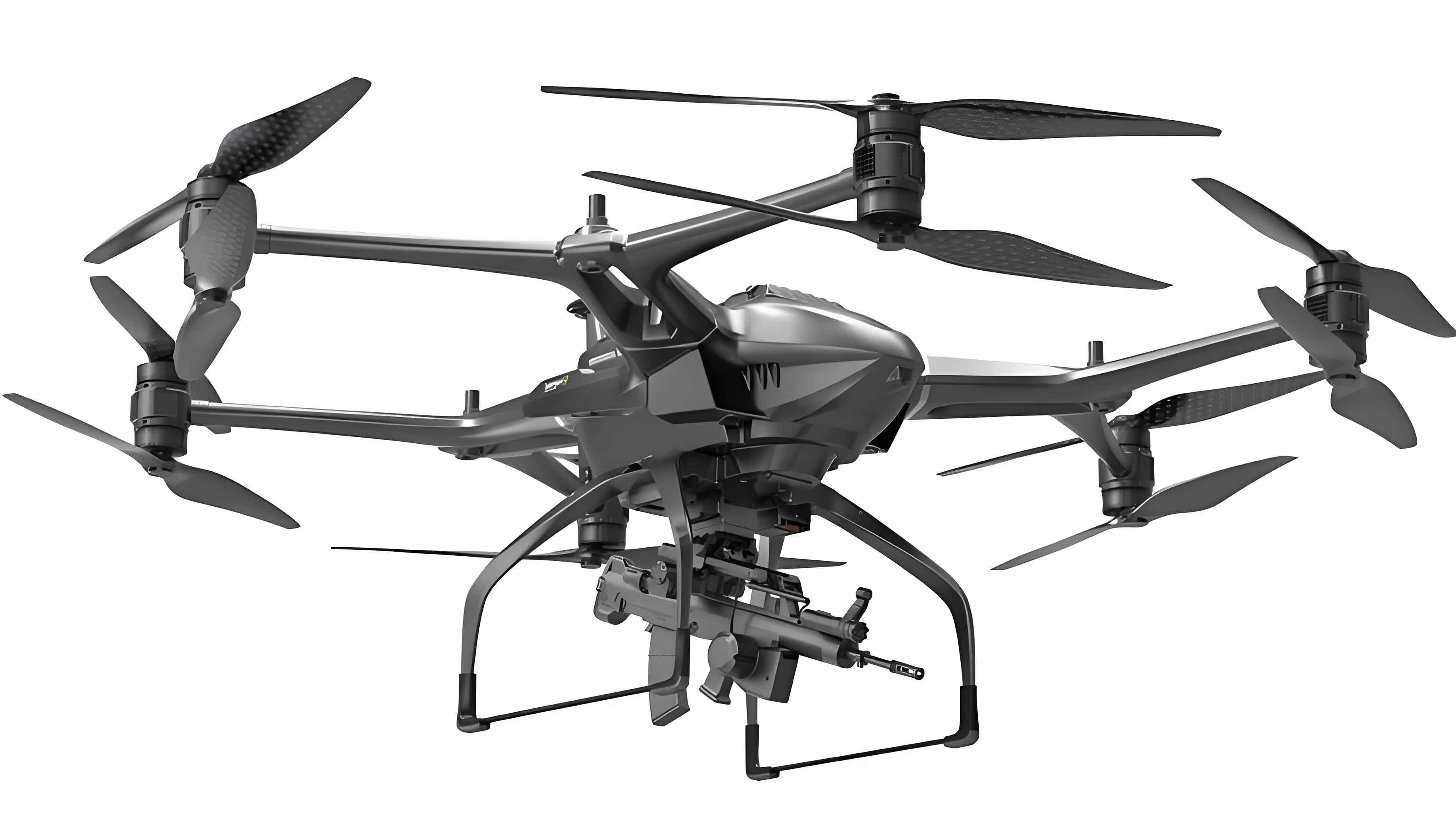
In these environments, Apache helicopters routinely operated with medium-altitude, long-endurance (MALE) military UAVs like the MQ-1C Gray Eagle. Reports indicated that a significant percentage of Apache attacks were executed using targeting data provided by unmanned teammates. Standardized TTPs emerged, such as using multiple UAVs for target triangulation and designation for fixed-wing strikes, or having the Apache remain masked behind terrain while a military UAV performed over-the-hill surveillance, followed by a rapid “pop-up” attack.
A landmark demonstration in 0 further showcased the evolved capability: a single AH-64E successfully controlled two different types of military UAVs—an RQ-7 Shadow and an MQ-1C Gray Eagle—in a coordinated kill chain. The Shadow performed the detection and laser designation of a target located approximately 50 km away, and the Apache crew then commanded the Gray Eagle to launch a precision-guided munition to destroy it. This validated a powerful “remote launch” capability, keeping the manned platform far from danger. This operational experience has been formally codified into U.S. Army doctrine, such as Field Manual FM 3-04 “Army Aviation,” which now incorporates MUM-T as a core component of standard reconnaissance and attack methodologies.
| Capability Level | Description | Example | Key Enabler |
|---|---|---|---|
| Level 1: Indirect Receipt of UAV Data | Pilot views UAV-derived intelligence on a ground station, not in the cockpit. | Early 2000s, receiving UAV video feed at a Tactical Operations Center (TOC). | Common data formats, downlink receivers. |
| Level 2: Direct Receipt of UAV Data in Cockpit | Real-time UAV sensor payload data (video, imagery) is displayed on the helicopter’s cockpit displays. | AH-64D in AMUST-D receiving RQ-5 video. | Robust airborne data link (e.g., Common Data Link). |
| Level 3: Control of UAV Sensor Payload | Aircrew can directly control the pointing, zoom, and mode of the UAV’s camera or other sensors. | Apache pilot slewing a Gray Eagle’s electro-optical/infrared (EO/IR) ball. | Two-way digital data link, interoperable control protocols. |
| Level 4: Control of UAV Flight & Weapons | Aircrew can alter the UAV’s flight path and, if equipped, authorize and direct its weapon releases. | AH-64E commanding an MQ-1C to launch a missile. | Secure, reliable command link; weapons release authority protocols. |
| Level 5: Collaborative Team Autonomy | Manned crew issues high-level tasks to multiple autonomous UAVs, which collaboratively plan and execute. | Future “Advanced Teaming” concepts under FVL. | Artificial Intelligence, Machine Learning, advanced mission planning software. |
Deconstructing the Key Technological Pillars
The operational success of MUM-T rests on several interdependent technological pillars. These systems must work in concert to translate the conceptual benefits into tangible combat power.
1. Autonomous Behaviors in Military UAVs
To prevent overwhelming the human crew, especially when controlling multiple assets, the military UAV must transition from a remotely piloted vehicle to a semi-autonomous teammate. This involves several core autonomous functions:
- Adaptive Mission Planning & Re-planning: The ability to generate and adjust flight paths, communication schedules, and sensor tasks in real-time based on dynamic threats, fuel state, and priority changes. This can be modeled as an optimization problem minimizing risk and maximizing objective coverage:
$$J = \min_{x} \left( w_1 \cdot Risk(x) + w_2 \cdot (T_{total}) – w_3 \cdot Intel\_Gathered(x) \right)$$
where $x$ represents the plan variables and $w$ are weighting factors. - Collaborative Behaviors: Enabling UAVs to share information, hand off tracking tasks, and dynamically reassign roles within the team to maintain coverage or prosecute targets.
- Advanced Situational Awareness & Data Fusion: The UAV system must process its own sensor data, fuse it with data from other team members (manned and unmanned), and maintain a coherent track picture, alerting the human operator to critical changes.
2. The Human-System Interface: From Joystick to Tactical Supervisor
The cockpit interface must evolve from providing low-level joystick control to enabling efficient supervisory control and battle management. Modern MUM-T systems utilize plan-based control paradigms, where the pilot uses intuitive graphical interfaces to issue high-level tasking. For example, instead of manually flying a military UAV, the pilot might simply:
– Designate a point for “stare” surveillance, and the UAV autonomously plans a loiter pattern.
– Draw a line for a route survey, and the UAV calculates the optimal flight path and sensor settings.
– Select a moving target for “follow-and-track,” delegating the persistent tracking task to the UAV’s autonomy.
This shift is quantified by the reduction in required continuous control inputs ($C_{human}$) and the increase in high-level task commands ($T_{cmd}$), aiming for a high ratio:
$$\text{Supervisory Efficiency} \propto \frac{T_{cmd}}{C_{human}}$$
3. The Interoperability Backbone: The MUM-T Data Link
Reliable, high-bandwidth, and secure connectivity is the central nervous system of the team. The AH-64E’s MUM-T capability is enabled by a sophisticated datalink system like the MUM-T X, which typically features:
– Multi-band (e.g., Ku, C, L, S-band) operation for robustness and flexibility.
– High data rate throughput for streaming multiple full-motion video feeds.
– Network-enabled functionality to share data across the team and with ground forces.
– Low-latency command and control links for responsive weapon release authority.
The link margin must be sufficient to maintain connectivity at operational ranges, which can be analyzed using the link budget equation:
$$P_{rx} = P_{tx} + G_{tx} + G_{rx} – L_{fs} – L_{other}$$
where $P_{rx}$ is received power, $P_{tx}$ is transmitted power, $G$ are antenna gains, $L_{fs}$ is free-space path loss (a function of distance and frequency), and $L_{other}$ accounts for other losses. System design ensures $P_{rx}$ remains above the receiver’s sensitivity threshold for the required data rate.
In conclusion, the U.S. Army’s decades-long investment in Manned-Unmanned Teaming has yielded a mature, combat-proven capability that is now foundational to its aviation operations. The path forward, as seen in the Future Vertical Lift’s Advanced Teaming initiative, points toward even greater integration, autonomy, and network-centric warfare, where teams of intelligent military UAVs will operate as seamless extensions of manned platforms, fundamentally reshaping the tempo, reach, and effectiveness of aerial operations on the future battlefield.