
From my perspective as someone deeply invested in the evolution of secure communications and autonomous systems, the convergence of Fifth-Generation (5G) cellular technology and military unmanned aerial vehicles (UAVs) represents one of the most pivotal technological synergies of our era. While the broader discourse on mobile internet security rightly focuses on protecting personal data and financial transactions on consumer smartphones—a domain where risks are proliferating due to pervasive app usage and device vulnerabilities—the stakes are exponentially higher in the military domain. The secure, reliable, and real-time transmission of data is not merely a matter of convenience; it is a fundamental determinant of mission success and operational security. In this context, I believe the inherent capabilities of 5G networks are set to fundamentally redefine the operational envelope, intelligence fidelity, and collaborative potential of military UAV fleets.
The proliferation of military UAV platforms across all domains of modern warfare is an undeniable reality. Their advantages in terms of cost-efficiency, operational flexibility, and reduced risk to human personnel are well-documented. However, their effectiveness has always been intrinsically tied to the quality of their command, control, and communications (C3) links. Traditional datalinks, while functional, impose significant constraints. Bandwidth limitations restrict the volume and resolution of sensor data (e.g., full-motion video, synthetic aperture radar imagery) that can be transmitted. Latency, often measured in tens or hundreds of milliseconds, hinders real-time control for dynamic evasion or precision engagement. Perhaps most critically, the security and resilience of these dedicated links under intense electronic warfare conditions remain a constant concern. The following table summarizes the core limitations faced by military UAV operations under legacy communication paradigms.
| Operational Requirement | Legacy Communication Challenge | Impact on Military UAV Mission |
|---|---|---|
| High-Bandwidth ISR (Intelligence, Surveillance, Reconnaissance) | Limited spectral efficiency and channel capacity. | Reduced image/video resolution, slower data downlink, potential loss of critical detail. |
| Low-Latency Command & Real-Time Control | High end-to-end delay (>30ms typical). | Sluggish response in dynamic environments, degraded performance for swarming or countermeasure activation. |
| Secure & Resilient Data Transmission | Reliance on proprietary, sometimes vulnerable, encryption and fixed-frequency links susceptible to jamming. | Risk of interception, spoofing, or denial-of-service, compromising the entire mission. |
| Network Scalability & Density | Difficulty in managing a large number of concurrent UAV connections in a confined area. | Constraints on the scale of military UAV swarm operations and collaborative sensing. |
This is precisely where 5G technology introduces a paradigm shift. It is not merely an incremental improvement but a foundational upgrade in network capability. The key performance indicators (KPIs) of 5G, when compared to its predecessor 4G LTE, reveal a dramatic leap. These KPIs directly address the chronic pain points of military UAV communications.
Let us formalize some of these core communication metrics. The achievable data rate \( R \) in a wireless channel, a fundamental limit for ISR data transmission, is governed by the Shannon-Hartley theorem:
$$ C = B \log_2(1 + \text{SINR}) $$
where \( C \) is the channel capacity (maximum theoretical data rate in bits/sec), \( B \) is the bandwidth (Hz), and SINR is the Signal-to-Interference-plus-Noise Ratio. 5G’s use of massive bandwidth in millimeter-wave (mmWave) spectra (e.g., 28-40 GHz) directly increases \( B \), enabling order-of-magnitude higher capacity \( C \) for military UAV sensor data offload.
Furthermore, the end-to-end latency \( L_{e2e} \), critical for real-time control, can be modeled as:
$$ L_{e2e} = L_{\text{prop}} + L_{\text{trans}} + L_{\text{queue}} + L_{\text{proc}} $$
where \( L_{\text{prop}} \) is the propagation delay, \( L_{\text{trans}} \) is the transmission delay, \( L_{\text{queue}} \) is the queuing delay, and \( L_{\text{proc}} \) is the processing delay. 5G’s 1ms target for the user plane latency is achieved by aggressively minimizing each component: new frame structures reduce \( L_{\text{trans}} \), edge computing (MEC) slashes \( L_{\text{prop}} \) and \( L_{\text{proc}} \) for local data, and sophisticated scheduling minimizes \( L_{\text{queue}} \). For a military UAV performing threat avoidance, this near-instantaneous loop is transformative.
| Performance Metric | 4G LTE (Typical) | 5G (Target/Enhanced) | Implication for Military UAV |
|---|---|---|---|
| Peak Data Rate (Downlink) | 1 Gbps | 20 Gbps | Enables transmission of ultra-high-definition, multi-spectral sensor feeds in real-time. |
| User Plane Latency | 10-30 ms | < 1 ms | Facilitates real-time teleoperation, autonomous swarm coordination, and instant response to threats. |
| Connection Density | ~100,000 devices/km² | ~1 million devices/km² | Supports large-scale deployment of military UAV swarms for pervasive surveillance or saturation tactics. |
| Reliability | 99.9% | 99.999% | Provides “mission-assurance” level link availability for critical commands and data. |
| Mobility Support | Up to 350 km/h | Up to 500 km/h | Ensures stable connectivity for high-speed military UAV platforms, including loyal wingmen for fighter aircraft. |
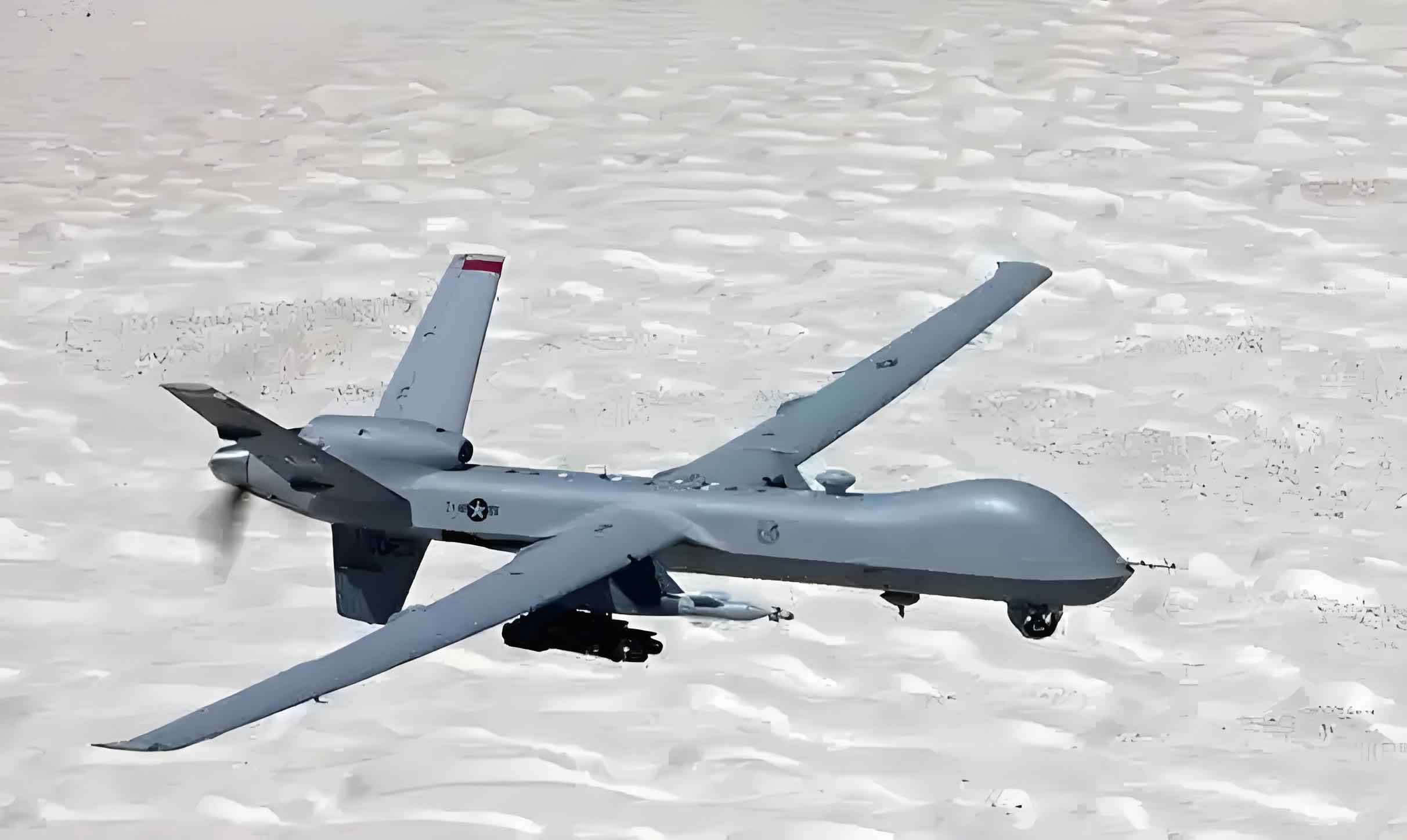
The true power of 5G for the military UAV ecosystem lies in two revolutionary architectural concepts: Network Slicing and Massive MIMO. In my analysis, these are the key enablers that translate raw performance metrics into tangible operational capabilities.
Network Slicing allows a single physical 5G infrastructure to be partitioned into multiple, isolated, virtual networks—each tailored for a specific service. For joint forces operating a diverse fleet of military UAV platforms, this is a game-changer. A single aerial operations area could host several concurrent, logically separate networks: one ultra-reliable low-latency slice for controlling armed reconnaissance military UAVs, a massive machine-type communication slice for a sensor network of small micro-drones, and an enhanced mobile broadband slice for streaming high-value intelligence from a high-altitude, long-endurance (HALE) platform. The isolation ensures that a data surge from the sensor swarm does not impact the critical control signals of the armed UAVs. The resource allocation for a slice can be dynamically adjusted based on mission priority, modeled as an optimization problem. For instance, allocating bandwidth \( B_s \) to slice \( s \) from a total pool \( B_{\text{total}} \) to maximize a utility function \( U_s(B_s) \) representing mission effectiveness:
$$ \underset{B_s}{\text{maximize}} \sum_{s \in S} w_s U_s(B_s) \quad \text{subject to} \quad \sum_{s \in S} B_s \leq B_{\text{total}} $$
where \( w_s \) is the priority weight of the military UAV mission supported by slice \( s \).
Massive MIMO, on the other hand, directly tackles the challenge of robust connectivity in complex environments. By deploying base stations with arrays of dozens or hundreds of antennas, the system can form extremely narrow and precise beams. For a military UAV, this means a dedicated, high-gain signal track can be formed and maintained, significantly improving the link budget and resistance to interference or jamming. The beamforming gain \( G \) scales with the number of antennas \( N \):
$$ G \propto 10 \log_{10}(N) \text{ dB} $$
This gain directly improves the SINR in our earlier capacity equation, making high-data-rate links more reliable even at the extended ranges typical of military UAV operations. Moreover, Massive MIMO enables spatial multiplexing, allowing the same time-frequency resource to be used for communicating with multiple military UAVs simultaneously, a vital feature for managing dense formations or swarms.
The synergy works in both directions. While 5G empowers military UAVs, UAVs themselves present a revolutionary use-case for 5G infrastructure: the aerial mobile base station. A persistent challenge in theater operations is establishing communications in denied, degraded, or disaster-struck environments where fixed infrastructure is non-existent or destroyed. A military UAV, equipped with a compact 5G base station (a “Cell-on-Wings” or COW), can be rapidly deployed to create an on-demand, localized communication bubble. This aerial node can provide connectivity for ground troops, other UAVs, and IoT sensors, effectively extending the network’s reach and resilience. The coverage area \( A_{\text{cov}} \) of such an airborne base station at altitude \( h \) is approximately:
$$ A_{\text{cov}} \approx \pi (h \cdot \tan(\theta))^2 $$
where \( \theta \) is the antenna’s elevation beamwidth. By dynamically adjusting the UAV’s position, network planners can optimize coverage for moving units or fill coverage gaps, a concept known as UAV-based network provisioning, which involves solving complex path planning and resource allocation problems in real-time.
However, this bright future is not without its profound challenges and security considerations. Integrating commercial-derived 5G technology into the national security fabric requires overcoming significant hurdles.
| Challenge Domain | Specific Issue | Potential Mitigation Strategy |
|---|---|---|
| Technical & Operational | Short range of mmWave frequencies; susceptibility to blockages (foliage, buildings). | Hydual-band networks using sub-6 GHz for coverage and mmWave for capacity hotspots; use of military UAVs as aerial relays to maintain line-of-sight. |
| Platform Integration | UAV size, weight, and power (SWaP) constraints for 5G modems and antenna arrays. | Development of militarized, SWaP-optimized 5G terminal equipment; reliance on larger mothership UAVs to act as primary communication nodes for smaller drones. |
| Network Management | Complexity of managing dynamic network slices and mobile aerial base stations in contested spectrum. | AI-driven network orchestration for autonomous slice lifecycle management and dynamic spectrum access. |
The security challenge is paramount and multi-layered. The attack surface expands considerably. We must consider not just the security of the data in transit, but the security of the 5G network functions themselves that now control military UAV assets. Threats range from classic jamming and spoofing to sophisticated attacks on virtualized network functions, slicing management protocols, or the supply chain of 5G components. A holistic security framework is non-negotiable. This includes:
- End-to-End Encryption: Applying strong, quantum-resistant encryption not just at the radio link but across the entire data path from the military UAV sensor to the command center cloud.
- Zero-Trust Architecture: Mandating strict identity and continuous verification for every device, user, and network function attempting to access a military UAV control slice, regardless of location.
- Resilience by Design: Building networks that can detect, isolate, and reconfigure autonomously under attack—using AI to re-route data through military UAV relay nodes or switch to alternative slices if one is compromised.
The mathematical model for a system’s resilience \( \rho \) can incorporate its ability to maintain a minimum level of service \( K \) for military UAV connectivity under a set of failure or attack states \( F \):
$$ \rho = \mathbb{E}_{f \in F} \left[ \frac{\text{Performance during failure } f}{ \text{Nominal Performance}} \right] \quad \text{subject to Performance} \geq K $$
The goal of secure design is to maximize \( \rho \).
In conclusion, from my viewpoint, the integration of 5G and military UAV technology is far more than a simple upgrade in datalink speed. It is the foundational step towards a truly networked, intelligent, and responsive battlespace. 5G provides the fabric upon which swarms of heterogeneous military UAVs can operate with unprecedented levels of autonomy, coordination, and situational awareness. However, realizing this potential demands a co-evolution of both technologies. It requires hardening 5G’s security posture to military-grade standards and innovating UAV platform design to host and exploit advanced communications. The nations and alliances that successfully navigate this integration—mastering both the transformative capabilities and the formidable security challenges—will secure a decisive advantage in the future of defense and strategic deterrence. The era of the smart, connected, and securely networked military UAV fleet, underpinned by 5G, is not just approaching; it is being built today.