
The ongoing evolution of the global security landscape, underscored by recent conflicts, has fundamentally reshaped investment theses within the defense sector. One domain that has moved decisively from a supporting role to a centerpiece of modern military strategy is that of unmanned aerial vehicles (UAVs). Observations from recent theaters of war indicate that military UAV systems are no longer mere force multipliers but are becoming primary determinants of aerial dominance and ground combat efficacy. Their ability to conduct persistent intelligence, surveillance, reconnaissance (ISR), and precision strikes with reduced risk to human operators has irrevocably altered the calculus of power. Consequently, the investment value of leading companies in the military UAV ecosystem demands a comprehensive and forward-looking re-evaluation.
The Expansive Frontier: Market Dynamics and Growth Trajectory
The contemporary battlespace is increasingly defined by unmanned combat systems. These systems are built on an open architecture, centered on network-centric communications, and are characterized by advantages in survivability, cost-effectiveness, distributed functionality, and intelligent autonomy. The proliferation of unmanned platforms in roles ranging from targeted strikes to large-scale combined arms operations is a testament to their operational necessity.
A core feature of this new paradigm is the high proportion of unmanned systems within the force structure, adhering to the principle of “unmanned platforms, manned systems.” An unmanned combat system is an integrated complex comprising the unmanned platform itself, mission payloads, command and control (C2) systems, and a seamless air-space-ground information network. The platform is the core physical component. These systems are broadly categorized by their operating domain, as summarized below:
| System Domain | Core Platforms | Primary Functions |
|---|---|---|
| Unmanned Aerial System (UAS) | Fixed-wing UAVs, Rotary-wing UAVs, Hybrid VTOL UAVs | ISR, Strike, Electronic Warfare, Communications Relay |
| Unmanned Ground Vehicle (UGV) | Tracked/Wheeled Robots | Logistics, Reconnaissance, Direct Fire, Explosive Ordnance Disposal (EOD) |
| Unmanned Maritime System (UMS) | Unmanned Surface Vessels (USV), Unmanned Underwater Vehicles (UUV) | Mine Countermeasures, Anti-Submarine Warfare, Harbor Patrol |
The market data corroborates the strategic shift. According to MarketsandMarkets, the global military UAV market was valued at approximately $12.1 billion in 2018. Projections indicate robust growth, with the market size expected to reach $26.8 billion by 2025, reflecting a compound annual growth rate (CAGR) of 12.00%. This growth can be modeled as an exponential function:
$$ M(t) = M_0 \cdot (1 + r)^{t} $$
Where \( M(t) \) is the market size in year \( t \), \( M_0 \) is the initial market size ($12.1B in 2018), and \( r \) is the annual growth rate (0.12). For instance, the projected 2025 market is calculated as \( 12.1 \times (1.12)^{7} \approx 26.8 \) billion USD.
The United States military, as a pioneer and largest operator, provides a benchmark. It currently fields over 1,040 large UAVs (excluding mini/micro systems), with the Army and Air Force being the primary operators. U.S. procurement budgets from 2010 to 2020 cumulatively exceeded $34.8 billion, averaging over $3 billion annually, which constitutes an average of about 6.19% of total aviation procurement spending. The focus has been on large, long-endurance, and multi-role (ISR/Strike) platforms like the MQ-9 Reaper and MQ-1 series.
This established demand creates a clear roadmap for other nations. There exists a significant capacity gap in many modern armed forces, particularly in the high-end military UAV segment. For example, while a leading power may currently operate a fleet numbering in the dozens of large UAVs, the benchmark set by the U.S. is in the hundreds for specific models alone. This disparity underscores a vast market opportunity for capable manufacturers who can leverage late-mover advantages in technology and cost to rapidly close the capability gap.
Technological Evolution and System Integration
The effectiveness of a military UAV is not solely dependent on the airframe. It is the synergy of platform performance, sensor quality, weapon system integration, and network connectivity that creates a decisive tool. Key performance parameters for a multi-role Medium-Altitude Long-Endurance (MALE) UAV can be expressed through a multi-objective function that investors and analysts should consider:
$$ \text{System Effectiveness} = f(Endurance, Payload, Comms Range, Sensor Fidelity, Weapon Precision, SWaP) $$
Where SWaP stands for Size, Weight, and Power constraints. Modern systems strive to maximize the numerator metrics while minimizing SWaP. Endurance often exceeds 24 hours, payload capacity ranges from hundreds to thousands of kilograms, and sensor suites now commonly include high-resolution EO/IR, SAR, and SIGINT packages.
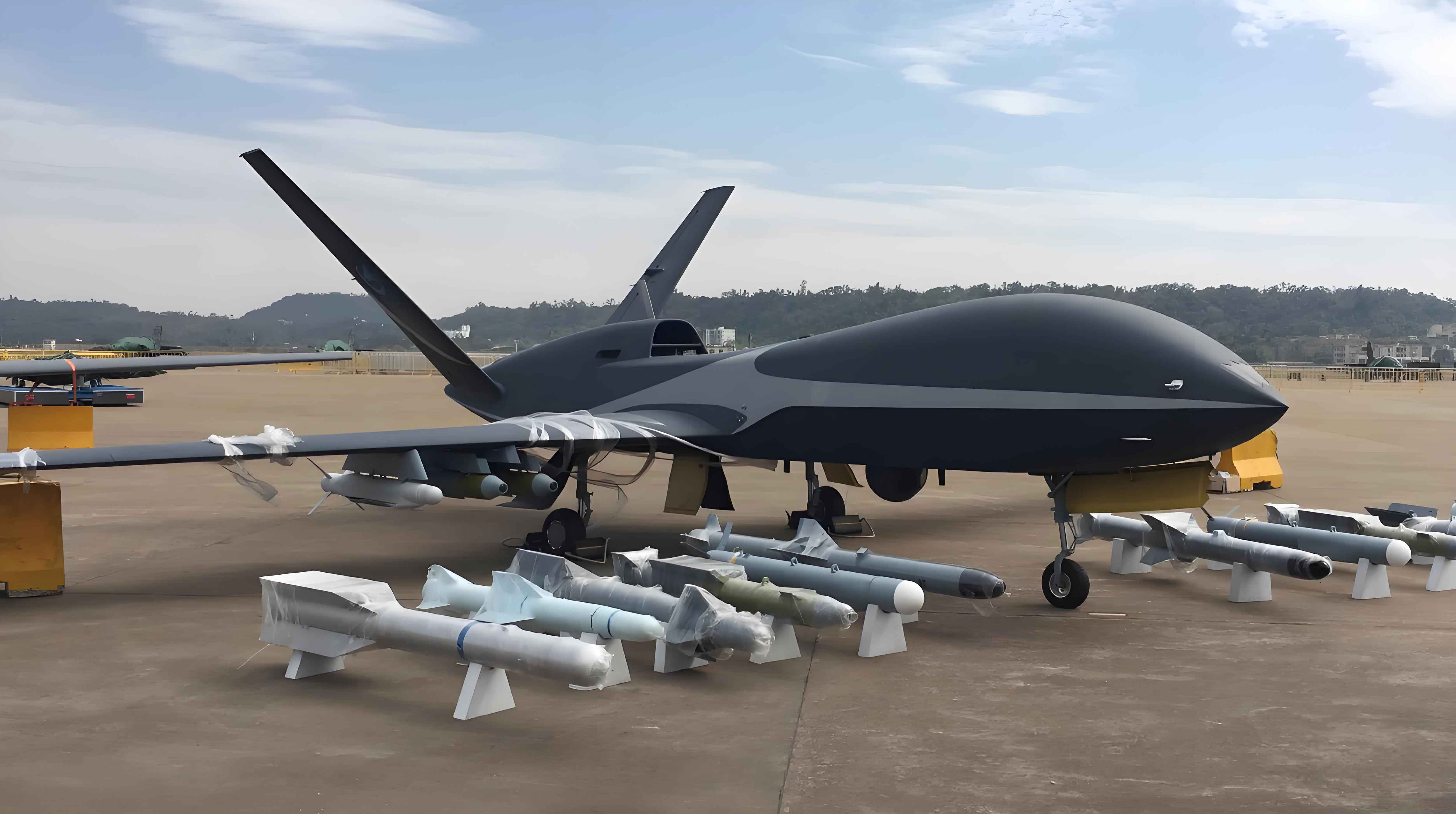
A critical differentiator for leading manufacturers is the move towards “airframe-missile integration.” This refers to the deep, co-engineering of the UAV platform and its associated air-to-ground munitions. A company that designs both the launch platform and the guided weapon achieves significant advantages in optimization. The interface between aircraft and weapon (electrical, data, physical) is streamlined, leading to higher reliability, more efficient use of payload capacity, and potentially lower total system cost. This integrated design philosophy enhances the weapon’s accuracy and the platform’s operational flexibility, as it can be more easily adapted for other payloads or munitions from different sources if needed. The combat performance of integrated systems in real-world conflicts, with reported high reliability and precision in hundreds of engagements, serves as the ultimate validation of this approach.
Competitive Landscape and Key Player Analysis
The global military UAV market features a mix of state-owned entities, publicly listed defense contractors, and specialized private firms. The competitive intensity is high, particularly in the MALE and HALE (High-Altitude Long-Endurance) segments. The following table provides a comparative overview of key competitors in a major market, focusing on their flagship products and noted characteristics.
| Company / Entity | Flagship UAV Product Series | Key Characteristics & Focus |
|---|---|---|
| AVIC UAV (Aerospace Industry Corporation) | Wing Loong (Yi Long) Series (WL-1, WL-1D, WL-2) | State-backed, products fielded both domestically and via foreign military sales (FMS), wide recognition. |
| Sky Swords Aviation / Haixin Aviation | Tianying, WJ-700, WJ-600A/D | Broad portfolio from tactical to strategic UAVs, part of a major defense research consortium. |
| Tengden Inc. | Double-tailed Scorpion (TB), others | Private company known for innovative twin-boom, multi-engine designs for heavy payload/long endurance. |
| CASIC / Tianyu Changying | BZK-005 series | Focus on strategic reconnaissance and strike drones, with products for both domestic and export markets. |
Within this landscape, a specific listed company serves as an illustrative case study for investors. Originally a manufacturer of new material films, it underwent a transformative reverse merger in 2017, injecting aerospace assets focused on unmanned systems. This created a dual-business entity: a military UAV and missile business primarily for export, and a films business for photovoltaic and consumer electronics applications.
Its UAV product line is comprehensive, developed over two decades with expertise in aerodynamics inherited from its state-owned parent research institute. It features a layered portfolio: “high, medium, low” altitude coverage combined with “long, medium, short” range capabilities. Its well-known product series, including the CH-3, CH-4, and CH-5, are considered direct competitors to Western MALE UAVs and have seen documented combat use. Financially, this entity has historically maintained leading revenue scales and attractive gross margins within its peer group in its core market, though recent performance was impacted by global pandemic-related export delays.
The company’s strategic edge lies in its “airframe-missile integration” capability. As one of the earliest entities with full-cycle development and production qualifications for both UAVs and air-to-ground missiles, it produces integrated weapon systems like the AR-1 and AR-2 precision-guided munitions. This vertical integration is a significant moat, optimizing performance and creating a one-stop-shop for customers. Recent corporate actions include a successfully approved management equity incentive plan—a positive signal for governance and performance alignment—and the strategic divestiture of a lower-margin capacitor film business. This refocuses its materials division on higher-growth sectors like solar energy, potentially improving overall corporate profitability and cash flow to support aerospace R&D.
Future growth is being fueled by directed capital investment. A recent private placement raised funds specifically allocated to next-generation UAV development (including enhanced models, tilt-rotor concepts, and stealth technology) and the expansion of low-cost airborne weapon production. The successful execution of these R&D and industrialization projects is poised to strengthen its product portfolio’s competitiveness further and capture a larger share of the expanding global military UAV market.
Investment Considerations and Value Chain Analysis
For investors, the military UAV theme extends beyond final assembly. The entire value chain presents opportunities, each with different risk/return profiles, technological barriers, and growth drivers. A holistic analysis is crucial.
| Value Chain Segment | Core Activities & Components | Investment Characteristics |
|---|---|---|
| Research, Design & Development | Aerodynamics, stealth design, flight control algorithms, system architecture. | High barrier to entry, IP-intensive, long development cycles, potentially high margins for successful designs. |
| Platform Manufacturing & Integration | Airframe composites, propulsion systems, landing gear, final assembly and testing. | Capital intensive, requires specialized manufacturing expertise, margins depend on production scale and efficiency. |
| Mission Payloads & Sensors | EO/IR cameras, SAR radars, SIGINT suites, laser designators. | Technology-driven, rapid iteration cycles. Critical for capability. High-value segment. |
| Weapon Systems | Precision-guided munitions (PGMs), launch mechanisms, targeting software. | Highly regulated, requires integration expertise. “Ammunition-like” recurring revenue stream post-platform sale. |
| Command & Control (C2) & Data Links | Ground control stations, satellite & line-of-sight communication systems, data encryption. | Software and network-centric. Enables swarm capabilities and long-range ops. Recurring upgrade revenue. |
| Training, Maintenance & Support | Simulators, spare parts, field service, software updates. | High-margin, recurring revenue business that builds long-term client relationships and creates stable cash flows. |
When evaluating a pure-play military UAV company, a discounted cash flow (DCF) analysis incorporating strategic factors is essential. The model must account for:
1. Order Book Visibility: Defense contracts often provide multi-year visibility. The value can be modeled as:
$$ PV_{\text{orders}} = \sum_{t=1}^{n} \frac{CF_t}{(1 + WACC)^t} $$
where \( CF_t \) represents contracted cash flows over \( n \) years.
2. R&D Success Probability: The payoff from R&D projects (e.g., new stealth UAV) is uncertain. An expected value approach can be used:
$$ EV_{\text{R&D}} = \sum (P_{\text{success}} \times PV_{\text{future sales}}) – Cost_{\text{R&D}} $$
3. Geopolitical Risk & Export Controls: This is a binary risk factor that can drastically alter market access. It often necessitates a scenario analysis (Base, Bull, Bear cases) rather than a single-point forecast.
4. Aftermarket Potential: The lifetime value of a UAV sale includes decades of support. This can be valued as a growing perpetuity post-warranty:
$$ PV_{\text{support}} = \frac{CF_{\text{support}} \times (1 + g)}{WACC – g} $$
Conclusion: Navigating the Future Battlespace
The trajectory of modern conflict has irrevocably cemented the role of unmanned systems. The military UAV, in particular, has evolved from a niche surveillance tool to a cornerstone of national defense strategies, influencing domains from air superiority to ground combat logistics. The associated market is on a steep growth path, driven by capability gaps, technological advancements, and the compelling operational advantages these systems offer.
Investment in this sector requires a nuanced understanding that goes beyond simple platform counts. Key differentiators for long-term value creation include deep system integration capabilities (especially airframe-missile synergy), a robust and layered product portfolio addressing multiple mission sets, sustainable access to key markets, and a profitable aftermarket services model. Companies that have demonstrated proven technology in operational environments, are actively investing in next-generation concepts (swarm, stealth, AI-piloted), and are streamlining their operations to focus on core competencies present compelling cases for fundamental analysis.
While cyclicality and geopolitical risks remain inherent to the defense industry, the structural shift towards unmanned and intelligent warfare suggests that the military UAV segment will experience above-sector growth for the foreseeable future. Discerning investors should therefore focus on entities with sustainable competitive moats, clear technology roadmaps, and financial strategies that balance ambitious R&D with shareholder returns. The performance inflection point for well-positioned leaders in this space appears imminent, marking a strategic entry point for portfolios aligned with the future of defense technology.