
As a researcher in the field of law enforcement technology, I have observed the rapid integration of police Unmanned Aerial Vehicles (UAVs) into modern policing strategies. Police UAVs, often referred to as drones, are revolutionizing执法 by providing aerial surveillance, data collection, and operational support. In this article, I will explore the multifaceted applications of police UAVs, analyze their benefits and drawbacks, and delve into the critical legal and ethical issues that arise from their use. My goal is to advocate for a balanced framework that harnesses the potential of police UAVs while safeguarding civil liberties. Throughout this discussion, I will emphasize the term ‘police UAV’ to highlight its centrality in contemporary law enforcement discourse.
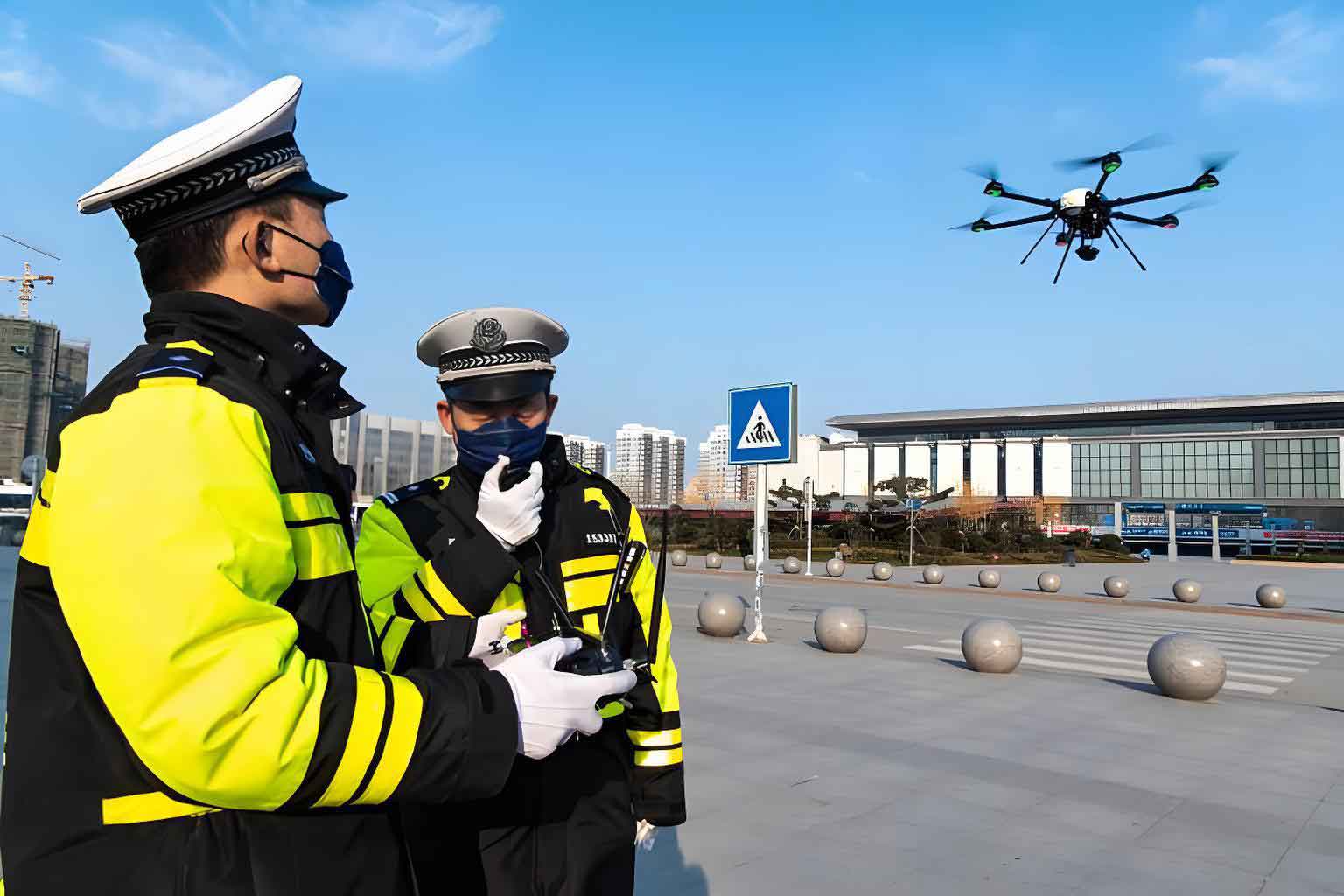
The advent of police UAVs marks a paradigm shift in执法 methodologies, enabling authorities to overcome traditional limitations such as geographical barriers and resource constraints. However, this technological leap necessitates rigorous legal scrutiny to ensure that police UAV执法 complies with principles of justice and transparency. From my perspective, the deployment of police UAVs must be guided by a comprehensive regulatory体系 that addresses both operational efficiency and individual rights. In the following sections, I will detail how police UAVs are utilized across various domains, assess their impact, and propose normative standards for their governance.
Police UAVs are deployed in numerous执法 scenarios, each leveraging their unique capabilities. I have categorized these applications into three primary areas: traffic enforcement, crowd management, and治安巡逻. Below, Table 1 summarizes these domains, illustrating the specific tasks and features associated with police UAV operations.
| Domain | Specific Tasks | Key Technologies | Operational Benefits |
|---|---|---|---|
| Traffic Enforcement | Monitoring traffic flow, detecting violations (e.g., speeding, illegal parking), managing accident scenes | High-definition cameras, automated license plate recognition, real-time data transmission | Reduced congestion, faster incident response, enhanced取证 accuracy |
| Crowd Management | Surveillance during protests or public events, crowd dispersion, identification of individuals | Thermal imaging, loudspeakers, facial recognition software | Aerial oversight, non-contact communication, early threat detection |
| Patrol and Surveillance | Routine area patrols, crime hotspot monitoring, emergency response support | Long-endurance batteries, night vision sensors, GPS tracking | Cost-effective coverage, ability to access hazardous zones, continuous monitoring |
From my analysis, the advantages of police UAV执法 are substantial. Firstly, police UAVs introduce innovative执法 methods, such as non-contact执法 and automated penalty systems, which minimize human error and increase precision. Secondly, they enhance执法 efficiency by enabling persistent,三维 patrols that cover extensive areas with minimal manpower. I can quantify this efficiency gain using a simple model: $$ E_{uav} = \frac{T_{task}}{C_{op}} $$ where \( E_{uav} \) represents the efficiency of police UAV执法, \( T_{task} \) is the time required to complete a执法 task, and \( C_{op} \) is the operational cost. By reducing \( T_{task} \) and \( C_{op} \), police UAVs significantly boost \( E_{uav} \). For instance, in traffic enforcement, police UAVs can cut response times by up to 40% compared to ground units, as shown in studies where \( \Delta E = E_{uav} – E_{traditional} \) yields positive values across scenarios.
Despite these advantages, police UAV执法 faces notable limitations. Technologically, police UAVs are constrained by factors like battery life, wind resistance, and obstacle avoidance capabilities, which can compromise reliability in adverse conditions. From an institutional standpoint, the lack of standardized protocols for police UAV operations creates inconsistencies in training and deployment. I have compiled these aspects in Table 2, contrasting the pros and cons of police UAV执法.
| Aspect | Advantages | Limitations |
|---|---|---|
| Operational Efficiency | High spatial coverage, real-time data acquisition, reduced reliance on human patrols | Dependence on weather conditions, limited flight duration, technical failures |
| Legal and Ethical Compliance | Potential for transparent取证 and accountability through recorded footage | Inadequate regulatory frameworks, privacy invasion risks, public skepticism |
| Public Perception | Increased sense of security in monitored areas | Concerns over surveillance overreach, erosion of privacy, fear of militarization |
The integration of police UAVs into执法 also raises profound institutional risks. One critical issue is the balance between efficiency and fairness. While police UAVs can detect violations more frequently—such as in traffic monitoring—this may lead to disproportionate penalties if not regulated. I model this fairness risk using: $$ R_f = P_d \times S_p $$ where \( R_f \) denotes fairness risk, \( P_d \) is the probability of violation detection by police UAVs, and \( S_p \) is the severity of the imposed penalty. If \( P_d \) increases without adjusting \( S_p \), \( R_f \) escalates, potentially undermining equitable执法.
Another major risk involves the tension between privacy protection and the expansion of公权力. Police UAVs equipped with advanced sensors, like thermal cameras and facial recognition, can collect intimate data without physical intrusion. The mosaic theory posits that aggregating disparate data points from police UAV surveillance can construct detailed personal profiles, heightening privacy threats. To assess this, I propose a privacy intrusion index: $$ PII = \sum_{i=1}^{n} w_i \cdot d_i $$ where \( PII \) is the Privacy Intrusion Index, \( w_i \) is the weight assigned to data type \( i \) (e.g., location, biometrics), and \( d_i \) is the volume of data collected. A high \( PII \) value indicates greater privacy风险, necessitating stringent data governance measures for police UAV operations.
Furthermore, ethical considerations surrounding police UAV执法 cannot be overlooked. The non-contact nature of police UAVs may diminish the human element in执法, leading to a sense of detachment and reduced accountability. As we embrace科技赋能, I argue that道德伦理 standards must be upheld to ensure police UAVs serve as辅助工具 rather than取代 human judgment. For example, decisions to use police UAVs for lethal force should always involve human oversight, as automated attacks could violate international humanitarian principles.
To mitigate these risks, I advocate for several基本原则 governing police UAV执法. First, the principle of fairness demands that police UAV执法 be conducted impartially, with transparent取证 and proportional处罚. Second, openness requires that执法 activities be publicly disclosed, including flight plans, data usage policies, and执法 outcomes. Third, necessity dictates that police UAVs be deployed only when alternative methods are ineffective, minimizing unnecessary intrusion. Fourth,规范性 emphasizes the need for clear legal frameworks and technical standards for police UAV operations. These principles can be integrated into a decision-making formula for police UAV deployment: $$ D_{deploy} = \frac{U \times N}{R_{total}} $$ where \( D_{deploy} \) is the deployment score, \( U \) is the urgency of the situation, \( N \) is the necessity of using a police UAV, and \( R_{total} \) is the total assessed risk (including privacy and fairness risks). If \( D_{deploy} \) exceeds a predefined threshold, deployment may be justified, subject to supervisory approval.
Building on these principles, I recommend establishing a unified执法 system for police UAVs. This involves完善一般程序规定, such as规范飞行行为 through pre-mission planning and空域 coordination. For instance, police UAV flights should be authorized based on risk assessments, with routes designed to avoid residential areas when possible. Additionally,飞行安全制度 must be强化, with regular maintenance checks and emergency protocols. Data management is critical; I propose that police UAV data be encrypted, stored securely, and deleted after a defined retention period. To illustrate, Table 3 outlines technical specifications for police UAVs in different applications, ensuring they meet safety and efficacy standards.
| Application | UAV Type | Key Sensors/Modules | Minimum Flight Time | Safety Features |
|---|---|---|---|---|
| Traffic Enforcement | Multi-rotor or fixed-wing | HD camera, radar, automated violation detection software | 60 minutes | Geo-fencing, obstacle detection |
| Crowd Management | Stable multi-rotor | Thermal camera, loudspeaker, facial recognition system | 45 minutes | Redundant propulsion, secure data links |
| Routine Patrol | Long-endurance UAV | Night vision, communication relay, environmental sensors | 120 minutes | Fail-safe mechanisms, encrypted transmissions |
For specific执法活动, such as交通执法, I advocate for national standards for police UAV equipment and procedures. Police UAVs used in traffic enforcement should be certified and calibrated, with visible标识 to alert the public. Moreover,执法目的 should prioritize education over处罚, using police UAVs for deterrence and awareness campaigns. In cases where police UAVs are equipped with警械 or weapons, strict legal授权 is necessary. I suggest amending existing laws to explicitly permit police UAVs to carry non-lethal tools under controlled conditions, with human oversight始终 required. The use of armed police UAVs should be restricted to extreme scenarios like counter-terrorism, governed by the formula: $$ A_{auth} = \frac{T_{hreat} \times I_{mm}}{R_{collat}} $$ where \( A_{auth} \) is the authorization score for armed deployment, \( T_{hreat} \) is the threat level, \( I_{mm} \) is the immediacy of the threat, and \( R_{collat} \) is the risk of collateral damage. Only if \( A_{auth} \) surpasses a high threshold should armed police UAVs be deployed.
In conclusion, police UAV执法 offers transformative potential for enhancing public safety and执法 efficiency. However, its成功 depends on robust legal规制 and ethical practices. By adhering to fairness, openness, necessity, and规范性 principles, we can harness the benefits of police UAVs while safeguarding individual rights. Future efforts should focus on advancing police UAV technologies, such as improving battery life and AI integration, while developing comprehensive policies that foster public trust. As I reflect on this topic, continuous stakeholder dialogue—including input from legal experts, technologists, and civil society—will be essential to shaping a balanced and effective approach to police UAV执法. The repeated emphasis on ‘police UAV’ throughout this article underscores its pivotal role in the evolution of modern law enforcement, and I remain committed to promoting its responsible adoption.