
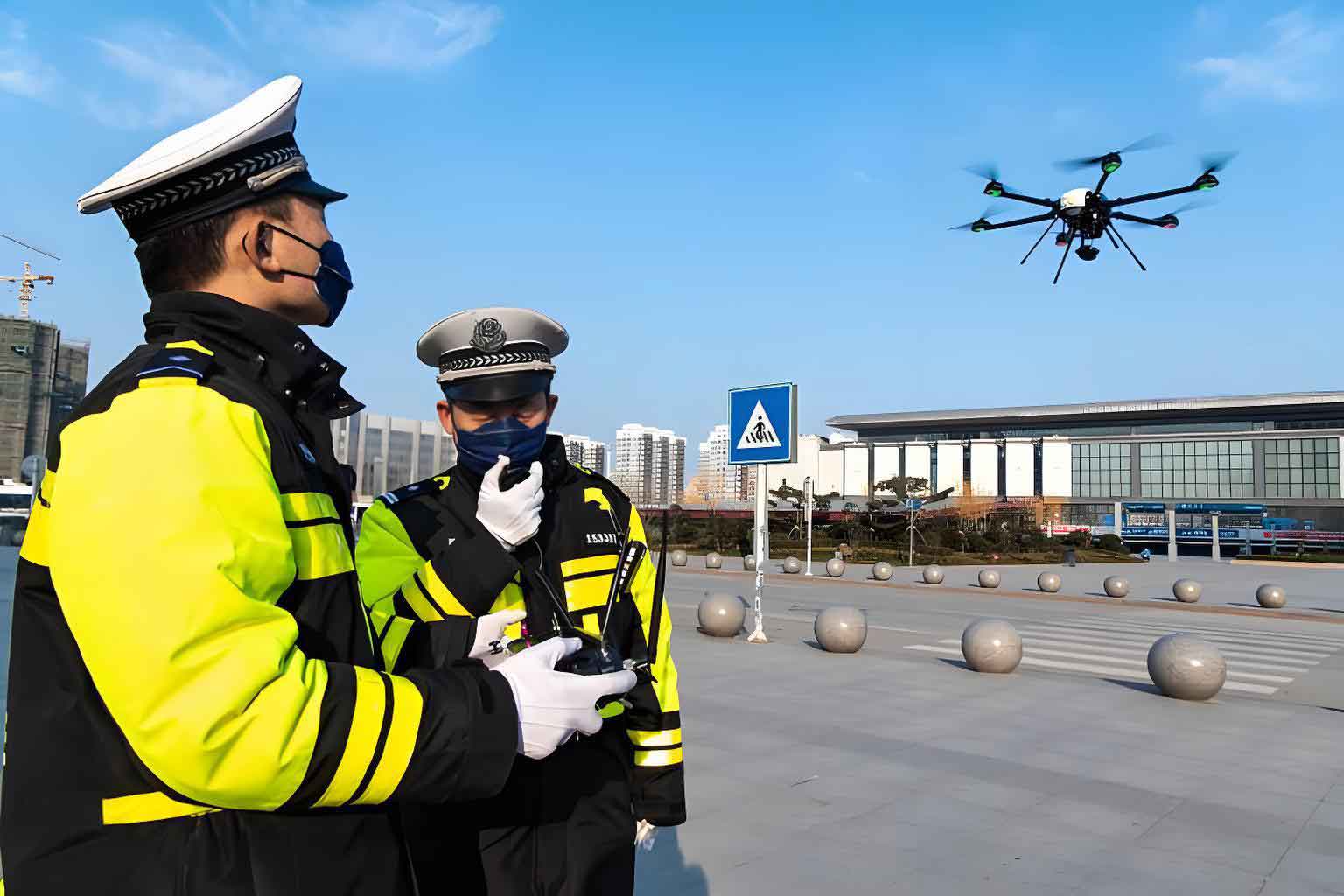
In recent years, driven by technology spillover, maturity of the hardware supply chain, and declining costs, Unmanned Aerial Vehicles (UAVs) have shed their veil as exclusive military assets. They have rapidly evolved into a new type of civilian science and technology, permeating various aspects of public life. Leveraging their cost-effectiveness, practicality, and intelligent features, UAVs have become crucial tools for law enforcement agencies, particularly for police departments. Police UAVs can assist in handling mass emergencies, combating crime, traffic management and patrol, security for major events, disaster relief and rescue, and geographic information collection, earning significant favor. Compared to just a few years ago, the number of operational police units equipped with UAVs and the variety of models in use have increased substantially. While the development of police UAV fleets across the country is rapid, prominent issues persist, including a lack of legal governance frameworks, undefined operational protocols, and concerns over security and controllability. Therefore, strengthening the regulation and deepening the practical application of police UAVs, and integrating UAV technology scientifically into policing work, represents a critical contemporary challenge for the development of police technological informatization. This analysis provides preliminary considerations and strategic recommendations from the perspectives of technical standards, regulatory requirements, and management structures.
1. Overview of Police UAVs
A UAV is an unmanned aerial device controlled via radio remote control equipment and its own programmed control unit, a product of artificial intelligence. UAVs can be broadly categorized into three tiers: consumer-grade, professional-grade, and military-grade. Police UAVs should adopt professional-grade or higher models as a key configuration standard (though many current domestic police UAV technologies still align with civilian-grade levels). These systems must be compatible or expandable with equipment from various police branches. Their performance parameters, such as wind resistance, endurance, and anti-interference capability, must be superior to adapt to diverse environmental demands.
The application of UAVs in Chinese policing can be traced back to the 2008 Beijing Olympics, where police in Beijing and Qingdao pioneered their use for security at large-scale events. As technology has matured, police UAVs can be equipped with cameras, infrared thermal imagers, loudspeakers, and other payloads. They possess functions like zoom-lock, 4G wireless real-time image transmission, hover-cruise, and定点监控 (fixed-point surveillance). Their role in the timely discovery and handling of incidents, precise deployment of police resources, real-time situation monitoring, evidence fixation, scene replay, and support for technical reconnaissance is increasingly vital. Police UAVs now play a significant part in law enforcement, counter-terrorism, and emergency response missions.
| UAV Type | Typical Configuration | Key Advantages for Police Work | Common Endurance Range |
|---|---|---|---|
| Multi-rotor | Electric, 4-8 rotors | Vertical Take-off and Landing (VTOL), stable hover, good low-speed maneuverability | 20 – 45 minutes |
| Fixed-Wing | Gasoline/Electric motor | Long endurance, high speed, large area coverage | 1 – 6+ hours |
| Hybrid VTOL | Combined rotor/wing design | VTOL capability with fixed-wing endurance | 1 – 3 hours |
2. Practical Applications of Police UAVs
The utility of police UAVs spans numerous critical operational domains, enhancing efficiency, safety, and situational awareness.
2.1 Emergency Response to Major Incidents
During major emergencies like explosions or natural disasters, police UAVs provide rapid, comprehensive, and accurate situational awareness from the air. They overcome challenges like communication breakdowns and obstructed ground access, enabling command centers to monitor crowd gatherings, flow directions, and the overall scene in real-time, which is essential for analysis, decision-making, and targeted action.
2.2 Security for Large-Scale Events
Utilizing their broad aerial视野 (field of view), wide monitoring range, and flexible perspectives, police UAVs oversee crowds at large events like international summits or sports gatherings. They enable tracking, surveillance, and precision guidance for ground units, forming an integral part of the multi-layered security apparatus.
2.3 Investigation and Pursuit
Police UAVs offer a surveillance footprint far exceeding that of ground officers. They are invaluable for pre-operation terrain reconnaissance, deployment of personnel at key points, and tracking fleeing suspects or vehicles across challenging landscapes like dense farmland or mountainous areas, effectively extending the “eyes” of the police force.
2.4 Aerial Patrol and Crime Deterrence
Equipped with police livery and warning lights, police UAVs conducting aerial patrols provide macroscopic monitoring of urban治安状况 (public order). They compensate for blind spots in older urban areas covered by fixed CCTV and serve as a visible deterrent to crime, thereby enhancing public perception of safety.
2.5 Traffic Management
At accident scenes, police UAVs enable rapid aerial勘察 (surveying), photography, and data collection, facilitating quick clearance and traffic flow restoration. They are also deployed for traffic flow monitoring, patrolling highways to detect violations like illegal lane changes or use of emergency lanes, and assessing road conditions during fog, snow, or other adverse weather.
The area coverage rate $A_{cov}$ for traffic incident documentation can be modeled as a function of flight time $t$, altitude $h$, and camera sensor parameters:
$$ A_{cov}(t) = v_{g} \cdot t \cdot w_{eff}(h, \theta) $$
where $v_{g}$ is the ground speed, and $w_{eff}$ is the effective swath width on the ground, dependent on altitude $h$ and camera field of view angle $\theta$.
2.6 Eradication of Illegal Drug Crops
Illicit drug crops are often hidden in remote, difficult-to-access terrain. Police UAVs conduct efficient low-altitude aerial surveys of mountains, forests, and farmlands, using imaging to precisely locate cultivation areas. This method is far more effective than ground searches, leading to targeted eradication and investigations.
2.7 Search and Rescue Operations
In scenarios involving lost hikers,山林火情 (forest fires), or water rescues, police UAVs provide a critical aerial platform. They can quickly locate individuals via thermal imaging, deliver emergency supplies like life jackets or medicine to inaccessible areas, and provide real-time video feeds to coordinate rescue efforts, significantly improving outcomes and responder safety.
2.8 Geographic Information and Data Collection
Traditionally, updating geographic information system (GIS) data like Points of Interest (POI) requires labor-intensive ground surveys. Police UAVs can rapidly capture aerial imagery of urban or rural areas. This imagery is then processed to extract and update map data resources, drastically reducing update cycles and improving data quality for policing and emergency response planning.
| Application Scenario | Primary Function | Typical Payload/Sensor | Key Benefit |
|---|---|---|---|
| Emergency Response | Situational Awareness | High-resolution zoom camera, Real-time video transmitter | Rapid overview for command decisions |
| Counter-Terrorism & Pursuit | Surveillance & Tracking | Thermal imaging camera, Low-light camera | 24/7 operational capability, target location |
| Traffic Management | Incident Documentation & Enforcement | Wide-angle camera, Automated license plate recognition (ALPR) | Efficient evidence collection, traffic flow management |
| Search & Rescue | Victim Location & Supply Delivery | Thermal imager, Loudspeaker, Payload drop mechanism | Access to difficult terrain, life-saving potential |
| Mapping & GIS | Data Acquisition | Survey-grade photogrammetry camera, LiDAR | High-accuracy 2D/3D models for planning |
3. Current Challenges in Police UAV Deployment
Despite their promise, the integration and operation of police UAV systems face several significant hurdles.
3.1 Lack of Specialized Technical Standards
The absence of industry-specific technical standards for police UAVs means there are no uniform benchmarks for technical specifications, functional用途 (purposes), or operational suitability. Procurement often lacks guided selection criteria, leading to the acquisition of民用级 (civilian-grade) models with unproven performance in demanding police scenarios. Furthermore, the “special identity” of police UAVs necessitates encrypted communication links and dedicated frequencies to protect operational secrecy, a requirement often unmet, leaving systems vulnerable.
3.2 Non-Standardized and Superficial Operational Application
Operational use remains exploratory and inconsistent. Selection of police UAV models is often based on price rather than capability, with a focus on procurement over实战 (practical application). Usage is frequently limited to basic, line-of-sight aerial photography, underutilizing advanced capabilities like automated mission planning via ground control stations. A severe shortage of trained pilots, maintenance technicians, and mission planners results in underused assets. Personnel often lack deep knowledge of aeronautical principles,通信链路 (communication links), and payload integration.
3.3 Ambiguity in Pilot Certification and Training
While regulations mandate that police UAV pilots obtain official licenses, clear pathways for standardized professional training and assessment within the police framework are often lacking. Many current operators receive only brief manufacturer training, creating significant safety and operational risks due to insufficient understanding of airspace regulations, emergency procedures, and advanced flight dynamics.
3.4 Incomplete Regulatory and Approval Mechanisms
Regulations typically require approval from flight control authorities for operations beyond visual line of sight (BVLOS) or for heavier UAVs. However, police operations, such as counter-terrorism or sudden emergencies, are characterized by their immediacy and unpredictability. Multi-layered bureaucratic审批 (approval) processes can cause critical delays. Additionally, police UAVs themselves are “low, slow, and small” (LSS) targets, and comprehensive management systems to ensure their own safe integration into national airspace are still evolving.
3.5 Disconnect from Broader Police Information Systems
Most police UAV systems operate as standalone tools rather than being integrated into the wider police信息化 (informatization) ecosystem. While they solve前端侦察 (front-end reconnaissance) and中端传输 (mid-end transmission) challenges, seamless connection to backend command centers and databases (e.g., GIS, wanted persons systems, traffic management systems) is often weak. This disconnect prevents the real-time transformation of aerial intelligence into rapid dispatch, command decisions, and investigative leads, limiting their strategic impact.
| Problem Area | Specific Issue | Associated Risk |
|---|---|---|
| Standards & Procurement | No specialized technical standards; ad-hoc procurement. | Acquisition of unsuitable, unreliable equipment; security vulnerabilities. |
| Operations & Training | Superficial use; lack of trained pilots/technicians. | Underutilization of capabilities; high accident rate; mission failure. |
| Regulation | Cumbersome airspace approval processes for urgent missions. | Delayed response in critical situations; potential for regulatory violation. |
| System Integration | Isolated from core police IT/command systems. | Inefficient intelligence processing; slowed decision-making cycle. |
4. Strategic Recommendations for Enhanced Governance and Application
To address these challenges and unlock the full potential of police UAV technology, a multi-faceted strategy is required.
4.1 Establishing Specialized Technical Standards
1. Reliability as a Core Standard: Given the critical nature of police work, reliability metrics—mean time between failures (MTBF), component lifespan—must be defined and become the primary selection criterion over mere cost.
2. Mission-Specific Configuration: Police UAVs should be purpose-built, professional-grade systems. A mixed fleet of electric/gasoline-powered and multi-rotor/fixed-wing/hybrid UAVs should be maintained based on regional geographic and operational needs.
3. Develop Universal Technical Standards: National police standards committees should urgently lead the development of a “Universal Technical Standard for Police UAVs.” This framework will guide standardized production, procurement, operation, and maintenance.
A simple reliability model for a police UAV system can be expressed as:
$$ R_{system}(t) = R_{airframe}(t) \times R_{flightCtrl}(t) \times R_{comms}(t) \times R_{payload}(t) $$
where $R_{system}(t)$ is the probability of the entire system operating without failure up to time $t$, and each $R_{component}(t)$ represents the reliability of critical subsystems.
4.2 Improving Management Structures and Organizational Frameworks
A dedicated, vertically integrated management structure from national to local levels is essential. Municipal and county police should establish specialized police UAV aviation units within their tactical (e.g., SWAT) or operational support departments. These units, staffed with qualified personnel (pilots, sensor operators, data analysts, maintenance engineers), would be responsible for daily training, mapping, and mission support. They must establish liaison mechanisms with all operational police branches to gather requirements and feed them upward to guide national-level research and development of police UAV applications.
4.3 Strengthening Professional Capacity Building
1. Professional Talent Development: Police UAV operators must be recognized as specialized professionals. Recruitment should prioritize individuals with relevant backgrounds (e.g., former military UAV operators) and strong technical aptitudes.
2. Standardized and Comprehensive Training: Training must move beyond basic manufacturer instruction. Provincial-level authorities should partner with certified institutions to provide standardized courses covering aviation law, meteorology, mission planning,地面站 (ground control station) operations, data processing, and maintenance. Licensing should be mandatory.
3. Establish Counter-UAV Units: Provincial and municipal police should form teams equipped with counter-UAV technology (e.g., radio frequency jammers, spoofers, net-capture UAVs). This capability is crucial for protecting sensitive airspace during major events and from malicious “rogue” drone use.
4.4 Optimizing Equipment, Funding, and Data Infrastructure
1. Rationalized Equipment Rollout: Municipal units should be equipped with at least 2 professional-grade, modular police UAV systems, while county units should have 1 plus several standard models. Support vehicles, secure communication links (e.g., high-power RF antennas for beyond-line-of-sight video), dedicated workshops, and simulation trainers are essential.
2. Dedicated and Managed Funding: Procurement should follow centralized frameworks negotiated at national/provincial levels to ensure quality and cost control. Special funds at national and local levels must be established for R&D, procurement, training, and maintenance, with oversight to prevent misuse.
3. Investment in Foundational Data: High-resolution 2D and 3D geospatial data is the bedrock for effective police UAV mission planning (e.g., automated flight path generation, obstacle avoidance). Police should collaborate with surveying firms to build and continuously update this critical dataset, integrating it with police UAV mission planning software.
The required resolution $\Delta G$ for a mapping mission depends on the smallest feature $s_{min}$ that needs to be identified:
$$ \Delta G \leq \frac{s_{min}}{2} $$
This dictates the necessary ground sample distance (GSD) and thus the flight altitude and camera specifications for the police UAV.
4.5 Fostering Technological Innovation and Systems Integration
Police must actively collaborate with research institutions and manufacturers to drive innovation tailored to实战需求 (practical operational needs). Key R&D areas include battery technology for extended endurance, increased payload capacity, intelligent autonomous巡航 (cruising), robust and secure data links, and advanced onboard AI for real-time object/person recognition. Crucially, a major effort is needed to integrate police UAV systems deeply into existing police information architectures. This means creating interfaces so that live UAV feeds and data products can automatically populate GIS platforms, alert command centers, and query investigative databases, closing the loop between aerial sensing and ground action.
| Strategic Pillar | Key Actions | Expected Outcome |
|---|---|---|
| Standardization & Procurement | Develop national technical standards; establish centralized procurement frameworks. | Reliable, secure, and interoperable police UAV fleets. |
| Organization & Management | Create dedicated UAV units under a clear command structure; define SOPs. | Professional, accountable, and efficient management of police UAV operations. |
| Training & Expertise | Implement standardized license-based training; develop counter-UAV capabilities. | Highly skilled personnel; secure control of operational airspace. |
| Technology & Integration | Fund targeted R&D integrate UAV data streams into core police IT systems. | Smarter police UAVs that directly enhance situational awareness and response speed. |
As police UAV technology continues to advance, the focus must shift from mere acquisition to developing robust governance, specialized standards, and deep operational integration. The true value of a police UAV is realized not just in the hardware, but in the ecosystem of regulations, trained personnel, and interconnected information systems that support it. Only through dedicated research, standardized practices, and a commitment to solving real policing problems can the transformative potential of police UAVs be fully harnessed to enhance public safety and operational effectiveness.