
The rapid advancement of Unmanned Aerial Vehicle (UAV) technology has ushered in a transformative era for modern policing. From traffic monitoring and crime scene documentation to crowd control, search and rescue, and counter-terrorism operations, the police UAV has evolved from a novel gadget into an indispensable tool in the law enforcement arsenal. Its ability to provide a rapid, aerial, and often covert perspective fundamentally enhances situational awareness, officer safety, and operational efficiency. As the application of police UAV systems becomes more widespread and integral to daily and tactical operations, a critical bottleneck has emerged: the stark shortage of professionally trained personnel and the underdeveloped, inconsistent methodologies for their deployment. Police colleges, as the foundational pillars for nurturing future law enforcement leaders and advancing tactical research, bear a significant responsibility. We must proactively develop, standardize, and continually refine comprehensive police UAV training curricula. This is not merely an addition to our programs; it is a strategic imperative to support the sustainable and effective integration of this technology into the fabric of public security.
The necessity for robust police UAV training programs within academic institutions is underscored by two interrelated challenges: a profound talent deficit and shallow tactical research. Currently, many officers operating police UAV platforms are drawn from other units, often relying on self-taught skills from hobbyist experience or abbreviated external courses. This results in an ad-hoc, unstandardized skill base lacking the depth required for complex law enforcement scenarios. There is no structured career path or talent pipeline for police UAV specialists. Furthermore, while many agencies have procured equipment, the transition from basic aerial photography to sophisticated, mission-specific tactics—what we term “UAV-enabled policing doctrine”—remains in its infancy. Applications are frequently limited to simple video capture, with more advanced uses like persistent surveillance, spectral analysis, or coordinated multi-drone swarms being poorly understood and rarely practiced in a standardized manner. This gap between technological potential and practical, repeatable tactical application represents a significant opportunity and obligation for police colleges. We are uniquely positioned to bridge this gap through systematic education, transforming sporadic use into disciplined, effective, and safe operational protocols.
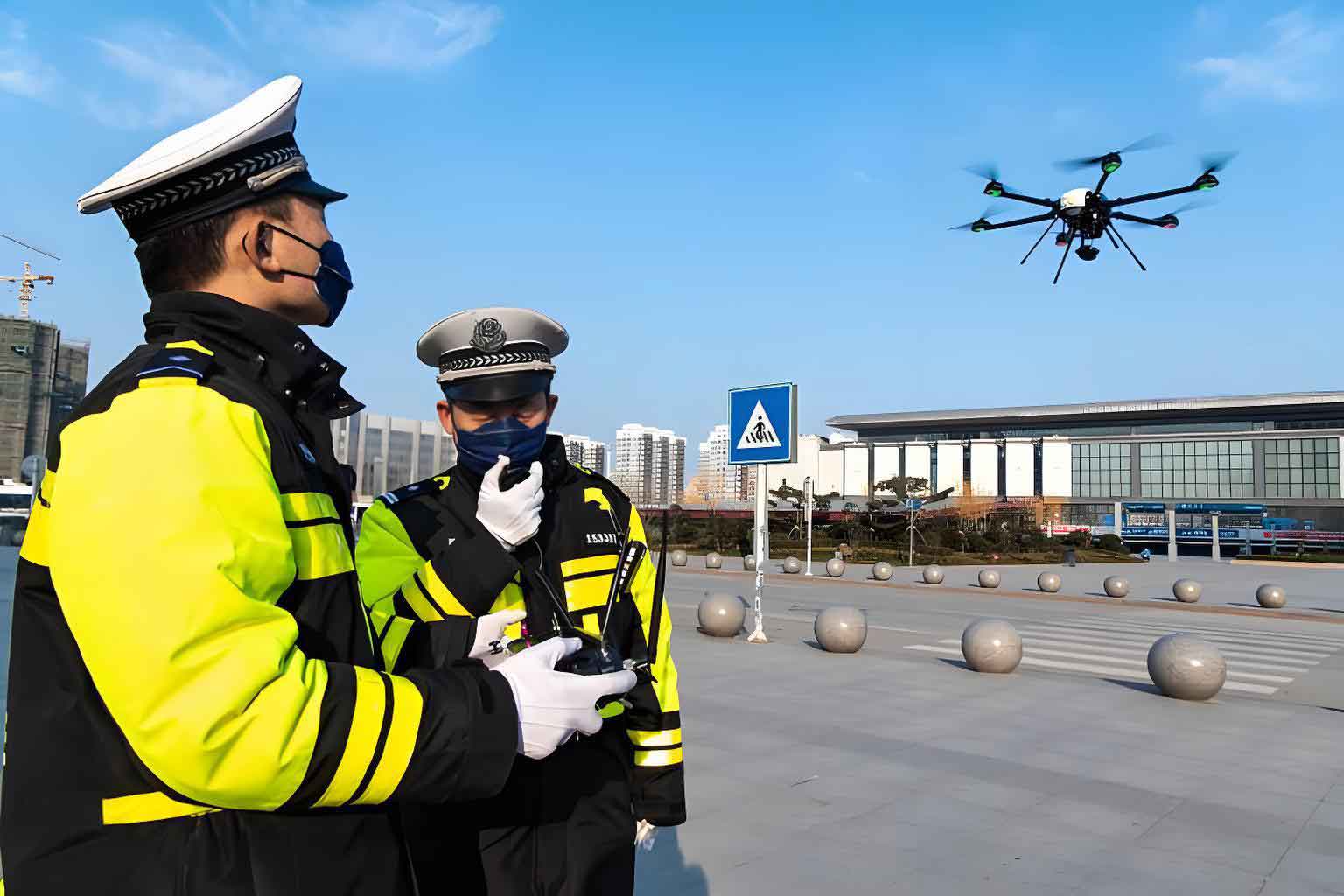
An examination of the current landscape for police UAV education reveals a field still taking shape. Nationally, dedicated faculty with both deep technical knowledge and rich law enforcement experience in police UAV operations are scarce. Curricula are often fragmented, developed in isolation by individual colleges or trainers, leading to a lack of standardization in learning outcomes. Textbooks and teaching materials specifically tailored for law enforcement contexts are not universally adopted. A pioneering step was taken with the establishment of dedicated UAV training and examination centers at leading national police universities. These centers have begun the crucial work of creating structured training plans, securing operational airspace, and conducting train-the-trainer courses for instructors and examiners. However, the task of permeating this standardized, high-level training down to the foundational level of pre-service education in all regional police colleges is immense. Our goal must be to move beyond isolated centers of excellence and build a nationwide ecosystem of police UAV education, ensuring every graduate possesses a baseline competency and understanding of this tool.
The core of any educational transformation lies in its curriculum. For police UAV training, a multi-tiered, modular approach is essential. We propose a curriculum structured around progressive mastery, moving from fundamental piloting to advanced tactical integration.
| Training Tier | Core Objectives | Key Content Modules | Outcome Metrics |
|---|---|---|---|
| Tier 1: Foundational Pilot & Safety | Safe operation, regulatory compliance, basic maneuvers. | Flight physics, national airspace regulations (e.g., CAAC), pre-flight checks, manual piloting skills, basic maintenance, emergency procedures. | Successful completion of simulated and live basic flight tests; passing written exam on regulations. |
| Tier 2: Mission-Specific Applications | Executing standard police missions using UAV platforms. | Aerial photography/videography for evidence; 360° panoramic scene capture; traffic accident scene mapping using photogrammetry; search pattern execution; loudspeaker and lighting deployment. | Ability to produce evidentiary-grade aerial imagery; generate a 3D model of a simulated crash scene; execute a coordinated grid search. |
| Tier 3: Advanced Technical & Tactical Integration | Complex data exploitation, platform integration, and tactical command. | Real-time data linking to command centers; GIS integration and geotagging; multi-spectral imaging (thermal, multispectral) for forensic search; counter-UAV tactics; introductory swarm logistics. | Live-stream operational feed to a simulated command post; use thermal data to locate a hidden object; design a basic counter-drone protocol for an event. |
| Tier 4: Instructor & Tactical Development | Pedagogy, course design, and advanced tactical innovation. | Instructional methods for flight training; curriculum development; analysis of real-world case studies; developing and validating new tactical doctrines for police UAV deployment. | Develop and deliver a short training module; author a tactical case study analysis; propose a new standard operating procedure for a specific scenario. |
This structured progression ensures that learning is scaffolded. A critical component, often overlooked in basic training, is the mathematical and technical foundation. For instance, understanding the relationship between flight time, payload, and mission radius is crucial for planning. A simplified endurance model can be expressed as:
$$ E = \frac{C \cdot \eta \cdot V}{P} $$
where \(E\) is endurance (in hours), \(C\) is battery capacity (Ah), \(\eta\) is system efficiency, \(V\) is battery voltage (V), and \(P\) is average power draw (W). Training should enable officers to use such models to plan feasible missions rather than relying on guesswork. Similarly, the principles of photogrammetry for creating 3D models or orthomosaics involve understanding overlap (side lap and forward lap) requirements, often expressed as percentages (e.g., 70% forward overlap, 60% side overlap). Calculating ground sampling distance (GSD) is vital for understanding image resolution:
$$ GSD = \frac{H \cdot s}{f} $$
where \(H\) is flight altitude (m), \(s\) is sensor pixel size (m), and \(f\) is focal length (m). Embedding these quantitative concepts, even at an applied level, fosters a more professional and effective use of the police UAV as a precision tool rather than a simple flying camera.
The effectiveness of this curriculum hinges on deep, operational collaboration between the police college and frontline law enforcement agencies—a “college-agency partnership” model. This partnership must be active and multidimensional. First, faculty “going out”: instructors must engage in regular secondments, ride-alongs, and collaborative research projects with UAV units in police departments. This keeps academic knowledge grounded in real-world challenges and evolving tactics. Second, experts “coming in”: seasoned police UAV operators and tacticians from the field should be integrated as adjunct faculty, guest lecturers, or members of curriculum advisory boards. They bring immediate, relevant experience into the classroom. Third, collaborative development: joint research on tactical applications, co-authoring of case studies and training manuals, and shared access to training facilities and airspace create a symbiotic relationship where theory and practice continuously inform each other. This ecosystem ensures the police UAV curriculum remains dynamic, relevant, and directly responsive to the needs of the profession.
| Partnership Activity | College Role | Agency Role | Shared Outcome |
|---|---|---|---|
| Curriculum Design | Provide pedagogical structure, learning theory, assessment frameworks. | Define operational competencies, identify skill gaps, provide scenario input. | A standardized, competency-based training syllabus. |
| Joint Training Exercises | Provide students, simulation facilities, theoretical briefing. | Provide operational scenarios, field locations, expert evaluators. | Realistic, evaluated training for students; fresh perspectives for agencies. |
| Tactical Research & Development | Conduct controlled experiments, data analysis, literature reviews. | Provide access to real operational data, identify research questions, test prototypes. | Evidence-based improvements to police UAV tactics and hardware use. |
Parallel to curriculum and partnership development is the urgent need to build a professional cadre of instructors. We must invest in creating a career track for police UAV education specialists. This involves targeted recruitment, perhaps from within the ranks of experienced operational pilots with an aptitude for teaching, and then providing them with advanced pedagogical training. Furthermore, a national framework for instructor certification should be established, ensuring a consistent standard of teaching excellence across all police colleges. This framework could include tiers such as Assistant Instructor, Instructor, and Senior Instructor/Master Trainer, each with defined requirements for flight hours, operational experience, teaching hours, and continuing education. The professionalization of the instructional corps is the single most important factor in delivering a high-quality, standardized police UAV education nationwide.
Finally, the pedagogy within the police UAV classroom must evolve. Moving beyond traditional lecture-based instruction, we must embrace a blended, interactive, and scenario-driven approach. Problem-Based Learning (PBL) is highly effective: students are presented with a complex, realistic scenario (e.g., “a suspect has fled into a wooded area at night”) and must plan and justify a police UAV operation, considering equipment choice, flight parameters, legal constraints, and data management. Simulation technology is invaluable, allowing risk-free practice of complex maneuvers, emergency procedures, and mission planning in varied virtual environments. Flipped classrooms can be used for regulatory and technical knowledge, freeing up practical sessions for hands-on application. Micro-credentials or digital badges can be awarded for mastery of specific skills (e.g., “Thermal Imaging Operations”, “Advanced Mission Planning”), creating a granular and motivating record of competency. The integration of “Course Ideology and Politics” is also natural here, emphasizing the ethical use of surveillance technology, the importance of privacy considerations, and the overarching mission of the police UAV as a tool for public safety and justice, not intrusion.
In conclusion, the integration of police UAV technology into modern law enforcement is irreversible and accelerating. The current gaps in skilled personnel and mature tactics present a strategic vulnerability. Police colleges, through deep college-agency partnerships, must take the lead in constructing a comprehensive, standardized, and progressive training curriculum. This endeavor requires a multi-faceted approach: building a tiered and technically rigorous curriculum, fostering symbiotic partnerships with operational units, professionalizing the instructor corps, and employing modern, interactive teaching methodologies. By laying this solid educational foundation, we do more than just teach how to fly a drone; we cultivate a new generation of officers who are adept at leveraging aerial intelligence, who innovate safe and effective tactics, and who understand the profound responsibility that comes with this powerful technology. Our mission is to ensure that the police UAV evolves from a purchased asset into a fully integrated, intelligently deployed, and ethically applied cornerstone of 21st-century policing.