
As a researcher focused on modern security technologies, I have extensively studied the integration of police unmanned aerial vehicles (UAVs) into social security frameworks. Police UAVs, often called drones, are revolutionizing public safety by offering aerial capabilities that complement ground-based efforts. This article explores how police UAVs align with and enhance the three-dimensional social security prevention and control system—a multi-layered approach to maintaining public order across time, space, and psychological dimensions. The synergy between police UAVs and this system is not merely theoretical; it drives practical innovations in surveillance, response, and management. Here, I delve into the application logic, structural optimizations, and process reengineering that make police UAVs indispensable tools in contemporary security strategies.
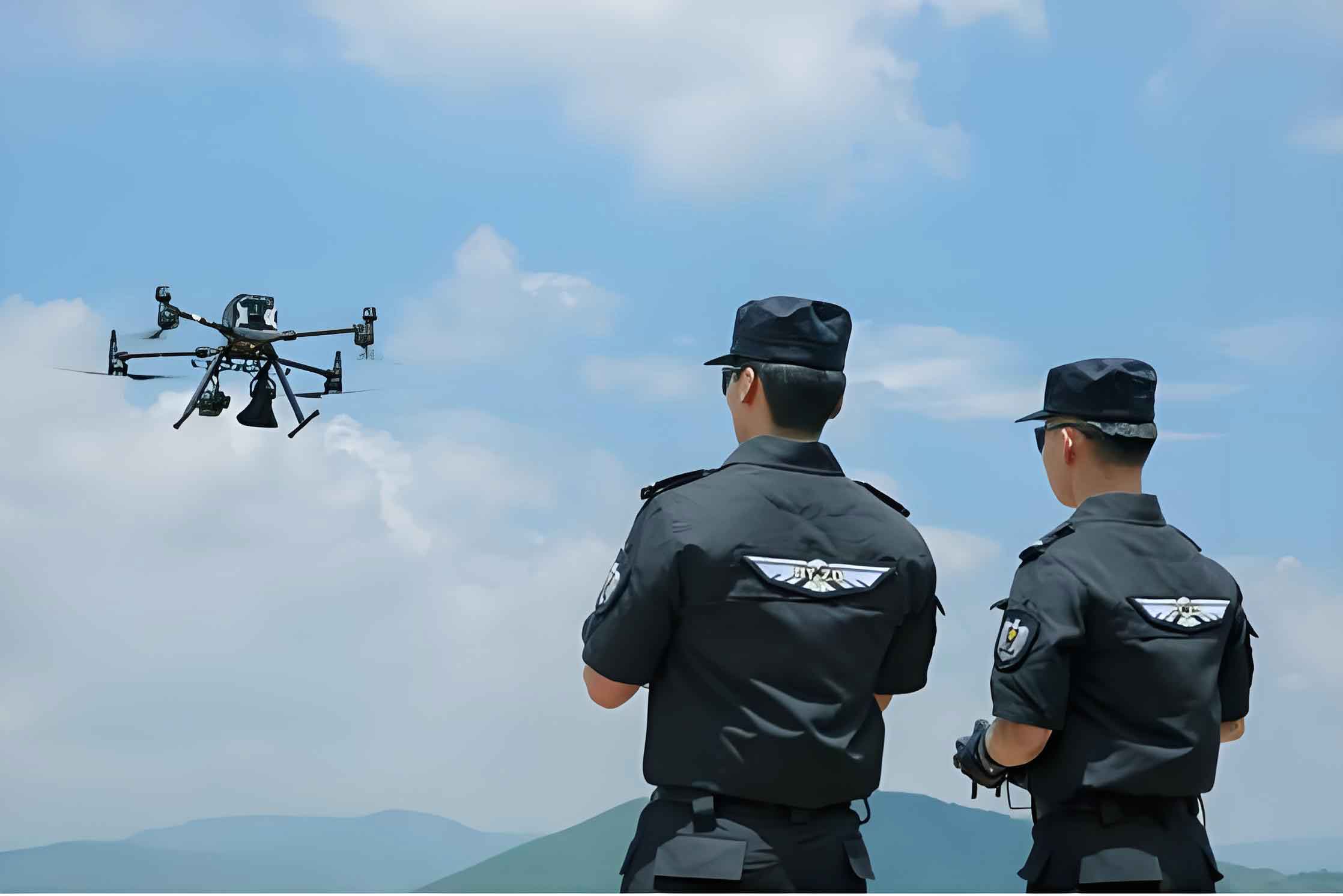
The three-dimensional social security prevention and control system aims to create a seamless network for crime prevention and emergency response. It emphasizes multi-dimensional coverage, including temporal continuity, spatial omnipresence, and psychological deterrence. Police UAVs inherently support these goals through their mobility, versatility, and technological adaptability. From an abstract view, police UAVs enable omnipresent monitoring and rapid intervention; from a concrete perspective, they enhance functional diversity via payload integrations like cameras, sensors, and communication devices. This alignment forms the basis for their widespread adoption, as police UAVs bridge gaps in traditional security methods. In this article, I analyze the application of police UAVs through theoretical models, structural frameworks, and operational schemes, using formulas and tables to summarize key insights. The goal is to provide a comprehensive understanding of how police UAVs contribute to a more resilient and efficient security ecosystem.
Theoretical Framework: Application Logic of Police UAVs
The integration of police UAVs into security systems follows a logical progression from technological diffusion to social innovation. This process can be modeled in stages, each building on the previous to maximize the impact of police UAVs. Initially, technological diffusion involves the spread of police UAV technology from economic sectors to security domains. Police UAVs serve as tools that extend human capabilities, such as surveillance and data collection, while reducing reliance on manual labor. The diffusion rate can be described using the Bass diffusion model, which accounts for innovation and imitation factors:
$$ \frac{dN(t)}{dt} = p \left( M – N(t) \right) + q \frac{N(t)}{M} \left( M – N(t) \right) $$
Here, \( N(t) \) represents the number of police UAV adopters at time \( t \), \( M \) is the total potential adoption capacity in security agencies, \( p \) is the innovation coefficient influenced by policy support, and \( q \) is the imitation coefficient driven by observed benefits. For police UAVs, \( M \) depends on factors like budget allocations and technological accessibility, with \( p \) and \( q \) varying across regions based on regulatory environments.
Next, technological fusion occurs when police UAVs combine with other technologies, such as artificial intelligence (AI), Internet of Things (IoT) sensors, and 5G networks. This fusion enhances functionality, leading to innovations in flight control, data processing, and operational tactics. A fusion index \( F \) can quantify this integration:
$$ F = \sum_{i=1}^{n} w_i T_i $$
where \( w_i \) is the weight of technology \( i \) (e.g., AI algorithms or thermal imaging), and \( T_i \) is its adoption level. For police UAVs, higher \( F \) values indicate greater versatility in tasks like crowd monitoring or disaster assessment. This fusion drives technological innovation, where continuous improvements in police UAV design and capabilities respond to evolving security needs. The innovation process can be modeled as:
$$ \frac{dI}{dt} = \alpha I \left( 1 – \frac{I}{K} \right) + \beta E $$
In this equation, \( I \) is the innovation level of police UAVs, \( K \) is the carrying capacity limited by resources, \( \alpha \) is the intrinsic growth rate from research and development, and \( \beta E \) represents external influences like funding or market demands. Finally, social innovation involves developing institutional frameworks—such as regulations, training programs, and public engagement strategies—to support police UAV applications. The relationship between technological and social innovation is expressed as:
$$ S = \gamma T + \delta C $$
where \( S \) is social innovation, \( T \) is technological innovation from police UAVs, \( C \) contextual factors like legal systems, and \( \gamma, \delta \) are coefficients. This logic ensures police UAVs evolve from isolated tools into integrated components of the security ecosystem. To summarize these stages, the table below outlines key aspects:
| Stage | Description | Key Metrics for Police UAVs | Mathematical Representation |
|---|---|---|---|
| Technological Diffusion | Spread of police UAV technology to security agencies | Adoption rate, market penetration | \( \frac{dN}{dt} = f(p, q, M) \) |
| Technological Fusion | Integration with AI, sensors, and communication systems | Fusion index, compatibility score | \( F = \sum w_i T_i \) |
| Technological Innovation | Continuous improvement in police UAV capabilities | Innovation level, patent count | \( \frac{dI}{dt} = \alpha I (1 – I/K) + \beta E \) |
| Social Innovation | Development of policies and public acceptance for police UAVs | Policy effectiveness, user satisfaction | \( S = \gamma T + \delta C \) |
This logical framework underscores how police UAVs transition from concept to cornerstone in security systems, driven by iterative enhancements and societal adaptation.
Structural Optimization: “Ping-Zhan Combination” Full-Time Application Architecture
The “ping-zhan combination” (平战结合) concept, derived from military strategy, refers to integrating peacetime routines with wartime emergency responses. For police UAVs, this translates into a full-time application architecture that seamlessly blends normal duties with crisis management. In normal operations, police UAVs enable air-ground coordination, forming a dual-line structure where aerial and ground forces collaborate. This enhances patrolling, monitoring, and data collection across urban and rural areas. The efficiency of such coordination, denoted as \( E_{coord} \), can be calculated using:
$$ E_{coord} = \frac{A_{UAV} \cap A_{ground}}{A_{total}} \times 100\% $$
Here, \( A_{UAV} \) is the area covered by police UAVs, \( A_{ground} \) is the area covered by ground units, and \( A_{total} \) is the total security zone. Optimal coordination occurs when \( E_{coord} \) approaches 100%, indicating minimal gaps. Police UAVs contribute by providing aerial views that complement ground patrols, especially in hard-to-reach locations. For instance, during daily surveillance, police UAVs can autonomously follow pre-defined routes, using cameras and sensors to detect anomalies. The benefits include extended coverage and reduced manpower costs, as summarized in the table below.
| Aspect | Normal Duties with Police UAVs | Emergency Response with Police UAVs | Transition Mechanism |
|---|---|---|---|
| Primary Functions | Patrol, traffic management, environmental monitoring | Disaster assessment, crowd control, search and rescue | Swift mode switching based on incident alerts |
| Key Technologies | Autonomous flight, real-time streaming, data analytics | Thermal imaging, payload delivery, swarm algorithms | AI-driven decision systems for rapid deployment |
| Performance Metrics | Coverage area, incident detection rate, resource utilization | Response time, success rate, data accuracy | Transition time, system downtime, adaptability score |
| Benefits | Continuous oversight, cost-efficiency, deterrence effect | Rapid intervention, enhanced situational awareness, risk mitigation | Operational flexibility, minimized disruption, scalability |
In emergency response, police UAVs facilitate rapid deployment and real-time situational awareness. The response time \( T_{resp} \) is critical and can be modeled as:
$$ T_{resp} = T_{detect} + T_{deploy} + T_{act} $$
where \( T_{detect} \) is detection time, \( T_{deploy} \) is deployment time for police UAVs, and \( T_{act} \) is action time. Police UAVs reduce \( T_{deploy} \) due to their mobility—often launching within minutes—and enhance \( T_{act} \) via quick data transmission. For example, in natural disasters, police UAVs can survey damage, locate survivors, and deliver supplies, all while relaying information to command centers. The transition between normal and emergency modes is equally important; its efficiency \( \eta_{trans} \) is defined as:
$$ \eta_{trans} = 1 – \frac{T_{trans}}{T_{total}} $$
where \( T_{trans} \) is the time to switch modes, and \( T_{total} \) is total operational time. High \( \eta_{trans} \) values indicate smooth transitions, achievable through automated alerts and pre-programmed protocols for police UAVs. This architecture ensures that police UAVs are always ready, whether for routine patrols or sudden crises, thereby strengthening the three-dimensional security system’s resilience.
Process Reengineering: “Qing-Zhi-Xing Integration” All-Domain Application Scheme
The “qing-zhi-xing integration” (情指行一体) refers to unifying intelligence, command, and action into a cohesive workflow. For police UAVs, this translates into an all-domain application scheme that enhances data collection, decision-making, and operational execution. In the intelligence phase, police UAVs conduct three-dimensional patrols, gathering data from aerial perspectives that ground units might miss. The intelligence-gathering efficiency \( I_{eff} \) can be expressed as:
$$ I_{eff} = \frac{D_{collected}}{D_{total}} \times \frac{1}{T_{collect}} $$
Here, \( D_{collected} \) is the amount of relevant data collected by police UAVs, \( D_{total} \) is the total data needed, and \( T_{collect} \) is collection time. Police UAVs improve \( I_{eff} \) by covering large areas quickly—for instance, using high-resolution cameras to monitor public events or sensors to detect environmental hazards. This data feeds into the command phase, where police UAVs support combined operations by providing real-time video and analytics to command centers. Command effectiveness \( C_{eff} \) depends on data accuracy and latency:
$$ C_{eff} = \alpha A_{data} – \beta L_{latency} $$
where \( A_{data} \) is data accuracy from police UAVs, \( L_{latency} \) is communication delay, and \( \alpha, \beta \) are weights based on mission criticality. Lower latency and higher accuracy, facilitated by police UAVs’ direct feeds, enable faster and more informed decisions. In the action phase, police UAVs employ swarm intelligence for coordinated tasks, such as surrounding a suspect or distributing resources in disasters. The swarm performance \( S_{perf} \) can be modeled using principles from particle swarm optimization:
$$ S_{perf} = \sum_{i=1}^{n} f(x_i) + \sum_{i \neq j} g(x_i, x_j) $$
In this equation, \( f(x_i) \) represents the individual performance of police UAV \( i \) (e.g., speed or payload capacity), and \( g(x_i, x_j) \) denotes coordination benefits between police UAVs \( i \) and \( j \), such as shared data or synchronized movements. This integration ensures police UAVs operate seamlessly across domains, from urban centers to remote borders. The table below summarizes this scheme’s components:
| Phase | Role of Police UAVs | Supporting Technologies | Performance Indicators |
|---|---|---|---|
| Intelligence (Qing) | Aerial surveillance, data acquisition, anomaly detection | HD cameras, LiDAR, multispectral sensors | \( I_{eff} \), coverage density, detection accuracy |
| Command (Zhi) | Real-time data transmission, situational analysis, decision support | 5G networks, AI analytics, cloud computing | \( C_{eff} \), decision speed, command accuracy |
| Action (Xing) | Swarm operations, targeted interventions, payload delivery | Swarm algorithms, autonomous navigation, weaponized payloads | \( S_{perf} \), mission success rate, resource efficiency |
This scheme not only streamlines workflows but also amplifies the impact of police UAVs in diverse scenarios, from crime prevention to emergency救援.
Practical Applications and Performance Metrics of Police UAVs
Police UAVs have been deployed in numerous real-world scenarios, demonstrating their versatility within the three-dimensional social security prevention and control system. To quantify their effectiveness, I propose a performance index \( P \) that combines coverage, response, and accuracy metrics:
$$ P = w_1 \cdot C_{cov} + w_2 \cdot R_{speed} + w_3 \cdot A_{acc} $$
where \( C_{cov} \) is coverage efficiency (percentage of area monitored), \( R_{speed} \) is response speed (inverse of time to react), \( A_{acc} \) is action accuracy (percentage of successful interventions), and \( w_1, w_2, w_3 \) are scenario-specific weights. For example, in large-event security, \( w_2 \) might be high due to crowd safety priorities, while in border patrol, \( w_1 \) could dominate for extensive coverage. The table below outlines key applications of police UAVs, along with their benefits and challenges:
| Application Scenario | Specific Use of Police UAVs | Benefits Enabled by Police UAVs | Performance Metrics (Example Values) | Challenges for Police UAVs |
|---|---|---|---|---|
| Large-Scale Event Security | Aerial crowd monitoring, emergency response coordination, perimeter surveillance | Enhanced situational awareness, rapid incident containment | \( C_{cov} = 95\% \), \( R_{speed} = 2 \text{ min} \), \( A_{acc} = 90\% \) | Airspace congestion, privacy regulations, weather sensitivity |
| Traffic Management | Traffic flow analysis, accident documentation, violation detection | Reduced congestion, improved enforcement efficiency | \( C_{cov} = 85\% \), \( R_{speed} = 5 \text{ min} \), \( A_{acc} = 88\% \) | Regulatory compliance, public acceptance, technical reliability |
| Disaster Response | Search and rescue, damage assessment, supply delivery to inaccessible areas | Access to hazardous zones, real-time data for decision-making | \( C_{cov} = 90\% \), \( R_{speed} = 10 \text{ min} \), \( A_{acc} = 85\% \) | Battery life limitations, payload capacity, environmental interference |
| Crime Prevention and Investigation | Patrol in high-crime areas, suspect tracking, forensic evidence collection | Deterrent effect, efficient resource allocation, enhanced evidence quality | \( C_{cov} = 88\% \), \( R_{speed} = 3 \text{ min} \), \( A_{acc} = 92\% \) | Legal boundaries for surveillance, data security risks, operational costs |
| Border and Coastal Security | Illegal crossing detection, surveillance of remote regions, smuggling interception | Wide-area coverage, cost-effectiveness compared to manned patrols | \( C_{cov} = 98\% \), \( R_{speed} = 15 \text{ min} \), \( A_{acc} = 80\% \) | Technical robustness in harsh climates, communication range limits, geopolitical issues |
These applications show how police UAVs adapt to different needs, with performance metrics guiding improvements. For instance, in disaster response, battery life can be extended using solar-powered police UAVs, modeled by:
$$ B(t) = B_0 e^{-kt} + S(t) $$
where \( B(t) \) is battery charge at time \( t \), \( B_0 \) initial charge, \( k \) discharge rate, and \( S(t) \) solar input. Such innovations enhance the longevity of police UAV missions, directly boosting \( C_{cov} \) and \( R_{speed} \). Moreover, swarm tactics for police UAVs can be optimized using algorithms like:
$$ \text{Maximize } S_{perf} = \sum_{i=1}^{n} \left( \frac{1}{T_i} + \frac{D_i}{A_i} \right) $$
where \( T_i \) is task completion time for police UAV \( i \), \( D_i \) is data collected, and \( A_i \) is area covered. This formula helps deploy police UAV clusters efficiently, whether for monitoring festivals or coordinating rescue efforts.
Challenges and Future Directions for Police UAV Integration
Despite their advantages, police UAVs face several challenges that must be addressed for optimal integration into the three-dimensional social security prevention and control system. Technically, limitations in battery life, payload capacity, and communication reliability can hinder operations. For example, battery life \( L_{bat} \) often restricts flight duration, but advancements can be projected using:
$$ L_{bat}(t) = L_0 (1 + r)^t $$
where \( L_0 \) is current battery life, \( r \) is annual improvement rate, and \( t \) is time in years. Similarly, payload capacity \( P_{load} \) affects what police UAVs can carry—from cameras to medical supplies—and can be enhanced through lightweight materials. Regulatory hurdles include airspace management, privacy laws, and standardization. A compliance score \( R_{comp} \) can assess adherence:
$$ R_{comp} = \frac{N_{safe}}{N_{total}} \times 100\% $$
where \( N_{safe} \) is the number of incident-free police UAV flights, and \( N_{total} \) is total flights. Social challenges involve public acceptance and ethical concerns, which can be modeled via surveys yielding an acceptance index \( A_{pub} \):
$$ A_{pub} = \frac{E + T + C}{3} $$
Here, \( E \) represents education efforts about police UAVs, \( T \) transparency in operations, and \( C \) community engagement, each scaled from 0 to 100. Future directions for police UAVs focus on autonomy, AI integration, and swarm intelligence. Autonomous police UAVs could use machine learning for decision-making, with performance gains quantified as:
$$ \Delta P = \lambda \cdot \text{AI}_{level} \cdot \text{Data}_{input} $$
where \( \Delta P \) is improvement in performance index, \( \lambda \) a constant, \( \text{AI}_{level} \) AI sophistication, and \( \text{Data}_{input} \) volume of training data. The table below summarizes these aspects:
| Challenge Category | Specific Issues for Police UAVs | Potential Solutions | Impact Metrics |
|---|---|---|---|
| Technical | Battery life, payload limits, communication dropouts | Hybrid power systems, modular designs, 5G/6G networks | \( L_{bat} \), \( P_{load} \), signal strength \( \sigma \) |
| Regulatory | Airspace restrictions, privacy regulations, lack of standards | Dynamic air traffic management, privacy-by-design frameworks, international protocols | \( R_{comp} \), incident rate \( I_r \), standardization level \( S_l \) |
| Social and Ethical | Public distrust, ethical use concerns, job displacement fears | Awareness campaigns, ethical guidelines, workforce training programs | \( A_{pub} \), trust score \( T_s \), ethical compliance \( E_c \) |
| Future Innovations | Autonomous operations, AI-driven analytics, swarm scalability | Deep learning algorithms, edge computing, interoperable swarm platforms | \( \Delta P \), autonomy level \( A_l \), swarm size \( N_s \) |
Addressing these challenges will unlock the full potential of police UAVs, making them cornerstone assets in modern security frameworks. As technology evolves, police UAVs will likely become more integrated with other smart city systems, fostering a proactive rather than reactive security posture.
Conclusion
In summary, police UAVs are transformative tools that align perfectly with the three-dimensional social security prevention and control system. Their application logic—from technological diffusion to social innovation—ensures continuous improvement and adaptation. Through structural optimization via the “ping-zhan combination” architecture, police UAVs provide full-time coverage for both routine duties and emergencies. Process reengineering with the “qing-zhi-xing integration” scheme enables all-domain operations, enhancing intelligence, command, and action phases. Practical applications across events, traffic, disasters, crime, and border security demonstrate the versatility of police UAVs, quantified by performance metrics and formulas. However, challenges in technical, regulatory, and social domains require ongoing attention to maximize benefits. Looking ahead, advancements in autonomy, AI, and swarm intelligence will further elevate the role of police UAVs in public safety. As a researcher, I believe that embracing these technologies is essential for building resilient, efficient, and humane security systems. Police UAVs are not just gadgets; they are integral components of a future where safety is omnipresent, responsive, and intelligent, driven by innovation and collaborative governance.