
As I reflect on the rapid advancements in technology, the advent of 5G marks a transformative era for various industries, including law enforcement. In my experience, police unmanned aerial vehicles (UAVs) have emerged as a pivotal tool in modern policing, offering capabilities in surveillance, traffic management, criminal investigation, and public safety. However, the current reliance on 4G or microwave-based systems limits their potential. In this article, I will explore how 5G technology can overcome these limitations, enhancing the effectiveness of police UAVs in diverse scenarios. By integrating 5G, police UAVs can achieve unprecedented data speeds, low latency, and extensive coverage, ultimately revolutionizing law enforcement operations.
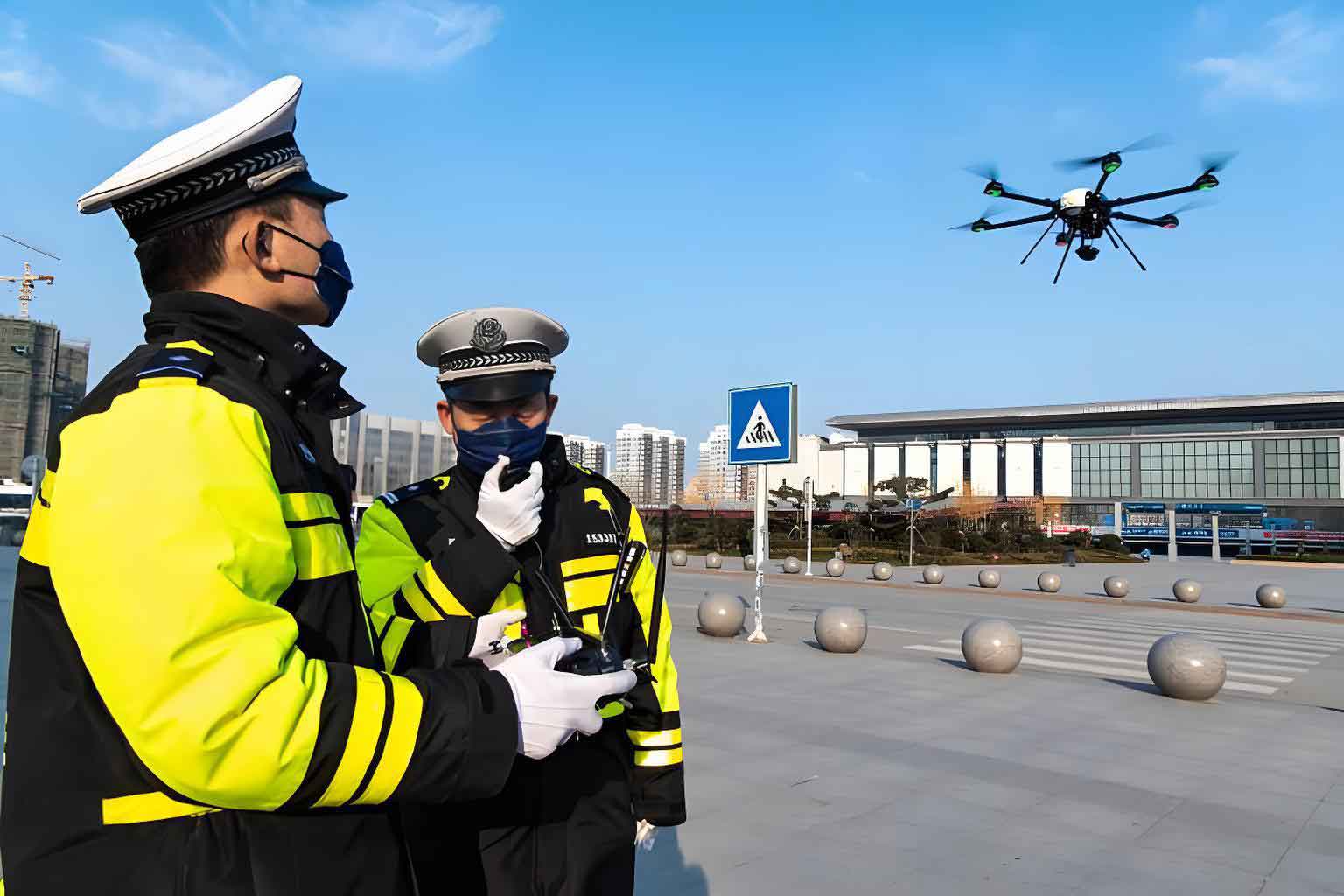
This image captures a typical police UAV in action, showcasing its sleek design and advanced sensors. With 5G integration, such police UAVs can transcend current boundaries, enabling real-time high-definition streaming and intelligent analytics. As I delve into the specifics, I will analyze the challenges faced by existing police UAV systems, compare 5G with 4G technologies, and detail the multifaceted applications of 5G-powered police UAVs. Throughout this discussion, the term “police UAV” will be emphasized to highlight its centrality in modern policing strategies.
Current Challenges in Police UAV Applications
In my assessment, police UAVs are currently deployed using communication systems based on point-to-point microwave or 4G networks. These systems present several technical hurdles that impede optimal performance in complex law enforcement environments. The primary issues include low data transmission rates, high latency, outdated image transmission technology, and restricted coverage areas.
Data transmission rate, a critical metric for real-time operations, is often measured in bits per second (bps). The signal rate S, representing the number of bits transmitted per second, is defined as:
$$ S = \frac{N}{T} $$
where N is the number of bits and T is the time in seconds. For 4G networks, typical data rates range from 10 Mbps to 100 Mbps, which is insufficient for streaming high-definition video from a police UAV. This results in blurred or delayed footage, hampering situational awareness during critical incidents. For instance, in a pursuit scenario, a police UAV might capture fuzzy images, making suspect identification difficult. Moreover, latency—the delay between data transmission and reception—often exceeds 50 milliseconds in 4G systems, causing control lags that can lead to crashes or missed opportunities.
Image transmission in current police UAVs relies on wireless video networks with fixed base stations, which have limited coverage, especially at low altitudes. The coverage area A can be approximated by the formula:
$$ A = \pi r^2 $$
where r is the transmission range. With 4G, r is constrained due to signal attenuation, reducing the operational radius of a police UAV. In crowd management, this restricts the ability to monitor large gatherings accurately. Additionally, 4G networks cannot support 4K or higher resolution videos, limiting advanced features like facial recognition. Table 1 summarizes the key parameters of 4G-based police UAV systems versus desired benchmarks for effective policing.
| Parameter | 4G-Based Police UAV | Desired Benchmark for Policing |
|---|---|---|
| Data Rate | 10-100 Mbps | >1 Gbps |
| Latency | 50-100 ms | <1 ms |
| Coverage Radius | Up to 5 km | >10 km |
| Video Resolution | 1080p maximum | 4K or 8K |
| Simultaneous Connections | Limited to thousands | Massive (e.g., 1 million/km²) |
| Energy Efficiency | Moderate, with frequent recharging | High, enabling longer flight times |
These limitations underscore the need for an upgrade. In emergency responses, a police UAV must transmit clear, real-time data to command centers, but 4G’s bottlenecks often result in incomplete or delayed information. Furthermore, the inability to handle multiple connections simultaneously restricts the deployment of police UAV swarms for coordinated operations.
5G Technology: A Comparative Analysis with 4G
5G, or fifth-generation mobile networks, represents a quantum leap from 4G, designed to offer enhanced mobile broadband, ultra-reliable low-latency communications, and massive machine-type communications. As I examine its features, 5G’s core advancements include millimeter-wave (mmWave) frequencies, massive MIMO (Multiple Input Multiple Output), beamforming, and network slicing.
Millimeter waves operate in the frequency range of 30-300 GHz, enabling higher data rates. The fundamental relationship between frequency f, wavelength λ, and the speed of light c is given by:
$$ c = f \lambda $$
Higher frequencies allow for more bandwidth, but they have shorter ranges and are more prone to obstruction. To mitigate this, 5G employs massive MIMO with hundreds of antennas, using spatial multiplexing to serve multiple users simultaneously. The capacity gain from massive MIMO can be expressed as:
$$ C = M \log_2(1 + \text{SNR}) $$
where M is the number of antennas, and SNR is the signal-to-noise ratio. This significantly boosts network capacity, which is crucial for supporting multiple police UAVs in dense urban areas.
Additionally, 5G networks deploy dense micro-cells instead of macro-cells. In 4G, large macro-cells cover wide areas but with power inefficiencies, leading to signal degradation at edges. 5G’s micro-cells reduce the transmission distance, improving coverage and reducing interference. The path loss PL in decibels for a distance d is modeled as:
$$ PL(d) = PL_0 + 10n \log_{10}\left(\frac{d}{d_0}\right) $$
where PL_0 is the reference path loss, n is the path loss exponent, and d_0 is the reference distance. By minimizing d through micro-cells, PL is reduced, enhancing signal quality for police UAVs.
Table 2 provides a detailed comparison between 4G and 5G technologies, emphasizing the advantages for police UAV applications.
| Feature | 4G Technology | 5G Technology | Impact on Police UAV |
|---|---|---|---|
| Peak Data Rate | 1 Gbps | 20 Gbps | Enables 4K/8K video streaming from police UAV |
| Latency | 10-50 ms | 1 ms | Real-time control and response for police UAV |
| Frequency Bands | Sub-6 GHz | Sub-6 GHz and mmWave | Higher bandwidth and speed for police UAV data |
| Connection Density | 100,000 devices/km² | 1 million devices/km² | Supports swarms of police UAVs and IoT integration |
| Mobility Support | Up to 350 km/h | Up to 500 km/h | Effective for high-speed chases using police UAV |
| Energy Efficiency | Moderate | High (up to 90% reduction) | Extends flight times of police UAV |
| Network Slicing | Not available | Customizable virtual networks | Prioritizes police UAV traffic for critical missions |
5G’s low latency and high reliability are game-changers for police UAV operations. For example, in emergency responses, a delay of even a few milliseconds can be critical; with 5G, police UAVs can achieve near-instantaneous data transmission, facilitating swift decision-making. Moreover, the enhanced connection density allows for the deployment of multiple police UAVs in a coordinated manner, enabling comprehensive area coverage.
Applications of 5G in Police UAVs
Integrating 5G with police UAVs unlocks a wide array of applications that enhance law enforcement capabilities. I will discuss several key areas where 5G-powered police UAVs can make a significant difference, from surveillance to tactical interventions.
1. Aerial Surveillance and Monitoring
As an aerial surveillance tool, police UAVs equipped with 5G can stream 4K video in real-time, providing law enforcement officers with high-clarity monitoring of large areas. For instance, during public events, a police UAV can offer comprehensive coverage, detecting anomalies and tracking suspicious activities. The high data rates of 5G enable advanced computer vision algorithms for real-time facial recognition and object detection. The video data rate required for 4K video can be estimated as:
$$ R = f_r \times r_w \times r_h \times \text{bpp} $$
where \( f_r \) is the frame rate, \( r_w \) and \( r_h \) are the resolution width and height, and bpp is bits per pixel. For 4K at 60 fps with 24 bpp, R ≈ 12 Gbps, which is feasible with 5G but not with 4G. This capability allows a police UAV to identify individuals in crowds or monitor traffic violations with precision.
Furthermore, 5G facilitates the deployment of police UAV swarms for coordinated surveillance. Multiple police UAVs can work together, covering vast territories and sharing data seamlessly through 5G networks. The efficiency E of such a swarm can be modeled as:
$$ E = \sum_{i=1}^{n} \frac{A_i}{t_i} $$
where n is the number of police UAVs, \( A_i \) is the area covered by each, and \( t_i \) is the time taken. With 5G, data synchronization reduces \( t_i \), maximizing E.
2. Aerial Communication and Deterrence
Police UAVs can serve as aerial communication platforms, broadcasting warnings or instructions via integrated speakers. In crowd control situations, a police UAV can fly over a gathering and issue directives, helping to de-escalate tensions. The low latency of 5G ensures that messages are delivered without delay, making interventions more effective. Additionally, police UAVs can act as signal jammers in specific scenarios. By carrying signal interference devices, they can temporarily block communication in a targeted area, such as during operations against organized crime. This requires precise control and real-time updates, which 5G provides.
3. Tactical Reconnaissance and Search Operations
In tactical operations, police UAVs with 5G can perform reconnaissance in hazardous environments. For example, in hostage situations or building searches, a police UAV can enter ahead of officers, streaming live footage to command centers. The high-speed data transmission allows for instant analysis, enabling commanders to make informed decisions. Search and rescue missions also benefit from 5G police UAVs. They can cover large areas quickly, using thermal imaging and other sensors to locate missing persons. The data can be processed in real-time, reducing search times. The effectiveness E of a search can be modeled as:
$$ E = \frac{A_c}{A_t} \times \frac{1}{t} $$
where \( A_c \) is the area covered, \( A_t \) is the total area, and t is the time taken. With 5G, \( A_c \) increases due to better coverage, and t decreases due to faster data processing.
4. Command and Control Enhancement
5G-enabled police UAVs can serve as mobile command posts, relaying communications between ground units and headquarters, especially in remote areas with poor infrastructure. Using 5G’s massive MIMO, a single police UAV can handle multiple data streams, ensuring uninterrupted coordination. Moreover, police UAVs can integrate with other IoT devices, creating a networked ecosystem. For instance, in smart city initiatives, a police UAV can interact with traffic cameras, sensors, and patrol cars, providing a holistic view of security situations.
5. Equipment Delivery and Intervention
Police UAVs equipped with payload mechanisms can deliver essential gear, such as medical supplies or communication devices, to inaccessible locations. With 5G, the delivery can be coordinated precisely based on real-time video feedback. In emergency responses, this can save lives. Moreover, police UAVs can be armed with non-lethal weapons for intervention. For example, in active shooter scenarios, a police UAV can deploy tear gas or stun devices, neutralizing threats without risking officers. The control accuracy required for such tasks is achievable with 5G’s ultra-reliable low-latency communication (URLLC).
Table 3 summarizes the applications of 5G in police UAVs, along with the required 5G features.
| Application | Description | Key 5G Features Utilized |
|---|---|---|
| Aerial Surveillance | Real-time HD video streaming for monitoring | Enhanced Mobile Broadband (eMBB) |
| Communication Deterrence | Broadcasting audio messages or jamming signals | Ultra-Reliable Low Latency (URLLC) |
| Tactical Reconnaissance | Recon in dangerous areas with live feed | URLLC and eMBB |
| Command and Control | Relaying communications and data integration | Massive Machine-Type Communication (mMTC) |
| Equipment Delivery | Precise delivery of supplies or intervention tools | URLLC and Network Slicing |
| Swarm Operations | Coordinated multiple police UAVs for coverage | mMTC and eMBB |
Technical Implementation and Mathematical Models
To fully leverage 5G for police UAVs, understanding the technical implementation is crucial. I will discuss key mathematical models and formulas that govern 5G-enhanced police UAV operations.
The data transmission rate in a 5G network can be derived from Shannon’s theorem, which states the channel capacity C as:
$$ C = B \log_2(1 + \text{SNR}) $$
where B is the bandwidth and SNR is the signal-to-noise ratio. For a police UAV, increasing B through mmWave bands boosts C, enabling high-definition video transmission. Additionally, the latency L in a 5G network can be broken down into components:
$$ L = t_{\text{prop}} + t_{\text{trans}} + t_{\text{queue}} + t_{\text{proc}} $$
where \( t_{\text{prop}} \) is propagation delay, \( t_{\text{trans}} \) is transmission delay, \( t_{\text{queue}} \) is queuing delay, and \( t_{\text{proc}} \) is processing delay. 5G minimizes these through edge computing and optimized protocols, ensuring L < 1 ms for police UAV control.
For coverage optimization, the signal strength S at a distance d from a 5G micro-cell can be modeled as:
$$ S(d) = P_t – PL(d) + G_t + G_r $$
where \( P_t \) is transmit power, PL(d) is path loss, and \( G_t \) and \( G_r \) are antenna gains. By deploying micro-cells densely, S remains strong even for police UAVs flying at varying altitudes.
Moreover, the energy consumption E of a police UAV during a mission can be expressed as:
$$ E = P_{\text{flight}} \cdot t_{\text{flight}} + P_{\text{com}} \cdot t_{\text{com}} $$
where \( P_{\text{flight}} \) is power for flight, \( t_{\text{flight}} \) is flight time, \( P_{\text{com}} \) is power for communication, and \( t_{\text{com}} \) is communication time. 5G’s energy efficiency reduces \( P_{\text{com}} \), extending the operational duration of a police UAV.
Case Studies and Real-World Scenarios
To illustrate the impact of 5G on police UAVs, I will present hypothetical case studies based on real-world policing challenges.
Case Study 1: Large-Scale Event Security
During a major public festival, law enforcement deploys multiple 5G-powered police UAVs for surveillance. The police UAVs stream 4K video to a command center, where AI algorithms detect overcrowding or suspicious behavior. With 5G’s low latency, officers receive instant alerts and can dispatch ground units proactively. The police UAVs also broadcast safety announcements, managing crowd flow effectively. This scenario demonstrates how a police UAV enhances situational awareness and response efficiency.
Case Study 2: High-Speed Pursuit
In a vehicular chase, a police UAV is deployed to track the suspect vehicle. Using 5G, the police UAV transmits real-time 4K footage with minimal delay, allowing commanders to plan intercepts. The police UAV’s facial recognition capability identifies the suspect, and its signal jammer disrupts the suspect’s communications, aiding apprehension. Here, the police UAV acts as a force multiplier, reducing risks to officers.
Case Study 3: Search and Rescue in Remote Areas
A hiker goes missing in a mountainous region. A 5G-enabled police UAV with thermal imaging is deployed, covering a large area quickly. The police UAV streams data to a rescue team, who use edge computing to analyze footage in real-time. The police UAV also drops a communication device to the lost hiker, establishing contact. This highlights the life-saving potential of a police UAV in critical missions.
Future Prospects and Integration with Emerging Technologies
Looking ahead, the integration of 5G with police UAVs will continue to evolve, especially when combined with emerging technologies like artificial intelligence, edge computing, and blockchain. AI-powered police UAVs can autonomously patrol areas, detect crimes through pattern recognition, and even predict incidents based on data analytics. For instance, a police UAV could analyze traffic patterns to anticipate accidents or monitor social gatherings for potential disturbances.
Edge computing, coupled with 5G, allows data processing closer to the source, reducing latency and bandwidth usage. A police UAV can process video locally using on-board AI and only send relevant alerts to the cloud, improving efficiency. The latency reduction ΔL from edge computing can be expressed as:
$$ \Delta L = t_{\text{cloud}} – t_{\text{edge}} $$
where \( t_{\text{cloud}} \) is the cloud processing time, and \( t_{\text{edge}} \) is the edge processing time. With 5G, \( t_{\text{edge}} \) is minimized, enabling faster responses from the police UAV.
Blockchain technology can enhance the security and transparency of data collected by police UAVs. By storing footage and logs on a decentralized ledger, law enforcement agencies can ensure data integrity and prevent tampering. This is particularly important for evidence collected by a police UAV in legal proceedings.
Furthermore, the development of autonomous police UAV swarms will revolutionize policing. These swarms can perform complex tasks like area denial, environmental monitoring, or disaster response. The coordination efficiency C of a swarm of n police UAVs can be modeled as:
$$ C = \frac{n \cdot k}{\log(n)} $$
where k is a constant representing communication efficiency. With 5G, k increases due to reliable links, boosting C.
Challenges and Considerations for Deployment
Despite the advantages, deploying 5G-powered police UAVs presents challenges. Regulatory issues, such as airspace management and privacy concerns, must be addressed. Public acceptance of police UAV surveillance is crucial, requiring transparent policies and community engagement. Additionally, the cost of upgrading to 5G infrastructure and training personnel to operate advanced police UAVs can be significant.
Technical challenges include ensuring cybersecurity for police UAV communications and managing interference in crowded spectrum bands. The signal-to-interference ratio (SIR) for a police UAV in a 5G network can be calculated as:
$$ \text{SIR} = \frac{S}{I} $$
where S is the desired signal strength and I is interference. Through beamforming and network slicing, 5G can optimize SIR for police UAV operations.
Moreover, environmental factors like weather conditions can affect police UAV performance. Adaptive algorithms powered by 5G can help a police UAV navigate such challenges, but robust design is essential.
Conclusion
In conclusion, 5G technology addresses the core limitations of current police UAV systems, enabling faster, more reliable, and broader applications. As I have outlined, the integration of 5G with police UAVs enhances aerial surveillance, communication, tactical operations, command and control, and equipment delivery. The mathematical models and case studies demonstrate the transformative potential of a 5G-powered police UAV in real-world scenarios.
The future of policing is inextricably linked with technological advancements, and police UAVs stand at the forefront of this transformation. By embracing 5G, law enforcement agencies can improve operational efficiency, enhance officer safety, and achieve better public security outcomes. Ongoing research, collaboration between stakeholders, and attention to ethical considerations will be key to realizing the full potential of police UAVs. As we move forward, the police UAV will undoubtedly become an indispensable tool in the modern policing arsenal, driven by the revolutionary capabilities of 5G.
I encourage continued innovation and investment in this field, as the benefits of 5G-enabled police UAVs extend beyond law enforcement to disaster response, public safety, and community well-being. The journey has just begun, and with each advancement, the police UAV will redefine the boundaries of what is possible in policing.