
The persistent and evolving threat of terrorism and explosive-related incidents on a global scale presents a formidable challenge to public safety and security forces. In these scenarios, the devices encountered are increasingly sophisticated, rendering traditional Security Inspection and Explosive Ordnance Disposal (EOD) operations exceptionally hazardous. The paramount objective, therefore, is to maximize standoff distance from the threat while maintaining operational efficacy, ensuring the safety of EOD personnel. The integration of advanced technology is no longer a luxury but a necessity in this high-stakes field. Among the most transformative tools to emerge in recent years is the Police Unmanned Aerial Vehicle (UAV). Characterized by its unmanned, remotely operated nature, the police UAV has begun to fundamentally alter the tactical landscape, providing a critical layer of protection and capability for EOD teams.
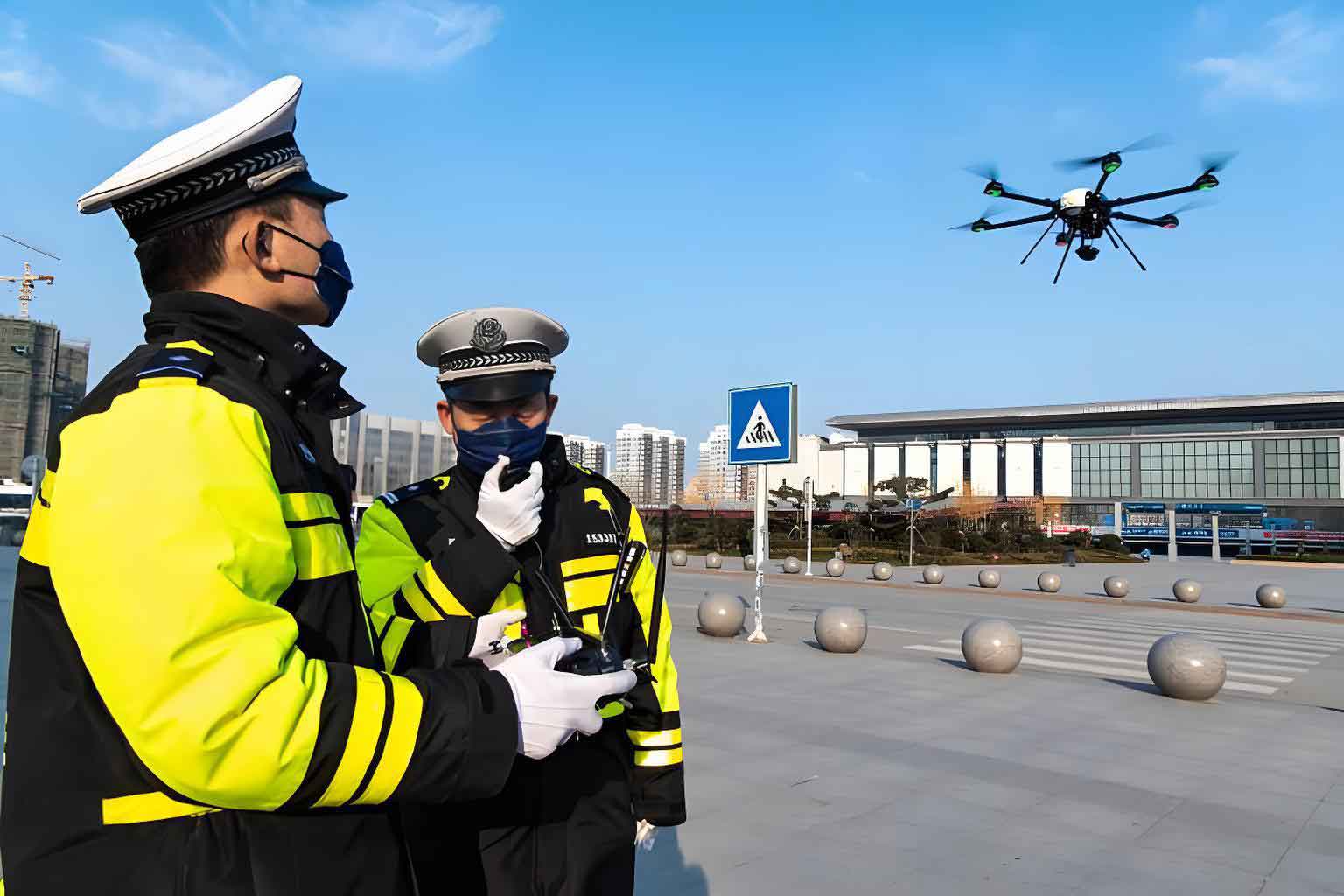
My experience and observations in this domain confirm that we are at a pivotal juncture. The traditional procedural response to a confirmed explosive device—prioritizing controlled removal over manual disruption—often relies on ground-based robots. However, these platforms have inherent limitations. The emergence of the police UAV as a versatile aerial platform offers a complementary and, in many cases, superior set of capabilities. Its remote operation, facilitated by radio control and onboard programmable controllers, allows for intervention with minimal risk to human life. This technological shift represents a core component of the modern “tech-powered policing” strategy, demanding thorough research and adept application.
Operational Advantages of Police UAVs in EOD
The adoption of police UAV systems is driven by a compelling set of advantages over conventional methods, which can be systematically analyzed.
1.1 Enhanced Scenario Adaptability and Rich Application Context
Traditional EOD robots, typically with tracked or wheeled locomotion, are constrained by terrain. They struggle with significant vertical obstacles, soft or muddy ground, and complex urban debris. In contrast, a police UAV operates in a three-dimensional space, bypassing ground-level obstacles entirely. This creates a rich spectrum of application scenarios:
- Vertical and Overhead Inspection: Scanning high roofs, stadium rafters, ventilation shafts, and other areas inaccessible to ground teams or pole cameras.
- Hazardous Environment Penetration: Entering structures with suspected chemical, biological, or radiological contamination, or visually surveying unstable rubble piles.
- Modular Payload Flexibility: Modern police UAV platforms can be equipped with various payloads—high-zoom cameras, thermal imagers, manipulator arms, disruptors, or chemical sniffers. This allows a single platform to perform reconnaissance, analysis, and even direct intervention based on the threat.
The following table contrasts the capabilities of traditional methods versus a police UAV approach:
| Operational Task | Traditional Method / Ground Robot | Police UAV Application |
|---|---|---|
| Initial Scene Reconnaissance | Limited line-of-sight from perimeter; risky manned observation. | Rapid, overhead 360° assessment from a safe distance. |
| Suspicious Object Inspection | Slow, ground-level approach; perspective limited to robot camera height. | Dynamic, multi-angle (top-down, side) visual inspection using zoom and stabilization. |
| Accessing Confined/High Spaces | Often impossible or requires complex, risky infrastructure. | Direct flight into voids, atop structures, or over barriers. |
| Payload Delivery/Intervention | Possible with specialized robots, but limited by terrain and reach. | Aerial deployment of disruptors, grabbers, or sensors to precise coordinates. |
1.2 Multi-Dimensional Observation and Situational Awareness
A critical weakness in traditional EOD is the limited perspective. Operators often make decisions based on a single, ground-level video feed. A police UAV, equipped with a gimbal-stabilized camera, provides立体 (three-dimensional) intelligence. It can orbit a suspect device, providing top-down, oblique, and side views crucial for identifying booby traps, wiring, and device construction. This comprehensive visual dataset significantly improves threat assessment accuracy. For instance, when dealing with historical ordnance found in riverbeds or construction sites, the police UAV can quickly map the area and the object’s orientation in the mud, informing the safest removal strategy. The intelligence gain can be modeled as an increase in information entropy $I$:
$$
I_{UAV} = -\sum_{i=1}^{n} P(x_i) \log_2 P(x_i)
$$
Where $x_i$ represents different observable states of the threat (e.g., visible trigger, orientation, secondary device). The police UAV, by providing more observation angles $n$, reduces uncertainty $P(x_i)$, leading to a higher overall information value $I_{UAV}$ compared to a single-view ground robot.
1.3 Precision and Efficiency in Operations
Precision is non-negotiable in EOD. Many ground robots suffer from positional inaccuracy and lag in control feedback, making delicate tasks like grasping unstable. Police UAV platforms now integrate Real-Time Kinematic (RTK) Global Navigation Satellite System (GNSS) technology. This provides centimeter-level positioning accuracy. When combined with detailed aerial mapping, the police UAV can hover at an exact coordinate, deploy a payload with minimal error, or create a precise 3D model of the scene for planning. The positional error $\epsilon_{pos}$ of an RTK-equipped police UAV is drastically lower than a robot relying on inertial measurement and wheel encoding:
$$
\epsilon_{pos_{UAV(RTK)}} \approx 0.01 – 0.02m \quad \text{vs.} \quad \epsilon_{pos_{Robot}} \approx 0.05 – 0.5m
$$
This precision directly translates to higher success rates in render-safe procedures and safer removal operations.
1.4 Cost-Effectiveness in Acquisition and Maintenance
From a logistical and financial perspective, the police UAV presents a compelling case. A high-end commercial-off-the-shelf (COTS) police UAV with EOD payloads may cost tens of thousands of dollars, whereas a sophisticated EOD robot can cost an order of magnitude more. Furthermore, the maintenance ecosystem for multi-rotor UAVs is mature and standardized. Batteries, motors, propellers, and even gimbals are often modular and replaceable by field technicians. This contrasts with proprietary robotic systems that require specialized, expensive service contracts. The total cost of ownership $C_{T}$ over a period $t$ can be approximated as:
$$
C_{T(UAV)} = A_{UAV} + \sum_{t=1}^{T} (M_t + O_t) \quad \text{where } M_t \text{ is low, modular maintenance}
$$
$$
C_{T(Robot)} = A_{Robot} + \sum_{t=1}^{T} (M’_t + O’_t) \quad \text{where } M’_t \text{ is high, specialized maintenance}
$$
Typically, $A_{Robot} >> A_{UAV}$ and $M’_t >> M_t$, making the police UAV a more scalable and sustainable asset for many departments.
Current Challenges and Limitations
Despite the clear advantages, the operational integration of police UAV units in EOD is not without significant hurdles. Acknowledging and addressing these is crucial for future development.
2.1 Technical Performance Constraints
The two most pressing technical limitations are flight endurance and communications resilience.
Endurance: Most tactical police UAV platforms rely on lithium-polymer batteries, offering flight times ($T_{flight}$) typically between 20 to 45 minutes. This is governed by the energy density of the battery $E_{bat}$, the weight of the aircraft $W$, and the power consumption $P_{consumption}$ of the propulsion and payload systems. The relationship can be simplified as:
$$
T_{flight} \propto \frac{E_{bat} \times \eta}{W \times P_{consumption}}
$$
where $\eta$ is the powertrain efficiency. For a given battery technology, increasing payload (e.g., heavier manipulators) directly reduces $T_{flight}$. This limits prolonged operations and necessitates multiple battery swaps or UAV rotations during a single incident.
Communications and Interference: Police UAV systems operate on public ISM bands (e.g., 2.4 GHz, 5.8 GHz for control and video). In dense urban environments or during large-scale events, these bands can suffer from congestion and interference ($I_{ext}$), potentially leading to signal degradation, latency ($L$), or loss of link. The effective data throughput $R_{eff}$ can be modeled as:
$$
R_{eff} = B \cdot \log_2\left(1 + \frac{S}{N + I_{ext}}\right) – \Delta(L)
$$
where $B$ is bandwidth, $S$ is signal strength, $N$ is noise, and $\Delta(L)$ is a latency penalty function. Secure, robust, and dedicated communication links are an area requiring advancement for critical EOD missions.
2.2 Regulatory and Operational Governance Gaps
The operational framework for police UAV use is often fragmented. Key issues include:
- Unclear Protocols: Lack of standardized national guidelines for authorization, airspace coordination (especially with aviation authorities), and rules of engagement for EOD-specific UAV use.
- Administrative Burden: Cumbersome and slow approval processes for flight missions can negate the rapid-response advantage of the police UAV.
- Public Perception and Identification: While standardized livery for police UAV exists, public awareness is low. A UAV responding to a scene may be mistaken for a civilian or media drone, causing confusion or concern.
2.3 Personnel Training and Talent Shortage
The technology is only as good as its operator. There is a severe shortage of proficient police UAV pilots, particularly those trained for the high-stress, precision demands of EOD work. The current training and certification ecosystem is underdeveloped. Most pilots obtain basic flight certificates (e.g., Part 107 in the U.S. or equivalent B-level certs elsewhere), but EOD operations require advanced skills in:
– Precise payload maneuvering
– RTK mapping and modeling
– Tactical flight in GNSS-denied or obstructed environments
– Integration with ground team command structures
Furthermore, dedicated police UAV programs in law enforcement academies are rare, creating a talent pipeline problem. The imbalance is geographical as well, with affluent urban departments having better access to training and equipment than rural or underfunded ones.
| Training Level | Current Common Focus | Required Focus for EOD |
|---|---|---|
| Basic Certification | Flight regulations, basic piloting, safety. | Foundation for all operations. |
| Intermediate/Applied | Aerial photography, search patterns. | Advanced camera work for device assessment; basic mapping. |
| Advanced/Tactical EOD | Often lacking or ad-hoc. | Payload operation (manipulator/disruptor); coordinated tactics with team; degraded environment operation. |
Future Trajectory and Strategic Development
The future of police UAV in EOD is intrinsically linked to focused investment in technology, training, and doctrine. Based on current trends, several key development vectors are apparent.
3.1 Advancing Core Technology for Enhanced Autonomy
The next generation of police UAV must evolve from remotely piloted vehicles to intelligent, collaborative agents.
Artificial Intelligence and Computer Vision: AI algorithms will enable real-time threat detection and classification from aerial imagery, flagging potential devices based on shape, thermal signature, or context. Onboard processing will allow for automatic tracking of subjects or maintaining a stable inspection orbit around an object without constant pilot input.
Swarm Technology and Manned-Unmanned Teaming (MUM-T): The future points to the coordinated use of multiple, heterogeneous police UAV units. One UAV could provide persistent surveillance and communications relay, while another, smaller unit equipped with a manipulator performs the intervention. This can be described as a multi-agent optimization problem, maximizing overall system utility $U_{swarm}$:
$$
\max U_{swarm} = \sum_{i=1}^{k} f_i(Cap_i, Task_j, Env)
$$
where $k$ UAVs with different capabilities $Cap_i$ are assigned to tasks $Task_j$ (recon, disruption, comms) in environment $Env$.
Advanced Propulsion and Power: Research into hybrid power systems (fuel cells, hydrogen), improved battery density, and wireless charging pads at scenes will gradually overcome the endurance bottleneck.
Resilient Communications: Integration of mesh networking and secure, frequency1 agile datalinks will ensure command and control in contested electromagnetic environments.
3.2 Institutionalizing Training and Building a Talent Pipeline
Sustained capability requires a formalized human resource strategy.
- Curriculum Integration: Police UAV operation and tactics must be embedded into the core curriculum of national police academies and university criminal justice programs.
- Specialized EOD UAV Courses: Development of advanced, certified courses focusing on the unique psychomotor skills and decision-making required for EOD aviation.
- Public-Private Partnerships: Leveraging the agility and R&D prowess of the commercial UAV industry. Police departments should actively collaborate with manufacturers to co-develop and test EOD-specific airframes, payloads, and software, moving beyond the adaptation of commercial platforms.
3.3 Fostering Strategic Research and Unified Deployment
National-level initiative is required to accelerate progress.
- Directed Research Funding: Government science and technology agencies should establish grant programs specifically for “High-Risk Response Robotics” or “Public Safety UAVs,” incentivizing research into autonomy, ruggedization, and EOD-specific applications.
- Development of Standards and Protocols: A national regulatory body, in concert with law enforcement leadership, should establish clear, streamlined protocols for police UAV deployment in emergencies, including pre-approved airspace corridors and inter-agency coordination procedures.
- Large-Scale Demonstration Projects: Funding and executing large-scale, realistic exercises involving police UAV swarms in simulated EOD scenarios will drive practical innovation and reveal integration challenges.
The progression towards a truly integrated police UAV capability in EOD is inevitable. From providing a simple aerial camera to becoming an intelligent, semi-autonomous platform capable of direct intervention, the police UAV is redefining the perimeter of safety for bomb technicians. The challenges of today—endurance, regulation, and training—are significant but surmountable with focused effort. By investing in technological research, institutionalizing advanced training, and fostering supportive policies, we can ensure that police UAV systems evolve into even more reliable and powerful partners. This will not only enhance the safety and effectiveness of EOD personnel but also fundamentally improve public safety outcomes, creating a more resilient security infrastructure for the complexities of the modern world.