
In recent years, the adoption of police UAV (Unmanned Aerial Vehicle) systems has emerged as a transformative approach in law enforcement, particularly under the frameworks of technology-driven and efficiency-oriented policing. This trend has gained momentum in various urban centers, where pilot programs have demonstrated significant outcomes in enhancing police operations. The COVID-19 pandemic has further underscored the necessity for innovative policing methods, as traditional approaches faced challenges in maintaining public safety while minimizing health risks. In this article, I explore the role of police UAV in reshaping police operations during health crises, drawing on conceptual analyses, feasibility assessments, and practical applications. I will employ tables and formulas to summarize key points, ensuring a comprehensive discussion that highlights the multifaceted benefits and challenges of police UAV integration.
The concept of police operations, often referred to as police action, encompasses the specific tasks and requirements undertaken by law enforcement agencies within defined periods and regions. It represents the concrete manifestation of police work, characterized by systematic, operable, and efficient structures tailored to societal needs. From my perspective, police operations exhibit three core attributes: phase-specificity, reflecting temporal and social contexts; systemic integration, ensuring coordinated efforts; and operability, allowing adaptable implementation based on environmental factors. These attributes form the foundation for integrating advanced tools like police UAV into routine and emergency scenarios.
Similarly, police UAV can be defined in both narrow and broad terms. Narrowly, a police UAV is an unmanned aircraft with official markings, capable of performing multiple tasks without an onboard pilot. Broadly, it constitutes a Policing Unmanned Aircraft System (PUAS), which includes the aerial vehicle, data links, and ground control stations. To illustrate its characteristics, I present the following table:
| Characteristic | Description |
|---|---|
| Auxiliary Nature | Police UAV primarily supports police operations, enhancing efficiency without replacing human officers. |
| Extensibility | It can be equipped with various payloads, such as loudspeakers, cameras, or sensors, expanding its functional scope. |
| Technical Complexity | Operation requires specialized skills in flight control, maintenance, and data interpretation, demanding trained personnel. |
The feasibility of deploying police UAV during pandemics, such as the COVID-19 outbreak, stems from the urgent need to reform traditional police practices. Conventional methods often rely on high-intensity human labor, leading to officer fatigue and increased health risks. In my view, police UAV offers a paradigm shift by introducing cost-effective and efficient solutions. For instance, the efficiency gain from using police UAV can be quantified using a simple formula: $$ \text{Efficiency Gain} = \frac{A_c}{T} \times R_s $$ where \( A_c \) represents the area covered by the police UAV, \( T \) is the time required, and \( R_s \) denotes the risk reduction factor for officers. This highlights how police UAV can optimize resource allocation while safeguarding personnel.
Moreover, the pandemic has accelerated the demand for non-contact policing models. Traditional methods involving direct interaction pose infection risks, whereas police UAV enables remote monitoring and communication. I believe this aligns with the broader trend toward smart policing, where technology augments human capabilities. The following table summarizes key feasibility factors for police UAV adoption during health crises:
| Factor | Impact of Police UAV |
|---|---|
| Cost Efficiency | Reduces reliance on extensive patrol teams, lowering operational expenses. |
| Operational Efficiency | Enables rapid deployment for surveillance and response, covering larger areas in less time. |
| Health Safety | Minimizes physical contact between officers and the public, reducing infection transmission. |
| Technological Integration | Facilitates synergy with existing police systems, enhancing overall command and control. |
In terms of innovative applications, police UAV has demonstrated versatility in pandemic response. One significant area is the establishment of coordinated mechanisms for police UAV deployment. For example, during the COVID-19 pandemic, agencies utilized police UAV to create “air-ground” defense systems, complementing foot and vehicle patrols. This approach addresses blind spots in surveillance, as illustrated by cases where police UAV monitored ports or urban areas for compliance with lockdown measures. The integration of police UAV into daily routines also transforms patrol methods. Instead of static “point-and-area” coverage, police UAV enables three-dimensional monitoring, allowing real-time assessment of crowd densities or traffic flows. A formula to model patrol effectiveness could be: $$ P_e = \int_{0}^{t} (D_m \times V_u) \, dt $$ where \( P_e \) is patrol effectiveness, \( D_m \) is the detection rate of incidents, and \( V_u \) is the police UAV’s velocity over time \( t \). This underscores how police UAV enhances situational awareness.
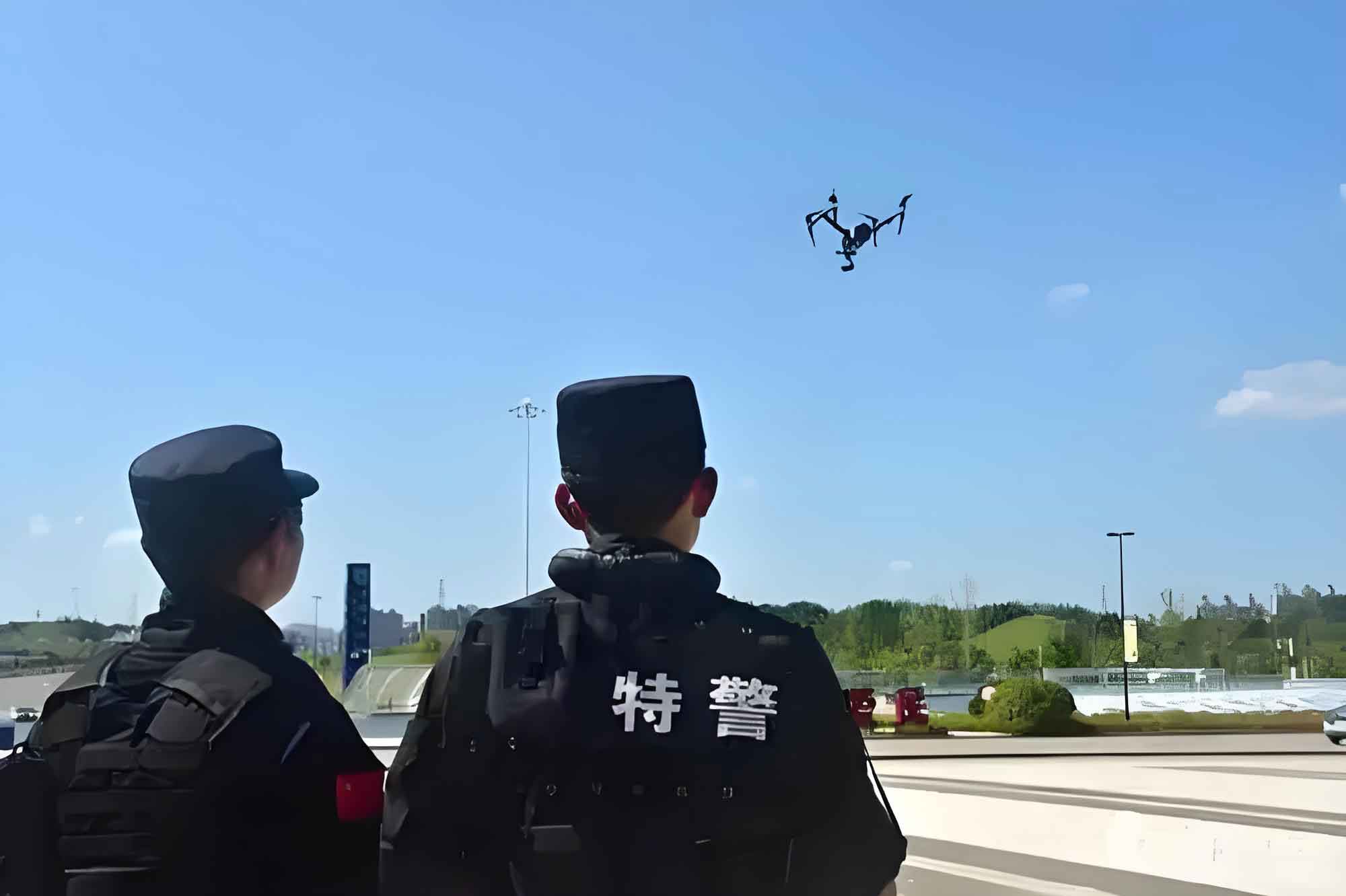
Another application involves reconfiguring checkpoint operations. Traditionally, setting up checkpoints requires manual reconnaissance and often leads to congestion. With police UAV, authorities can pre-assess traffic patterns and environmental conditions using aerial data. For instance, police UAV equipped with thermal sensors can screen vehicle occupants for fever, streamlining health checks at borders. This not only speeds up processes but also reduces officer exposure. Additionally, police UAV supports inter-agency coordination by serving as communication relays during emergencies, ensuring uninterrupted information flow. The image below visually represents a typical police UAV in action, highlighting its compact design and multifunctional capabilities:
Furthermore, police UAV has been instrumental in public communication during pandemics. By mounting loudspeakers, police UAV can broadcast warnings or guidelines to dispersed populations, as seen in instances where gatherings were discouraged in parks or markets. This non-contact method aligns with social distancing protocols while maintaining law enforcement presence. I argue that such applications exemplify the adaptive potential of police UAV in crisis management. To quantify the benefit, consider a compliance rate model: $$ C_r = \frac{N_a}{N_t} \times 100\% $$ where \( C_r \) is the compliance rate, \( N_a \) is the number of individuals adhering to directives after police UAV interventions, and \( N_t \) is the total targeted population. This shows how police UAV can influence public behavior effectively.
Despite these advantages, the use of police UAV in pandemic contexts raises several critical considerations. From a legal standpoint, the regulatory framework for police UAV remains underdeveloped in many jurisdictions. While civilian drones are governed by aviation laws, police UAV often operates in a gray area due to its status as state aircraft. In my analysis, this necessitates clear legislation to define the legal status and operational protocols for police UAV. For example, guidelines should specify altitude limits, data privacy safeguards, and authorization procedures to prevent abuses. A potential regulatory formula could involve a risk-based approval matrix: $$ A_p = f(L, S, R) $$ where \( A_p \) represents approval likelihood, \( L \) is the legal basis, \( S \) is the societal impact, and \( R \) is the risk level. This emphasizes the need for balanced policies that uphold both security and civil liberties.
Ethical dilemmas also arise, particularly regarding privacy intrusions. During pandemics, police UAV may conduct widespread surveillance to enforce quarantine measures, potentially infringing on individual rights. I contend that such actions, while arguably justified in emergencies, require transparent oversight and sunset clauses to prevent normalization. Moreover, the technical proficiency of operators is crucial; without proper training, police UAV deployments may lead to accidents or inefficiencies. I propose a standardized training framework, encapsulated in a competency index: $$ C_i = \sum_{i=1}^{n} (S_k \times E_x) $$ where \( C_i \) is the competency index, \( S_k \) represents skill components (e.g., flight control, legal knowledge), and \( E_x \) denotes experience weights. This ensures that police UAV operators are adequately prepared for complex scenarios.
Looking ahead, the future of police UAV in policing appears promising, especially as societies grapple with recurring health threats. The pandemic has served as a catalyst for innovation, prompting agencies to invest in smart tools like police UAV. However, sustainable integration demands holistic strategies. From my viewpoint, this includes updating legal codes, fostering cross-departmental collaborations, and prioritizing human-centric design in technology adoption. For instance, police UAV systems could be enhanced with AI-driven analytics to predict outbreak clusters, further boosting preventive policing. The long-term efficacy can be modeled as: $$ E_f = \alpha \cdot T_u + \beta \cdot L_s $$ where \( E_f \) is overall efficacy, \( \alpha \) and \( \beta \) are coefficients for technological uptake (\( T_u \)) and legal support (\( L_s \)), respectively.
In conclusion, police UAV represents a pivotal advancement in modern policing, with demonstrated utility during the COVID-19 pandemic. By enabling non-contact operations, expanding surveillance capabilities, and improving resource efficiency, police UAV addresses critical gaps in traditional police work. Yet, its success hinges on addressing legal ambiguities, ethical concerns, and operational competencies. As I reflect on these insights, I am convinced that a proactive approach—combining regulatory clarity, continuous training, and public engagement—will maximize the benefits of police UAV while mitigating risks. The journey toward fully integrated police UAV systems is ongoing, but the lessons from pandemic response offer a robust foundation for future developments in police operations worldwide.