
As a pioneer in the field of law enforcement technology, we are proud to introduce our cutting-edge police UAV system, designed to revolutionize public safety operations. Our police UAV system represents a holistic integration of surveillance, intervention, management, control, rescue, and communication capabilities, all seamlessly unified into a single platform. This innovation emerged from years of dedicated research and实战 feedback, aiming to address the complex challenges faced by modern police forces. In this article, I will delve into the intricacies of our police UAV system, exploring its components, performance metrics, functional modules, and real-world applications, all while emphasizing the transformative impact of police UAV technology.
The core of our police UAV system lies in its versatile platform architecture, which we refer to as the “Three UAVs and One Vehicle” configuration. This setup ensures adaptability across diverse operational scenarios, from large-area reconnaissance to precision strikes. Our police UAV fleet includes three distinct无人机 models, each optimized for specific roles, coupled with a ground command and control vehicle that serves as the operational nerve center. The integration of these elements enables a robust and responsive police UAV network, capable of enhancing situational awareness and operational efficiency.
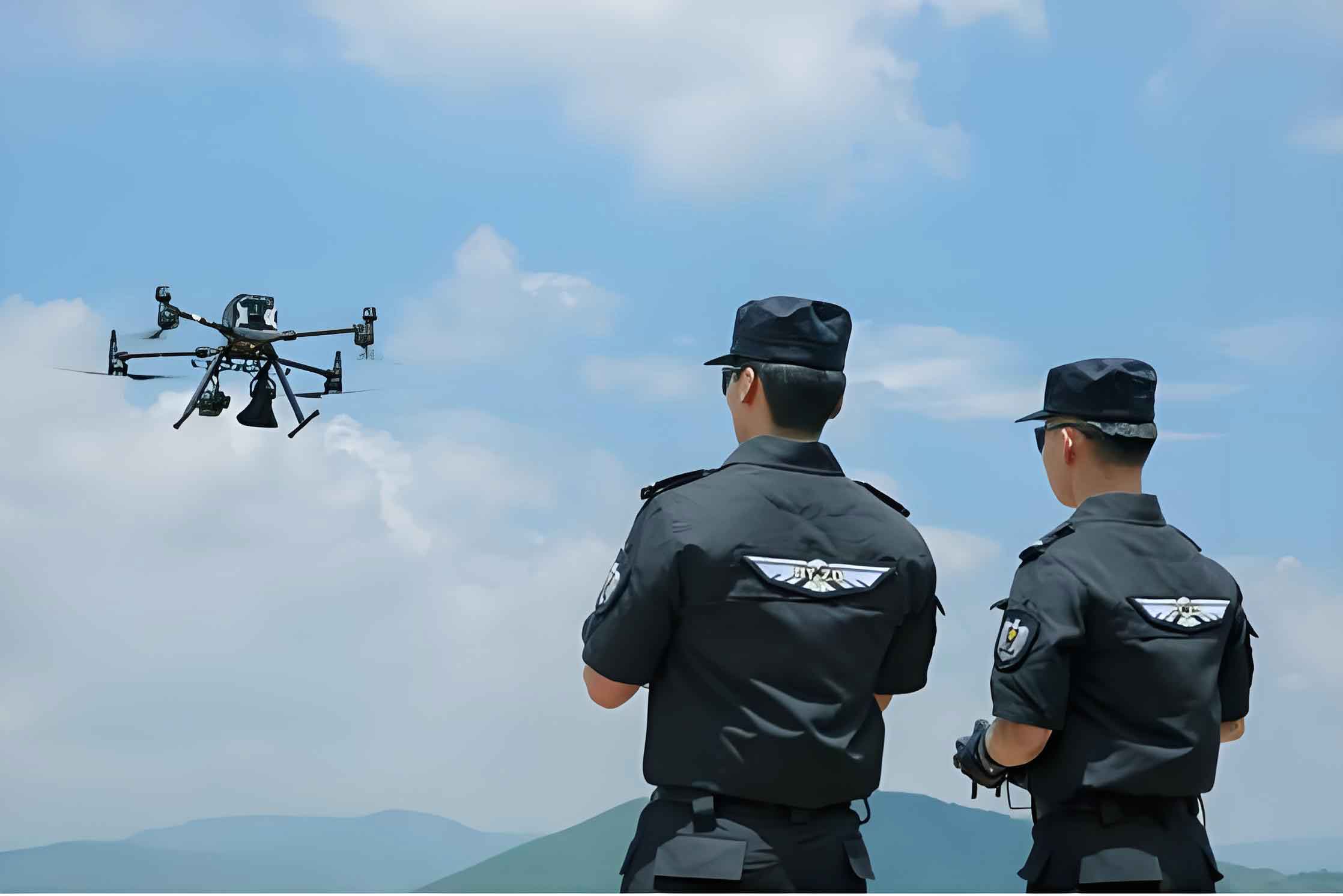
Let me begin by detailing the aerial platforms. Our police UAV models are engineered with modularity in mind, allowing for rapid deployment and customization. The following table summarizes the key specifications of each police UAV:
| UAV Model | Type | Primary Role | Max Payload | Endurance (with specific modules) | Key Features |
|---|---|---|---|---|---|
| Eagle Eye One | Fixed-wing | Reconnaissance | N/A (focused on sensors) | Several hours (depends on mission profile) | Modular interface,车载弹射起飞, suitable for山区/desert大面积侦察 |
| Eagle Eye Two | Quadcopter | Reconnaissance and Strike | 1.5 kg | 数十 hours with系留 module at 200m | High payload,系留 capability for prolonged monitoring |
| Eagle Eye Three | Hexacopter | Emergency Reconnaissance and Strike | Variable (based on module) | Moderate (enhanced by efficient design) | Low noise, high mobility, suitable for紧急 tasks |
Each police UAV is designed to leverage aerodynamic principles for optimal performance. For instance, the fixed-wing police UAV, Eagle Eye One, utilizes a lift-to-drag ratio that can be expressed as: $$ C_L/C_D $$ where \( C_L \) is the lift coefficient and \( C_D \) is the drag coefficient. This allows it to cover vast areas efficiently, with a reconnaissance coverage area \( A \) given by: $$ A = v \times t \times w $$ where \( v \) is the velocity, \( t \) is the flight time, and \( w \) is the sweep width of the sensors. This police UAV can be assembled and launched within minutes via a车载弹射 system, making it ideal for rapid deployment in challenging terrains like mountains or deserts.
The quadcopter police UAV, Eagle Eye Two, embodies stability and endurance. Its maximum payload of 1.5 kg enables it to carry various functional modules. When equipped with the系留 module, it can operate at a constant altitude of 200 meters for extended periods, providing persistent surveillance. The power consumption \( P \) of such a police UAV can be modeled as: $$ P = k \cdot m \cdot g \cdot h / \eta $$ where \( k \) is a constant factor, \( m \) is the mass, \( g \) is gravity, \( h \) is the altitude, and \( \eta \) is the efficiency of the propulsion system. This allows for precise energy management in prolonged operations.
The hexacopter police UAV, Eagle Eye Three, focuses on stealth and agility. Its six-rotor design reduces acoustic signature, which is crucial for covert operations. The thrust \( T \) generated by each rotor can be calculated using: $$ T = \frac{1}{2} \rho A v^2 C_T $$ where \( \rho \) is air density, \( A \) is rotor disk area, \( v \) is induced velocity, and \( C_T \) is the thrust coefficient. This ensures smooth and responsive control, essential for dynamic police UAV missions.
Complementing these aerial platforms is the ground command and control vehicle, which integrates multiple systems to orchestrate police UAV operations. This vehicle features a sophisticated suite including flight control systems, intelligent弹射 systems,鹰眼在线 systems,警力叠加 systems,三机一站 systems,自动跟踪 systems,摇杆操控 systems,倾斜摄影建模 systems, and指挥中心双传 systems. Essentially, it acts as a mobile hub that can remotely control up to three police UAVs simultaneously while managing 36实战 modules. The integration with existing police business systems allows for seamless data fusion and command decisions.
The true versatility of our police UAV system stems from its extensive array of functional modules. These modules can be swapped and combined based on mission requirements, transforming a standard police UAV into a specialized tool. Below is a comprehensive table listing the 36实战 modules, categorized by their primary functions:
| Module Category | Module Name | Description | Typical Application |
|---|---|---|---|
| Surveillance and Reconnaissance | Real-time Video Transmission Module | Streams live footage to ground control | Monitoring public events, tracking suspects |
| Reconnaissance and Evidence Collection Module | Captures high-resolution images and videos | Crime scene investigation, evidence gathering | |
| Thermal Imaging Module | Detects heat signatures for night operations | Search and rescue, suspect追踪 in darkness | |
| 倾斜摄影 Modeling System | Creates 3D models of terrain or structures | Disaster assessment, tactical planning | |
| Automatic Tracking System | Locks onto and follows moving targets | Pursuit operations, crowd monitoring | |
| Intervention and Strike | 捕网发射器 Module (Net Launcher) | Deploys nets to immobilize suspects or animals | Non-lethal apprehension, riot control |
| 38mm通用弹发射器 Module | Fires non-lethal or less-lethal projectiles | Dispersing crowds, disabling threats | |
| Multi-purpose投掷器 Module | Drops various payloads (e.g.,闪光,烟雾) | Tactical distractions, delivery of supplies | |
| Strike Coordination Module | Integrates with other intervention tools | Precision strikes in high-risk scenarios | |
| Jamming and Countermeasure Module | Disrupts communication or electronic devices | Neutralizing IEDs, countering drone threats | |
| Kinetic Energy Module | Provides physical impact capabilities | Barrier penetration, targeted disablement | |
| Communication and Control | Communication Relay Module | Extends radio and data networks | Operations in remote areas with poor connectivity |
| 4G Real-time Transmission Module | Utilizes cellular networks for data streaming | Urban surveillance, real-time collaboration | |
| SJQH Module (Secure Communication) | Ensures encrypted data links | Sensitive missions,防止 eavesdropping | |
| XH PB Module (Signal Processing) | Enhances signal clarity and range | Noisy environments, long-distance control | |
| DMXG R Module (Data Management) | Processes and stores collected data | Big data analysis, forensic review | |
| Rescue and Support | Search and Rescue Module | Includes life detectors and loudspeakers | Locating trapped individuals, disaster response |
| Lifesaving Module | Delivers medical supplies or flotation devices | Emergency aid, water rescues | |
| 探照灯 Module (Searchlight) | Provides powerful illumination | Night operations, illuminating large areas | |
| ZYQS Module (Environmental Sensing) | Measures air quality, temperature, etc. | Hazardous material incidents, environmental monitoring | |
| JGZX Module (Structural Analysis) | Assesses building integrity | Earthquake response, structural inspections | |
| Specialized Operations | Explosive Detection Module | Identifies explosive materials | Bomb disposal, security sweeps |
| 系留 Module (Tethering System) | Provides continuous power via cable | Prolonged stationary surveillance | |
| 警力叠加 System (Force Overlay) | Integrates officer positions on maps | Coordinated raids, resource allocation | |
| 指挥中心双传 System (Dual Transmission) | Streams data to multiple command centers | Large-scale events, multi-agency operations | |
| 三机一站 System (Three UAVs One Station) | Manages multiple police UAVs from one interface | Complex missions requiring diverse assets | |
| Ancillary and Utility | Intelligent弹射 System (Launch System) | Automates UAV launch from vehicles | Quick deployment, reducing setup time |
| 鹰眼在线 System (Eagle Eye Online) | Cloud-based platform for data sharing | Real-time analytics, remote monitoring | |
| 摇杆操控 System (Joystick Control) | Intuitive manual control interface | Training,精细操控 in tight spaces | |
| Other Custom Modules | Tailored for specific police needs | Emerging threats, specialized法律 enforcement tasks |
These modules empower our police UAV system to tackle a wide spectrum of challenges. For example, the real-time video transmission module ensures that command centers receive live feeds, enhancing decision-making speed. The effectiveness of such a module can be quantified using a communication model: $$ R = B \log_2 \left(1 + \frac{S}{N}\right) $$ where \( R \) is the data rate, \( B \) is bandwidth, \( S \) is signal power, and \( N \) is noise power. This ensures reliable video streaming even in干扰-prone environments.
Moreover, the integration of these modules with the police UAV platforms follows a modular interface design, allowing for quick swaps. The compatibility can be expressed as a function: $$ C = f(M, U) $$ where \( C \) is compatibility score, \( M \) is module type, and \( U \) is UAV model. We optimize this function to ensure that any module can be搭载 on the appropriate police UAV with minimal configuration. This flexibility is crucial for adapting to evolving police needs.
In实战 applications, our police UAV system has proven its worth across numerous operations. It has been deployed in various regions for tasks ranging from drug eradication campaigns to anti-terror missions and gambling busts. For instance, in large-area narcotics detection, the police UAV system utilizes aerial imaging to identify illegal crops. The detection probability \( P_d \) can be modeled as: $$ P_d = 1 – e^{-\lambda \cdot A \cdot \sigma} $$ where \( \lambda \) is the density of targets, \( A \) is the area covered, and \( \sigma \) is the sensor’s effectiveness. This mathematical approach helps optimize flight paths for maximum coverage.
Another critical application is in搜捕 operations for fugitives in野外 environments. The fixed-wing police UAV, with its long endurance, can sweep vast territories efficiently. The search time \( T_s \) required to locate a target with probability \( \alpha \) is given by: $$ T_s = \frac{-\ln(1-\alpha)}{\lambda \cdot v \cdot w} $$ where \( \lambda \) is the target’s spatial density, \( v \) is UAV speed, and \( w \) is sensor sweep width. This formula guides operators in planning missions to minimize time and资源.
The police UAV system also enhances officer safety by reducing the need for physical presence in hazardous situations. For example, in handling可疑 targets, the quadcopter police UAV with系留 module can maintain a safe distance while providing continuous监控. The risk reduction \( \Delta R \) can be approximated as: $$ \Delta R = k_1 \cdot T_{exposure} – k_2 \cdot T_{UAV} $$ where \( k_1 \) and \( k_2 \) are constants related to danger levels, \( T_{exposure} \) is time officers would be exposed, and \( T_{UAV} \) is UAV operation time. By maximizing \( T_{UAV} \), we significantly lower risks to personnel.
Furthermore, the police UAV system integrates with existing公安业务 systems, enabling data fusion and协同 operations. This interoperability is key to its success. The overall system effectiveness \( E \) can be represented as a weighted sum: $$ E = \sum_{i=1}^{n} w_i \cdot F_i $$ where \( w_i \) are weights for factors like reliability, speed, and integration, and \( F_i \) are performance metrics for each subsystem. Our police UAV system scores highly across all dimensions, thanks to rigorous testing and实战 refinement.
To illustrate the operational workflow, consider a typical scenario: a police UAV is dispatched for crowd monitoring during a public event. The ground control vehicle coordinates multiple police UAVs, each equipped with real-time video and喊话 modules. Data flows through the command center双传 system, allowing real-time analysis. The automatic tracking system locks onto any anomalous behavior, while the捕网发射器 module stands ready for intervention if needed. This seamless coordination is made possible by the unified design of our police UAV system.
In terms of technical innovation, our police UAV system employs advanced algorithms for autonomous flight and data processing. For instance, the倾斜摄影 modeling system uses structure-from-motion techniques to generate 3D models. The reconstruction accuracy \( \epsilon \) can be expressed as: $$ \epsilon = \frac{1}{N} \sum_{i=1}^{N} || \mathbf{x}_i – \hat{\mathbf{x}}_i ||^2 $$ where \( \mathbf{x}_i \) are ground truth points and \( \hat{\mathbf{x}}_i \) are estimated points from UAV imagery. This ensures high-fidelity models for tactical planning.
Additionally, the police UAV system’s energy management is optimized for longevity. For the系留 module, the power transmission efficiency \( \eta_t \) over the tether is given by: $$ \eta_t = \frac{P_{out}}{P_{in}} = 1 – \frac{I^2 R}{P_{in}} $$ where \( I \) is current, \( R \) is resistance, and \( P_{in} \) is input power. By minimizing losses, we enable extended operations crucial for surveillance tasks.
The economic impact of deploying police UAV systems is also significant. By reducing the need for manned aircraft or large ground teams, costs are lowered while efficiency is boosted. A cost-benefit analysis can be modeled as: $$ \text{Net Benefit} = \sum (B_i – C_i) $$ where \( B_i \) are benefits like faster response times and reduced risks, and \( C_i \) are costs包括 acquisition and maintenance. Our police UAV system demonstrates a positive net benefit across various police departments, making it a wise investment for public safety.
Looking ahead, we continue to evolve our police UAV system with emerging technologies like AI and 5G. Future iterations will feature enhanced autonomy, with decision-making algorithms based on reinforcement learning: $$ Q(s,a) \leftarrow Q(s,a) + \alpha [r + \gamma \max_{a’} Q(s’,a’) – Q(s,a)] $$ where \( Q \) is the action-value function, \( s \) is state, \( a \) is action, \( r \) is reward, and \( \alpha \) and \( \gamma \) are learning parameters. This will allow police UAVs to adapt dynamically to complex environments.
In conclusion, our police UAV system stands as a testament to innovation in law enforcement technology. By integrating multiple functions into a cohesive platform, it addresses critical gaps in traditional methods. The police UAV system not only enhances operational capabilities but also safeguards officer lives, making it an indispensable tool for modern policing. As we refine and expand its applications, the police UAV system will continue to set new standards in public safety, proving that technology can be a force multiplier in the hands of dedicated professionals.
Throughout this discussion, I have emphasized the multifaceted nature of our police UAV system. From its robust platforms to its extensive modules and seamless integration, every aspect is designed with警察实战 in mind. The police UAV system represents more than just equipment; it is a comprehensive solution that empowers law enforcement agencies to protect and serve with greater efficiency and safety. As adoption grows, we anticipate even broader impacts, solidifying the role of police UAV technology as a cornerstone of 21st-century policing.