
In today’s global landscape, the threat of terrorism and violent attacks remains a pressing concern, destabilizing societies and endangering innocent lives. From my perspective as a security professional, addressing these challenges requires not only traditional law enforcement tactics but also a robust integration of modern technology. Among these advancements, the police UAV (unmanned aerial vehicle) has emerged as a pivotal tool in constructing a multi-dimensional counter-terrorism framework. By leveraging high-tech solutions like police UAVs, we can significantly boost operational efficiency and combat effectiveness in handling violent terrorist incidents. This article delves into the characteristics, advantages, and practical applications of police UAVs, offering insights into their role in enhancing on-site处置 capabilities for暴恐 cases. I will explore how police UAVs transform response strategies, supported by tables, formulas, and real-world scenarios, while emphasizing the need for continuous improvement in this field.
The concept of a police UAV refers to an unmanned aircraft system specifically deployed for law enforcement missions, utilizing radio control or programmed flight paths to aid in policing operations. Unlike traditional police helicopters, police UAVs come in various designs, each suited to different operational needs. Broadly, they can be categorized into three main types: helicopter UAVs, fixed-wing UAVs, and multi-rotor UAVs. Each type has distinct features that influence their applicability in counter-terrorism scenarios. For instance, helicopter UAVs offer substantial payload capacity and extended endurance, making them ideal for aerial surveillance with specialized recording equipment. However, they often rely on fuel, which can lead to noise issues, stability challenges, and potential crash risks. Fixed-wing police UAVs resemble conventional airplanes, using engine thrust for takeoff and landing; they excel in high-altitude, high-speed operations with broad coverage areas, but require significant runway space for deployment. Multi-rotor police UAVs, equipped with 4 to 8 propellers, enable vertical takeoff and landing, allowing for precise hovering and agile maneuvers. They are cost-effective and easy to maintain, though their flight time is typically limited to around 30 minutes per session. Beyond these, police UAVs can also be classified by power source (e.g., fuel-based vs. electric), size (e.g., mini vs. large), and application domain (e.g., military, monitoring, rescue). To summarize these distinctions, consider the following table comparing key attributes of different police UAV types:
| Type | Advantages | Disadvantages | Typical Endurance | Best Use Case |
|---|---|---|---|---|
| Helicopter UAV | High payload, long endurance | Noisy, less stable, fuel-dependent | Up to 2 hours | Extended surveillance in open areas |
| Fixed-wing UAV | Fast, high-altitude, wide coverage | Requires runway, less maneuverable | Over 2 hours | Large-scale搜索 in rural or remote regions |
| Multi-rotor UAV | Vertical takeoff, agile, low cost | Short endurance, limited range | 20-30 minutes | Urban operations, close-quarter inspection |
When it comes to暴恐 incidents, responders face numerous complexities that hinder effective处置. From my analysis, these challenges stem from the nature of terrorist acts: they are often brutal, involving weapons like knives, firearms, vehicle ramming, or explosives aimed at maximizing civilian casualties. Politically motivated, such attacks are frequently orchestrated by extremist groups to instill fear in public spaces like stations or squares, making them highly unpredictable in timing and duration. Geographically,暴恐 events can occur in diverse environments, from densely populated cities to remote, inaccessible areas. In regions with vast territories and sparse populations, for example, traditional ground-based methods struggle due to poor infrastructure, language barriers, and cultural differences. This complicates情报 gathering and rapid response, as seen in某些 areas where maps fail to provide accurate terrain data, and入户 inspections are impractical. Thus, enhancing处置能力 demands tools that can overcome these hurdles—a role where police UAVs shine.
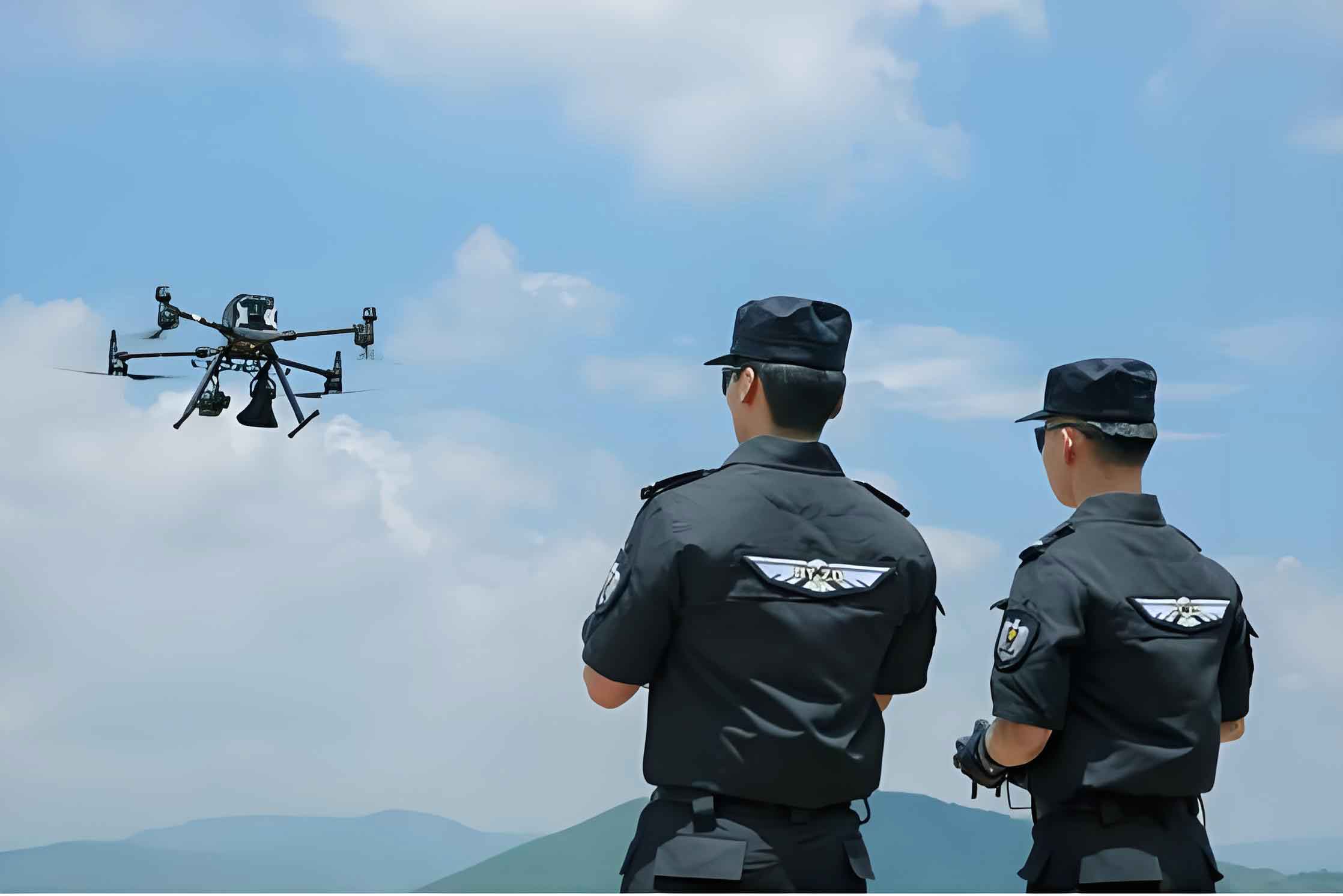
The technical superiority of police UAVs lies in their ability to address暴恐处置难点 through advanced features. First, consider endurance: fixed-wing police UAVs, such as the “Eagle Eye” model, utilize high-capacity lithium batteries to achieve extended flight times. We can model this with a simple formula for endurance $$ T = \frac{C \cdot \eta}{P} $$, where \( T \) is the endurance in minutes, \( C \) is the battery capacity in milliampere-hours (mAh), \( \eta \) is the efficiency factor (typically around 0.8 for modern systems), and \( P \) is the power consumption in watts. For instance, with a 10,000 mAh battery and optimized power settings, a police UAV can cover up to 150 square kilometers and remain airborne for 130 minutes, enabling sustained surveillance over large areas. This is crucial for搜索 operations in expansive regions where suspects might hide.
Second, police UAVs boast high-definition imaging and real-time data transmission capabilities. Equipped with 1080P cameras or better, they can capture and relay clear visuals from altitudes of 300 meters or more, even identifying license plates or individual movements. The image quality can be expressed using a resolution formula: $$ R = \frac{H \cdot \tan(\theta)}{p} $$, where \( R \) is the ground resolution in meters per pixel, \( H \) is the飞行高度, \( \theta \) is the camera field of view angle, and \( p \) is the pixel density. This allows commanders to monitor situations in real-time, enhancing decision-making during crises.
Third, thermal sensing is a game-changer for police UAVs. By integrating热像仪 modules, these UAVs can detect heat signatures day or night, making them ideal for tracking suspects in obscured environments like forests or buildings. The thermal sensitivity, often measured as Noise Equivalent Temperature Difference (NETD), can be as low as 60 mK for advanced models. This capability enables detection of humans or animals based on temperature differentials, with a detection range modeled by $$ D = \sqrt{\frac{A \cdot \sigma}{NETD}} $$, where \( D \) is the maximum detection distance, \( A \) is the target’s thermal cross-section, and \( \sigma \) is a constant related to atmospheric conditions. In practice, a police UAV can discern human activity inside structures from 300 meters away, proving invaluable for nocturnal searches.
Fourth, police UAVs offer rapid deployment and stealth. With modular designs, they can be assembled and launched within minutes via catapult systems from moving vehicles, reducing reliance on airstrips. Their electric motors minimize noise, often below 10 decibels, which enhances隐蔽性 during covert operations. The launch velocity can be calculated using $$ v = \sqrt{2a s} $$, where \( v \) is the launch speed, \( a \) is the acceleration, and \( s \) is the catapult length. This quick-response feature is vital for containing暴恐 events before they escalate.
Fifth, police UAVs are built to withstand harsh conditions. Intelligent flight control systems integrate GPS or北斗 navigation, allowing programmable routes and autonomous operation. Their airframes, often made from EPO carbon-coated materials, provide durability against rain, snow, or sandstorms. The抗风性 can be quantified by the Beaufort scale; many police UAVs can operate in winds up to Force 7 (50-61 km/h). This resilience ensures reliability in diverse operational environments, from deserts to mountainous terrains.
To illustrate the practical impact of police UAVs, let’s examine some application scenarios in暴恐案件处置. In one hypothetical case inspired by real events, terrorists conducted an attack in a remote区域, resulting in casualties and fugitives hiding in dense vegetation like thorn forests or cornfields. Traditional ground searches were inefficient, taking months with limited success. However, upon deploying a fixed-wing police UAV equipped with thermal imaging, authorities could conduct昼夜 surveillance over villages and farmlands. The UAV’s data pinpointed suspect locations in a thorn forest within days, leading to a swift apprehension. This demonstrates how police UAVs transform lengthy manhunts into precise operations, saving time and resources.
Another scenario involves群体性暴恐 incidents, where crowds gather in public spaces, posing challenges for conventional policing. Here, police UAVs can be deployed overhead to provide live footage, helping command centers assess dynamics and identify ringleaders. Additionally, auxiliary devices on police UAVs, such as loudspeakers or dispensers, allow for audio warnings or non-lethal measures like tear gas deployment. The effectiveness of such interventions can be modeled using a dispersion formula: $$ \frac{dN}{dt} = -k N + U(t) $$, where \( N \) is the crowd density, \( k \) is the dispersal rate常数, and \( U(t) \) represents the UAV-based intervention over time. By integrating police UAVs into crowd control strategies, agencies can de-escalate situations with minimal force.
Despite these advantages, the adoption of police UAVs faces several hurdles that I believe must be addressed. Regulatory frameworks are still nascent; while guidelines like the “Civil Unmanned Aircraft System Air Traffic Management Measures” exist in some countries, they often lack specificity for law enforcement use, creating legal ambiguities in airspace management. Moreover, the market for police UAVs is fragmented, with numerous manufacturers producing varying quality products. Without standardized industry norms, some police UAVs may fail to meet operational standards, compromising mission safety. The table below outlines key challenges and potential solutions for police UAV integration:
| Challenge | Description | Proposed Solution |
|---|---|---|
| Regulatory gaps | Insufficient laws governing police UAV usage in airspace | Develop specialized legislation for law enforcement UAVs |
| Technology standardization | Diverse manufacturing leading to inconsistent performance | Establish uniform technical specifications and认证 processes |
| Personnel training | Shortage of skilled operators and maintenance crews | Implement comprehensive training programs and certifications |
| Operational costs | High maintenance and保养 expenses in tough environments | Invest in durable designs and predictive maintenance tech |
| Technical limitations | Constraints in endurance, payload, and obstacle avoidance | Boost R&D for better batteries, AI navigation, and modular payloads |
From a technical standpoint, enhancing police UAV capabilities requires innovation in several areas. For endurance, we can explore公式 for energy density: $$ E_d = \frac{C \cdot V}{m} $$, where \( E_d \) is the energy density in Wh/kg, \( C \) is capacity, \( V \) is voltage, and \( m \) is mass. By improving battery technology, police UAVs could achieve longer missions without weight penalties. Similarly, obstacle avoidance systems can be optimized using algorithms based on simultaneous localization and mapping (SLAM), expressed as $$ P(x_t | z_{1:t}, u_{1:t}) $$, where \( x_t \) is the UAV’s pose at time \( t \), \( z \) are sensor observations, and \( u \) are control inputs. Integrating such AI would make police UAVs safer in cluttered environments.
In terms of training, agencies must cultivate expertise through模拟 and实战 exercises. A training effectiveness metric can be defined as $$ TE = \frac{S_c}{T_t} \cdot \alpha $$, where \( TE \) is training effectiveness, \( S_c \) is mission success rate post-training, \( T_t \) is training time, and \( \alpha \) is a adjustment factor for scenario complexity. By prioritizing such programs, we can mitigate the “buy but can’t use” dilemma常见 in police UAV deployment.
Looking ahead, I am convinced that police UAVs will play an increasingly central role in暴恐案件处置. Their ability to provide aerial intelligence, conduct searches, and support tactical operations makes them indispensable for modern policing. To maximize their potential, we must foster collaboration between policymakers, manufacturers, and law enforcement agencies. This includes developing robust protocols for data privacy and ethical use, as police UAVs collect sensitive information. Furthermore, interoperability with other technologies, such as ground robots or command centers, can create a seamless counter-terrorism network. The synergy can be modeled as $$ \text{System Effectiveness} = \sum_{i=1}^{n} w_i \cdot U_i $$, where \( U_i \) represents the utility of each component (e.g., police UAVs, ground units), and \( w_i \) are weighting factors based on mission requirements.
In conclusion, the integration of police UAVs into暴恐 response strategies represents a significant leap toward科技强警. By harnessing their endurance, imaging, thermal sensing, stealth, and resilience, we can overcome traditional处置难点 and save lives. However, realizing this vision demands addressing regulatory, technical, and training gaps through concerted efforts. As I reflect on the future, I believe that continuous innovation in police UAV technology—guided by practical insights and cross-sector partnerships—will elevate our counter-terrorism capabilities to new heights, ensuring safer communities in an uncertain world.