
As an industry practitioner deeply involved in the development and deployment of unmanned aerial vehicles for law enforcement, I have witnessed a remarkable transformation in how police UAVs are utilized across various sectors. The rapid growth of the industrial UAV market, with domestic scales expanding at approximately 50% annually and global markets at around 20%, underscores the increasing reliance on these technologies. Police UAVs, in particular, have emerged as critical tools in modern policing, addressing previously insurmountable challenges in public safety operations. This article delves into the current state, applications, and future trends of police UAVs, emphasizing their strategic importance through data analysis, models, and practical insights.
The integration of police UAVs into routine and emergency operations has been accelerated by supportive policies and technological advancements. In 2017, the market saw significant procurement activities, with over 332 public bidding cases involving police UAVs (including border patrol and firefighting) in China alone, leading to the purchase of more than 721 units and an expenditure of approximately 250 million RMB. This growth is not merely quantitative but qualitative, driven by standardization and training initiatives. For instance, the “National Police Unmanned Aerial Vehicle Tactical Exercise” held in May 2017 showcased the实战 capabilities of 139 teams from 26 provinces, while the August 2017 release of the “Police Unmanned Aerial Vehicle System” standard by the Ministry of Public Security filled regulatory gaps, setting technical benchmarks for performance and usage. Furthermore, the November 2017 designation of authorized training institutions规范化了 the skills required for operating police UAVs, ensuring safer and more effective deployments.
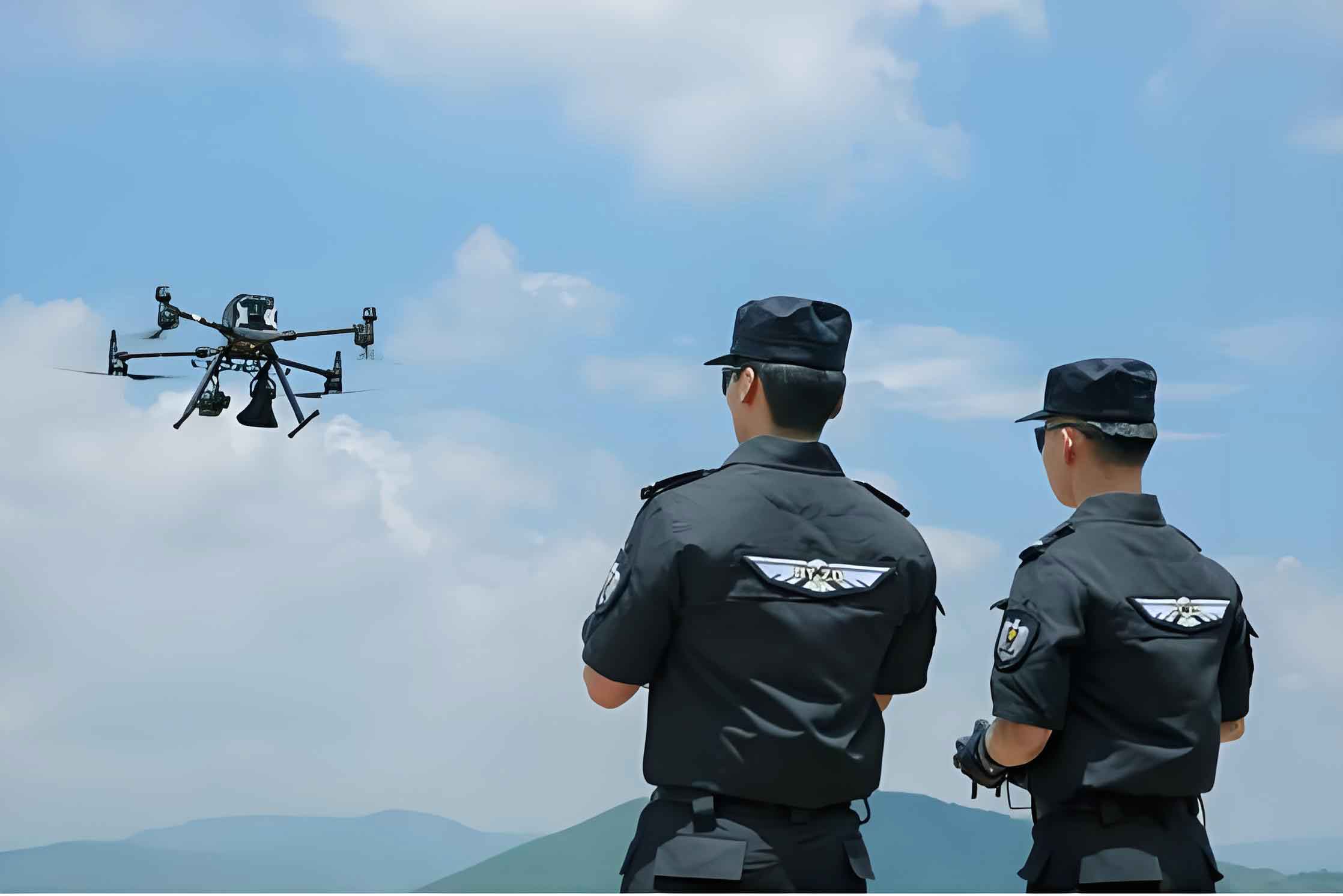
To better understand the market dynamics, let’s examine the procurement data in detail. The following table summarizes key statistics from 2017, highlighting the scale and scope of police UAV adoption.
| Category | Value | Notes |
|---|---|---|
| Number of Procurement Cases | 332 | Including border, fire, and other related sectors |
| Total UAVs Purchased | >721 units | Reflecting diverse models and applications |
| Total Expenditure | ~250 million RMB | Indicative of investment in advanced technology |
| Primary Applications | 反恐处突, security, inspection | Based on公开招投标 data analysis |
This growth is propelled by the versatility of police UAVs, which excel in environments where traditional methods fall short. The demand for police UAVs stems from their ability to enhance situational awareness, reduce operational risks, and improve efficiency. For example, in emergency response scenarios, police UAVs can provide real-time aerial footage, enabling commanders to make informed decisions quickly. The economic and social benefits are substantial, as evidenced by their use in森林防火,应急防控, and other critical missions. To quantify the performance metrics of police UAVs, we can use formulas to model key parameters. For instance, the endurance time \( T \) of a police UAV can be expressed as:
$$ T = \frac{E_{total}}{P_{avg}} $$
where \( E_{total} \) is the total energy available (e.g., in watt-hours) and \( P_{avg} \) is the average power consumption during flight (in watts). This formula highlights the importance of battery technology and energy efficiency in extending mission durations for police UAVs. Similarly, the control radius \( R \) for reliable communication can be approximated by the Friis transmission equation:
$$ R = \sqrt{\frac{P_t G_t G_r \lambda^2}{(4\pi)^2 P_r}} $$
where \( P_t \) is transmitter power, \( G_t \) and \( G_r \) are antenna gains, \( \lambda \) is wavelength, and \( P_r \) is receiver sensitivity. Optimizing these parameters is crucial for police UAVs operating in urban canyons or remote areas.
The applications of police UAVs are vast and continually expanding. Below, I outline six core scenarios where police UAVs have proven indispensable, each with unique requirements and outcomes.
| Scenario | Primary Functions | Typical Payloads | Benefits |
|---|---|---|---|
| Emergency Response | Real-time monitoring, crowd management, dispersal operations | HD cameras, loudspeakers, tear gas dispensers | Rapid deployment, enhanced situational awareness |
| Event Security | Surveillance, facial recognition, automatic tracking | Zoom cameras, AI processors, communication modules | Wide-area coverage, proactive threat detection |
| Investigation and Pursuit | Aerial patrols, suspect tracking, night operations | Thermal imagers, spotlights, net guns | Extended reach, reduced officer exposure |
| Traffic Management | Congestion monitoring, accident assessment, violation recording | High-resolution cameras, data transmission units | Quick clearance, evidence collection |
| Emergency Rescue | Search and rescue, delivery of supplies, damage assessment | 投递 devices, multispectral sensors, GPS locators | Access to inaccessible areas, lifesaving support |
| Narcotics Eradication | Aerial reconnaissance, plant identification, area mapping | Multispectral cameras, GIS software | Efficient detection in rugged terrain |
In emergency response, police UAVs excel by overcoming communication blackouts and交通受阻. For instance, during large-scale incidents, they provide a bird’s-eye view that helps in analyzing crowd dynamics and deploying resources effectively. The use of loudspeakers or non-lethal payloads allows for remote intervention, minimizing physical confrontations. This aligns with the trend towards实战化, where police UAVs are not just for demonstration but for daily警务工作. The performance demands are rigorous; police UAVs must operate in complex environments like urban high-rises, densely populated zones, and恶劣 conditions such as sandstorms. To assess the robustness of a police UAV, we can consider a reliability model based on failure rates:
$$ R_{system}(t) = e^{-\lambda t} $$
where \( R_{system}(t) \) is the probability of survival over time \( t \), and \( \lambda \) is the failure rate per hour. For police UAVs, low \( \lambda \) values are essential to ensure mission success in critical situations.
Activity security represents another growing domain. At marathons or international sports events, police UAVs monitor crowds for anomalies, using AI-driven features like facial recognition to identify persons of interest. This requires advanced data processing capabilities, which ties into the trend of结构化数据处理. The volume of data collected by police UAVs can be enormous, and extracting actionable insights is key. A simple formula for data volume \( V \) from a police UAV mission is:
$$ V = f_r \times t \times b $$
where \( f_r \) is the frame rate (e.g., in frames per second), \( t \) is mission duration, and \( b \) is bits per frame. With高清 cameras, \( V \) can easily reach terabytes, necessitating efficient algorithms for object detection and tracking. Police UAVs are thus evolving into intelligent nodes in a broader警务系统, contributing to big data analytics for predictive policing.
Investigation and pursuit benefit from the aerial advantage of police UAVs, which can cover larger areas than ground patrols. In manhunts, they use thermal imaging to detect body heat at night, significantly improving success rates. The need for提升性能 is evident here: longer endurance, greater control range, and higher payload capacities are constantly sought. For example, the required flight time \( T_{req} \) for a search mission over an area \( A \) can be estimated as:
$$ T_{req} = \frac{A}{v \times w} $$
where \( v \) is the police UAV’s speed and \( w \) is the sweep width. Optimizing \( v \) and \( w \) through better aerodynamics and sensor placement enhances the efficiency of police UAVs in such tasks.
Traffic management applications leverage police UAVs for real-time monitoring of highways and accident sites. They capture violations like illegal use of emergency lanes, and in crashes, they provide quick勘察 to aid in clearance. This demands快速部署, where police UAVs must be airborne within minutes of a call. The deployment time \( T_{deploy} \) can be modeled as:
$$ T_{deploy} = T_{prep} + T_{takeoff} $$
where \( T_{prep} \) includes setup and checks, and \( T_{takeoff} \) is the ascent time. Minimizing \( T_{deploy} \) is crucial for time-sensitive operations, leading to designs with automatic起飞 systems for police UAVs.
Emergency rescue scenarios, such as natural disasters, showcase the lifesaving potential of police UAVs. In earthquakes or floods, they deliver supplies, locate survivors, and assess infrastructure damage. The投递 of救生设备 requires precise control, which can be analyzed using kinematics equations. For a payload drop from a police UAV at height \( h \), the time to impact \( t_{impact} \) is:
$$ t_{impact} = \sqrt{\frac{2h}{g}} $$
where \( g \) is gravitational acceleration. Accurate calculations ensure that救援物资 reach intended targets, highlighting the operational precision needed for police UAVs.
Narcotics eradication relies on police UAVs for scanning remote山林 regions where manual inspection is impractical. Using multispectral sensors, they identify plant signatures, enabling targeted raids. This application underscores the丰富功能 of police UAVs, which must adapt to various payloads—from cameras to chemical detectors. The interoperability of police UAV systems can be expressed through a modularity index \( M \):
$$ M = \frac{N_{compatible}}{N_{total}} $$
where \( N_{compatible} \) is the number of payloads that can be integrated without modification, and \( N_{total} \) is the total payload types available. High \( M \) values indicate versatility, a key trait for police UAVs facing diverse missions.
Looking ahead, the demands and trends for police UAVs are shaping their evolution. I have identified seven critical areas where improvements are needed to meet future challenges.
| Trend | Description | Key Metrics |
|---|---|---|
| Operationalization | Integration into daily police work, beyond exercises | Mission success rate, user feedback scores |
| Performance Enhancement | Longer endurance, extended range, better precision | \( T > 60 \text{ min} \), \( R > 10 \text{ km} \), positioning accuracy < 1 m |
| Functional Diversity | Support for multiple tasks via modular payloads | Number of mission types supported, swap time |
| Rapid Deployment | Quick launch and autonomous response to alerts | \( T_{deploy} < 5 \text{ min} \), automated flight initiation |
| Data Security | Secure transmission and storage of sensitive information | Encryption strength,抗干扰能力 |
| Structured Data Processing | AI-driven extraction of insights from video feeds | Processing speed, detection accuracy for objects |
| Product Morphology | Development of varied forms: multirotor, fixed-wing, hybrid | 适用场景匹配度, cost-effectiveness |
Data security is paramount for police UAVs, given the confidential nature of law enforcement operations. Encryption algorithms like AES can be modeled for their effectiveness in protecting data streams. The security level \( S \) can be approximated as:
$$ S = \frac{2^k}{t_{attack}} $$
where \( k \) is the key length in bits, and \( t_{attack} \) is the time required to break the encryption. For police UAVs, high \( S \) values ensure that communications remain secure against eavesdropping. Similarly, structured data processing involves machine learning models for object detection. The accuracy \( Acc \) of such a system can be defined as:
$$ Acc = \frac{TP + TN}{TP + TN + FP + FN} $$
where \( TP \) is true positives, \( TN \) true negatives, \( FP \) false positives, and \( FN \) false negatives. Improving \( Acc \) allows police UAVs to automatically identify vehicles or persons of interest, reducing manual review time.
Product morphology influences the suitability of police UAVs for specific tasks. Large police UAVs with high-resolution gimbals are ideal for long-range surveillance, while small ones offer agility for quick scans. The choice between直升机,多旋翼, and固定翼 depends on mission profiles. A cost-benefit analysis can be conducted using a simple equation:
$$ CBI = \frac{B}{C} $$
where \( CBI \) is the cost-benefit index, \( B \) represents benefits (e.g., area covered per hour), and \( C \) is the total cost of ownership. For police UAVs, a high \( CBI \) justifies investment in diverse fleets.
In conclusion, the future of police UAVs lies in智能化. Beyond passive remote-controlled devices, they are becoming autonomous agents capable of independent decision-making. In complex environments like抢险救灾,人工操作 has limitations, but AI-enhanced police UAVs can perceive and adapt to动态 conditions. The autonomy level \( L_a \) can be scaled from 0 (manual) to 5 (fully autonomous), with current police UAVs around level 2-3. Advancements in sensors and algorithms will push \( L_a \) higher, enabling police UAVs to self-navigate, avoid obstacles, and execute missions with minimal human intervention. This progression will redefine public safety, making police UAVs indispensable partners in maintaining order and saving lives.
The integration of police UAVs into law enforcement is not just a technological shift but a strategic imperative. As markets grow and applications diversify, continuous innovation in performance, security, and intelligence will drive the next wave of adoption. From反恐处突 to日常巡逻, police UAVs are set to become ubiquitous, transforming how we approach safety and security in an increasingly connected world.