
The proliferation of smartphones has exponentially increased personal data vulnerability, where device loss or application breaches enable large-scale illegal exploitation of user identities. Financial data exposure through payment systems and compromised encrypted corporate files further compound these risks, necessitating urgent countermeasures across three strategic dimensions:
| Management Focus Area | Vulnerability Impact | Protection Mechanism |
|---|---|---|
| User Authentication | Cascade compromise across linked applications | National real-name verification systems |
| Payment Security | Direct financial asset threats | End-to-end transaction encryption |
| Enterprise Encryption | Multi-organizational operational risks | Quantum-resistant cryptographic protocols |
Security service specialization addresses critical gaps in threat mitigation capabilities, particularly against ransomware attacks where data recovery requires specialized intervention. This sector’s growth follows the equation:
$$S = \int_{t_0}^{t} \rho \cdot A_m \cdot e^{kt} \,dt$$
Where \(S\) = Security service market size, \(\rho\) = Threat density factor, \(A_m\) = Mobile user base, and \(k\) = Cyberattack complexity coefficient.
Segmented management frameworks further enhance protection through vertical expertise development. Domain-specific security teams achieve 68% faster threat response times according to operational matrices:
$$
\begin{bmatrix}
\text{Response Time} \\
\text{Threat Containment} \\
\text{Data Recovery}
\end{bmatrix} =
\begin{bmatrix}
0.32 & -0.15 \\
-0.21 & 0.47 \\
0.18 & 0.29
\end{bmatrix}
\begin{bmatrix}
\text{Specialization Index} \\
\text{Cross-Training}
\end{bmatrix}
$$
Transitioning to military applications, 5G capabilities revolutionize military drone operations through three fundamental performance vectors:
| Performance Metric | 4G/LTE Standard | 5G Enhancement | Military UAV Impact |
|---|---|---|---|
| Peak Data Rate | 42 Mbps (DL) 25 Mbps (UL) |
20 Gbps (DL) 50 Mbps (UL) |
High-resolution sensor data transmission |
| Latency | 10-100ms | <1ms | Real-time swarm coordination |
| Frequency Band | 0.7-2.1 GHz | 28-40 GHz | Anti-jamming resilience |
| Mobility Support | 350 km/h | 500 km/h | High-velocity targeting |
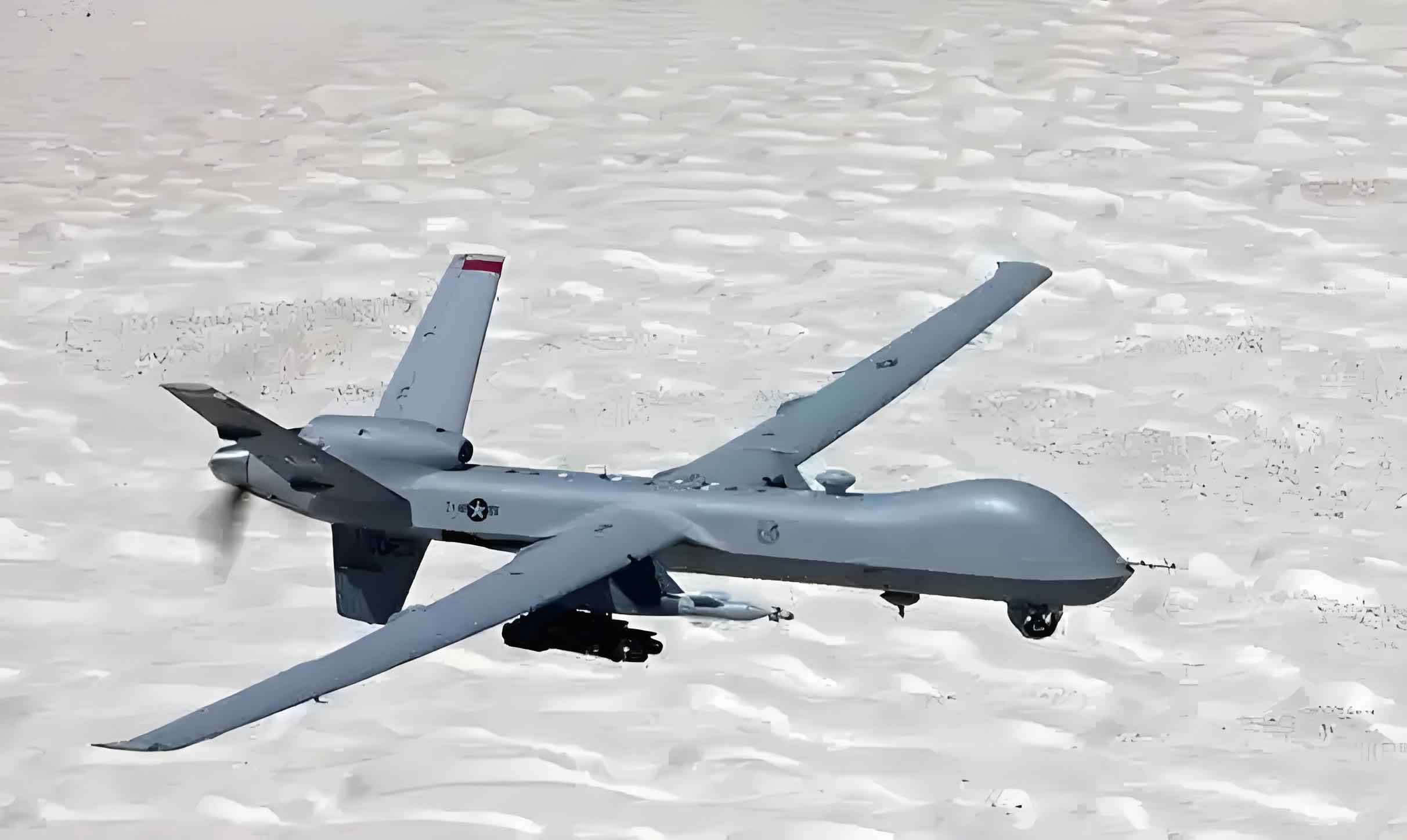
Massive MIMO configurations enable unprecedented spatial multiplexing for military UAV formations:
$$C = B \log_2 \left(1 + \frac{N_t N_r P}{\sigma^2}\right)$$
Where \(C\) = Channel capacity, \(B\) = Bandwidth, \(N_t\)/\(N_r\) = Transmit/receive antennas, \(P\) = Power, \(\sigma^2\) = Noise variance. This facilitates drone-to-drone communication density exceeding 1 million devices/km².
Network slicing creates dedicated virtual channels for distinct military drone functions:
$$\text{Slice}_\text{recon} = \{ \lambda_{\text{low-lat}} \oplus \beta_{\text{high-BW}} \}$$
$$\text{Slice}_\text{combat} = \{ \delta_{\text{ultra-rel}} \otimes \gamma_{\text{sec-enc}} \}$$
Enabling simultaneous ISR (Intelligence, Surveillance, Reconnaissance) and weapons deployment without cross-interface interference.
The symbiotic evolution between 5G and military UAV technology manifests through dual-directional enhancement. While 5G enables drone swarm coordination with sub-1ms latency critical for:
$$\Delta t_{\text{swarm}} < \frac{d_{\text{inter-drone}}}{v_{\text{max}}}$$
Conversely, military UAVs extend 5G coverage as aerial base stations (ABS) according to the coverage model:
$$R_{\text{ABS}} = \sqrt{ \frac{P_t G_t G_r \lambda^2}{(4\pi)^2 P_{\text{min}}} \cdot h_{\text{UAV}}$$
Where \(h_{\text{UAV}}\) = Operational altitude, demonstrating 78% coverage expansion in mountainous terrain simulations.
Technical maturation barriers include signal propagation constraints in millimeter-wave bands, expressed through atmospheric attenuation:
$$\alpha = \frac{0.0173f\sqrt{\epsilon”}}{\tan \delta} \left(1 + \left(\frac{\epsilon’ + 2}{\epsilon”}\right)^2 \right)$$
Where \(f\) = frequency, \(\epsilon’\)/\(\epsilon”\) = dielectric constants. Combined with power limitations reducing military drone loiter time to:
$$T_{\text{op}} = \frac{E_{\text{batt}}}{\eta(P_{\text{comm}} + P_{\text{sensors}} + P_{\text{prop}})} < 25 \text{ hours}$$
Future development vectors prioritize AI integration through distributed edge computing architectures:
$$\min_{x_i} \sum_{i=1}^N \left( \frac{\| \mathbf{w}_i – \mathbf{x}_i \|^2}{\sigma^2} + \lambda \| \mathbf{x}_i \| \right)$$
Optimizing processing distribution across drone networks while maintaining 1ms decision cycles for autonomous engagement.
Through these multidimensional advancements, 5G infrastructure and military UAV systems continue reciprocal enhancement cycles. The ongoing convergence promises battlefield networks achieving:
$$\mathcal{L}_{\text{battlenet}} = \bigcup_{i=1}^{\infty} \left( \text{UAV}_i^{\text{5G}} \otimes \text{C2}_{\text{AI}} \right)$$
Forming intelligent meshes where drone collectives operate as self-optimizing combat entities with exponentially growing capabilities.