
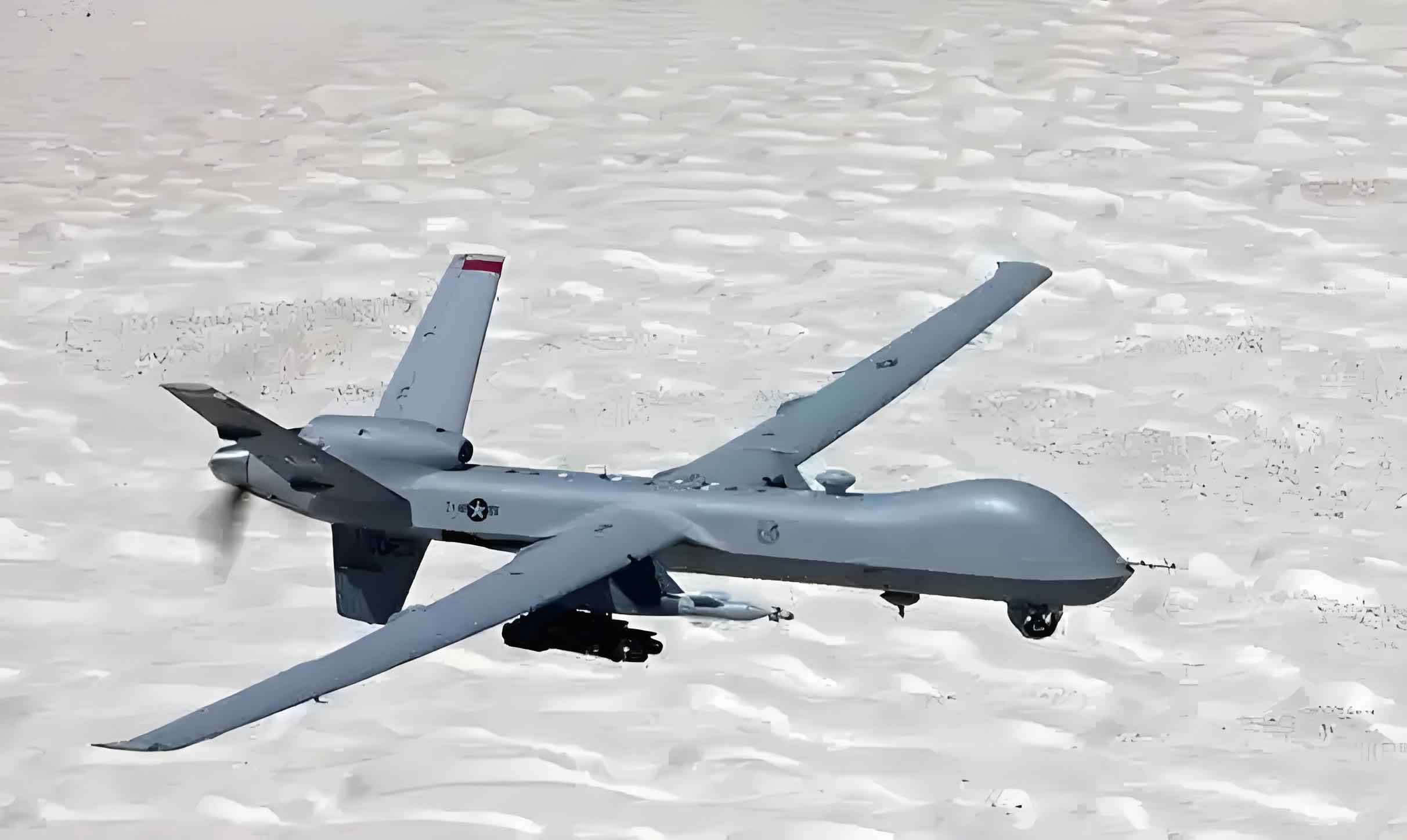
Military drones, formally termed Unmanned Aerial Vehicles (UAVs), represent aerial robotic systems revolutionizing combat paradigms. These sophisticated machines function as flying robots with autonomous capabilities, fundamentally altering battlefield dynamics across global conflicts. The 2020 Nagorno-Karabakh conflict demonstrated their devastating efficacy when Azerbaijan’s TB-2 military drones systematically eliminated Armenian armor, transforming once-dominant tanks into vulnerable targets. Similarly, the January 2020 targeted elimination of Qasem Soleimani by a US MQ-9 “Reaper” military UAV showcased precision strike capabilities through covert tracking and missile deployment.
Military UAVs exhibit distinct tactical advantages through three core characteristics:
$$
\begin{array}{c}
\text{Cost Efficiency} \\
\downarrow \\
\text{Reduced Risk} = \text{Minimized Personnel Exposure} \\
\downarrow \\
\text{Adaptive Deployment} = \int (\text{Stealth} + \text{Terrain Independence}) \, dt
\end{array}
$$
| UAV Classification | Primary Function | Operational Parameters |
|---|---|---|
| Surveillance/Reconnaissance | Intelligence gathering | High-altitude endurance (20+ hours) |
| Electronic Warfare | Signal jamming/deception | EM spectrum dominance |
| Combat Strike | Precision target elimination | Weapons payload capacity |
| Reconnaissance-Strike Integration | Real-time detect-destroy cycles | Sensor-weapon fusion systems |
| Communications Relay | Battlefield network extension | Secure data linking |
Control methodologies for military drones employ layered command structures:
1. **Direct Radio Control**: Short-range handheld systems
2. **Ground Control Stations (GCS)**: Command centers with satellite uplinks
3. **Orbital Networks**: Satellite-guided operations enabling global reach
The operational framework follows a closed-loop system:
– Ground Control Station (GCS) issues commands via radio/satellite
– UAV flight control system executes maneuvers
– Onboard sensors (LiDAR, IR, EO) collect environmental data
– Telemetry stream returned to GCS for analysis
– Updated commands transmitted to UAV
$$
\text{Command Latency} = \frac{\text{Processing Time} + \text{Signal Transit Time}}{\text{System Reliability}}
$$
Leading military UAV platforms demonstrate advanced capabilities:
| Platform | Max Altitude | Endurance | Payload | Key Capabilities |
|---|---|---|---|---|
| MQ-9 Reaper | 15,000m | 36h | 1,300kg | Multi-role strike/reconnaissance |
| Gray Eagle | 8,800m | 30h | 480kg | Synthetic aperture radar, EW suite |
| Hermes 450 | 9,000m | 24h | 150kg | All-weather ISR operations |
| CH-7 Rainbow | 13,000m | 15h | Classified | Stealth configuration, 920km/h speed |
| TB001 “Twin-Tailed Scorpion” | 8,000m | 35h | 1,000kg | 6,000km range, dual-engine |
Commercial platforms like DJI drones demonstrate dual-use adaptability in military contexts. Their compact design, imaging capabilities, and environmental resilience make them valuable for tactical reconnaissance, with modified versions deployed as micro-bombers. Specifications of militarized commercial UAVs:
$$
\text{Operational Effectiveness} = \frac{\text{Portability} \times \text{Sensor Resolution}}{\text{Detection Signature}}
$$
Drone swarm technology represents the frontier of military UAV development. China’s pioneering 48-unit launch systems demonstrate coordinated attack capabilities through AI-driven swarm intelligence. The mathematical foundation for swarm coordination involves distributed algorithms:
$$
f(\text{Swarm}) = \sum_{i=1}^{n} \left( \alpha \cdot \text{Position Sync}_i + \beta \cdot \text{Task Allocation}_i \right)
$$
Counter-UAV systems evolve alongside military drone technology. Traditional anti-aircraft artillery proves ineffective against high-altitude UAVs, while missile-based interception remains cost-prohibitive for small targets. Modern countermeasures employ:
– **Electronic Warfare**: Signal jamming and spoofing
– **Directed Energy**: Laser-based neutralization
– **Kinetic Interceptors**: Net-based capture systems
– **Cyber Warfare**: GPS spoofing and control hijacking
The drone-counterdrone dynamic follows an evolutionary pattern:
$$
\frac{d(\text{UAV Capability})}{dt} = k \cdot \frac{d(\text{Countermeasure Sophistication})}{dt}
$$
Military UAV proliferation continues to accelerate, with global exports dominated by cost-effective, multi-role platforms. Technological convergence points toward increased autonomy through machine learning integration, swarming capabilities, and hypersonic flight systems. As military drones become smaller, smarter, and deadlier, they redefine the fundamental principles of force projection and battlefield dominance.