
In recent years, the operational deployment of police drones has expanded significantly, necessitating the systematic training of qualified pilots. Drawing from my first-hand experience in managing and participating in such training programs, this article provides an in-depth analysis of the psychological and performance challenges faced by trainees. Using a structured, phase-based model, it identifies common issues and proposes a comprehensive management framework to enhance training efficacy and ensure the cultivation of a highly skilled police drone operator cadre.
The training curriculum for police drone certification is intensive and multifaceted, typically spanning several weeks. A standard program can be broken down into three macro phases: the Initial Foundational Learning Phase, the Mid-Term Core Skill Acquisition Phase, and the Final Assessment Preparation Phase. These can be further subdivided into five distinct psychological periods, as summarized in the table below.
| Macro Phase | Psychological Period | Typical Duration | Core Focus |
|---|---|---|---|
| Initial Foundational Learning | Curiosity & Excitement | Days 1-5 | Theory, Safety, Basic Simulator Training |
| Mid-Term Core Skill Acquisition | Stable Adaptation | Days 6-10 | Mastery of Flight Maneuvers (e.g., Pattern Flying) |
| Difficulty & Challenge | Days 11-15 | ||
| Fatigue & Plateau | Days 16-20 | ||
| Final Assessment Prep | Final Sprint & Pressure | Days 21-25 | Test Simulation, Precision Refinement, Certification Exam |
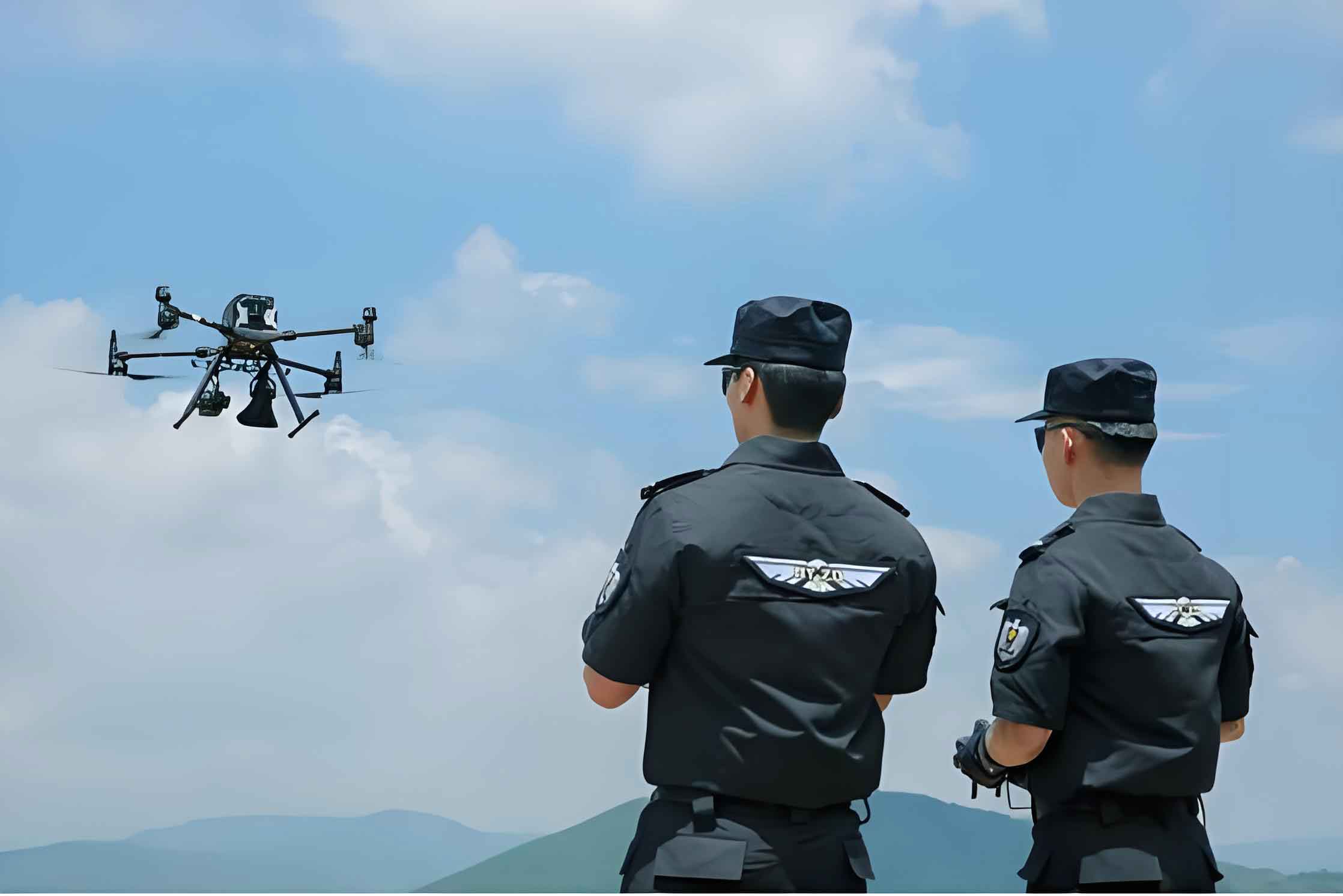
The progression of skill acquisition during police drone training often follows a non-linear trajectory. A common model to represent this is the learning curve, which can be approximated by a sigmoid function, indicating periods of rapid growth, plateau, and eventual mastery. The skill level \( S(t) \) over training time \( t \) can be conceptually modeled as:
$$
S(t) = \frac{S_{max}}{1 + e^{-k(t – t_0)}} + \epsilon(t)
$$
Where \( S_{max} \) is the maximum achievable skill level for the curriculum, \( k \) is the learning rate constant, \( t_0 \) is the inflection point, and \( \epsilon(t) \) represents performance variability due to psychological factors. The plateau period corresponds to a region where the derivative \( \frac{dS}{dt} \) is near zero, causing significant trainee frustration.
Phase 1: Initial Foundational Learning – The Curiosity & Excitement Period
Upon arrival, trainees enter a novel environment focused on a technologically advanced tool. The predominant emotions are curiosity and excitement, which are beneficial for initial engagement. However, three primary issues emerge during this phase for police drone trainees.
| Problem Category | Manifestation | Root Cause |
|---|---|---|
| Misperception of Training Nature | Viewing the course as a respite from regular duty; low prioritization. | Detachment from workplace pressures; lack of perceived immediate application. |
| Excessive Anxiety | Heightened nervousness, hesitation in early实操 sessions. | Awareness of operational risks (safety, privacy); late or involuntary assignment to the course. |
| Overconfidence | Underestimating the curriculum’s difficulty; dismissive attitude. | Prior casual experience with consumer drones; contrast with perceived complexity of regular police work. |
Phase 2: Mid-Term Core Skill Acquisition – Navigating Stability, Challenge, and Fatigue
This extended phase represents the core of police drone skill building and is where the most significant psychological dynamics unfold.
Period 2.1: Stable Adaptation
As the routine sets in, initial excitement wanes. Trainees become familiar with the schedule—theory review, prolonged flight drills, and simulated tests. The perceived monotony of repetitive pattern flying (e.g., horizontal ‘8’, rectangular orbits) can lead to diminished enthusiasm. Furthermore, the high-stakes nature of the final, externally evaluated certification exam becomes a tangible source of pressure, often reducing baseline confidence.
Period 2.2: Difficulty & Challenge
Advanced theory (e.g., aerodynamics, meteorology) and precise maneuver requirements create tangible hurdles. The emotional cost includes:
1. Homesickness: Intensified by封闭式管理 and prolonged absence from family.
2. Frustration: Stemming from inability to perfectly control the police drone in 3D space, especially during coordinated turns and altitude holds. Even previously experienced trainees struggle with the mandated precision.
3. Sense of Constraint: Caused by stringent safety protocols,警务化管理, and the physical remoteness of training bases, leading to latent stress.
Period 2.3: Fatigue & Plateau
This period is defined by the “learning plateau,” a critical concept in skill acquisition. Trainees invest effort but perceive no improvement in flight consistency or test scores. The performance variability term \( \epsilon(t) \) in the learning model becomes dominant. Key characteristics are:
- Skill Stagnation: Flight error rates remain constant despite practice.
- Mental Weariness: Loss of motivation, reduced peer interaction, and questioning of the utility of drill patterns.
- Behavioral Shifts: Resistance to administrative routines (e.g., slower assembly times), requests for altered schedules, reflecting a desire for autonomy.
The trainee’s perceived effectiveness, or self-efficacy \( E \), can be modeled as a function of recent performance success \( P \), perceived task difficulty \( D \), and mental fatigue \( F \):
$$
E = \alpha \cdot \log(P) – \beta \cdot D – \gamma \cdot F
$$
Where \( \alpha, \beta, \gamma \) are individual weighting coefficients. During the plateau, \( P \) stagnates, \( D \) remains high, and \( F \) increases, causing \( E \) to drop significantly.
Phase 3: Final Assessment Preparation – The Final Sprint & Pressure Period
In the final days, trainees operate near their peak skill ceiling. The primary challenge shifts from learning to optimal performance under evaluation pressure.
| Psychological State | Description | Potential Impact |
|---|---|---|
| Complex Ambivalence | Coexistence of pride in progress and acute anxiety about the impending exam. | Can be motivating or paralyzing. |
| Polarized Mindset | Divergence between confident, focused trainees and those impaired by anxiety. | Anxious trainees may underperform below their known capability level. |
| Catastrophic Anxiety | Excessive fear of failure, focusing on the professional and financial cost of not certifying. | Leads to insomnia, poor concentration, and erratic performance. |
A Systemic Management Framework for Police Drone Training
Effective management of a police drone training program requires proactive, phase-specific interventions targeting the cognitive, procedural, and psychological dimensions.
1. Cognitive Intervention: Proactive Pre-Training Guidance
Before the course begins, communication should set accurate expectations. This involves clearly outlining the rigor, safety rules, and assessment criteria. Showcasing past success stories and the tangible operational benefits of police drone competency can build positive motivation and mitigate initial anxiety or overconfidence.
2. Process Support: Dynamic Mid-Training Adjustments
Training must be responsive. This involves a balanced approach:
- Macro-Pacing with Micro-Support: Maintain the overall schedule but identify and provide remedial support (e.g., extra simulator time, one-on-one coaching) for struggling trainees to prevent them from falling behind.
- Contextualized Application: Integrate realistic scenario-based exercises (e.g., search patterns, simulated surveillance) to demonstrate the practical utility of drill maneuvers, thereby boosting engagement and purpose.
- Controlled Diversification: Introduce varied academic activities like guest lectures on airspace law or group discussions on police drone ethics to break monotony without compromising core skill time.
The optimal daily training load \( L_{opt} \) to maximize learning while minimizing burnout can be conceptualized as:
$$
L_{opt} = \frac{R \cdot (S_{max} – S(t))}{H + M(t)}
$$
Where \( R \) is the base learning rate, \( S(t) \) is current skill, \( H \) is inherent difficulty of the police drone tasks, and \( M(t) \) is cumulative mental fatigue. Trainers must intuitively or explicitly adjust \( L_{opt} \).
3. Assessment Preparation: Structured Pressure Management
The final phase requires meticulous preparation to convert training into certification success.
- Simulated Examinations: Frequent mock tests under exam conditions maintain “task-ready” mental and procedural sharpness, preventing complacency or overthinking.
- Psychological Buffering: Teach and encourage simple techniques like tactical breathing. Provide checklists for pre-flight checks and exam procedures to reduce anxiety stemming from uncertainty.
- Comprehensive Logistics: Ensure all police drone equipment is meticulously maintained and charged. Emphasize the importance of sleep and nutrition.
- Morale and Ritual: Use formal briefings, recognition of progress, and team-building rituals to foster a sense of shared purpose and confidence before the final test.
| Training Phase | Key Trainee Challenges | Recommended Management Interventions |
|---|---|---|
| Initial Foundation | Misperception, Anxiety, Overconfidence | Pre-course briefing; Clear framing of goals and challenges; Safety immersion. |
| Mid-Term Skill Build | Monotony, Frustration, Plateau, Fatigue | Blended training (drills + scenarios); Peer learning; Progress monitoring; Motivational activities. |
| Final Assessment | Performance Anxiety, Pressure, Burnout | High-frequency simulation; Stress inoculation training; Operational support; Confidence-building rituals. |
In conclusion, the path to certifying a competent police drone operator is as much a psychological journey as a technical one. Trainees navigate predictable periods of excitement, struggle, stagnation, and pressure. A successful training regimen recognizes these dynamics explicitly. By implementing a structured framework that combines clear expectation-setting, responsive and applied training methods, and proactive psychological support, training institutions can significantly elevate pass rates, enhance skill retention, and ultimately contribute to deploying more effective and resilient police drone units for modern law enforcement and public safety missions. Future research should longitudinally track the operational performance of graduates to validate and refine these phase-based management strategies.