
Helicopter-military UAV cooperative combat represents a pivotal advancement in modern warfare, enabling synergistic capabilities where manned platforms serve as command nodes while military drones act as force multipliers. This paradigm enhances intelligence, surveillance, reconnaissance (ISR), and precision strike capabilities while significantly reducing operator workload. The U.S. Army’s three-decade investment in Manned-Unmanned Teaming (MUM-T) has yielded transformative tactical advantages validated in combat operations.
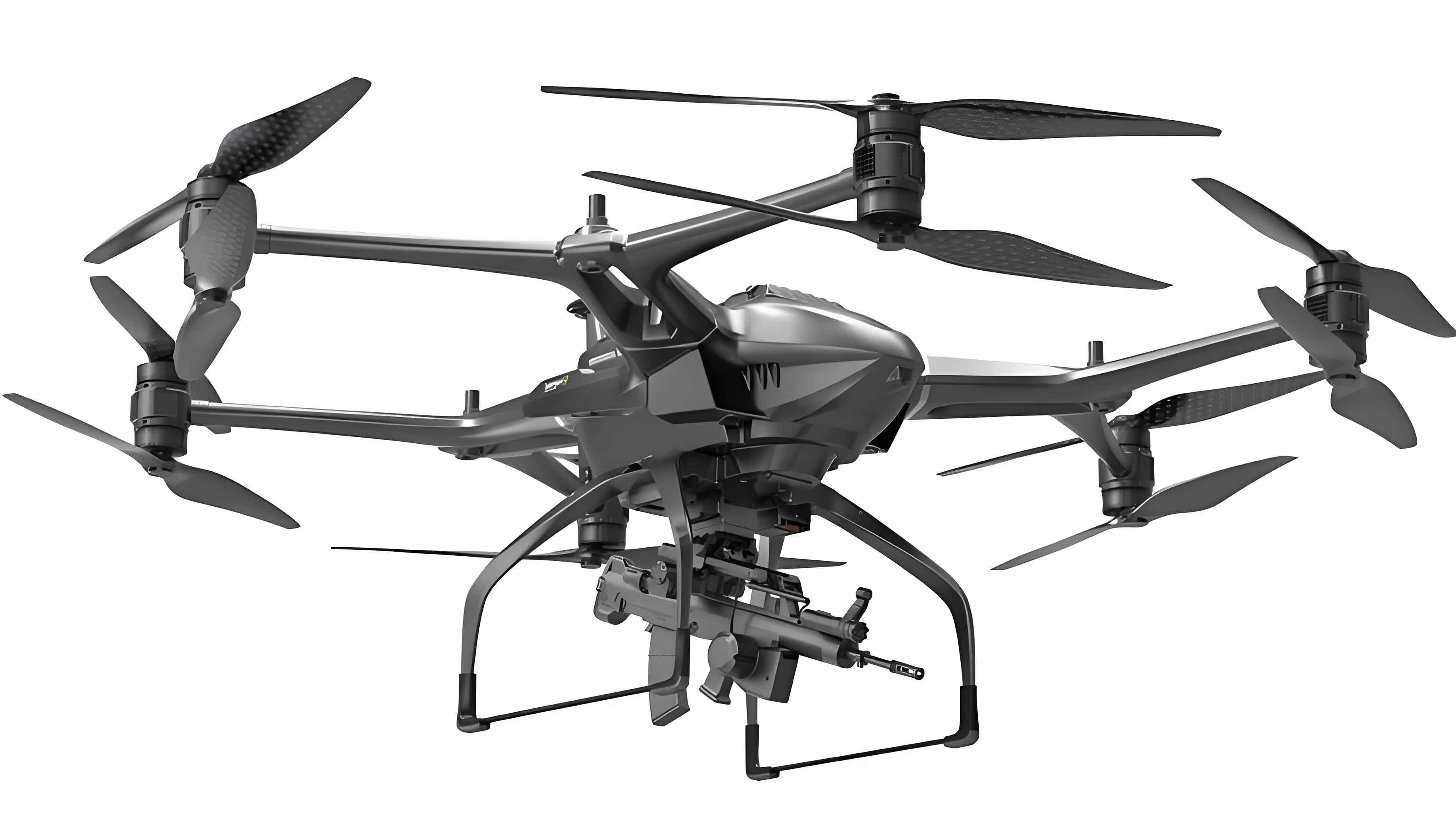
Research and Development Evolution
The U.S. Army Aviation and Missile Research, Development, and Engineering Center (AMRDEC) initiated MUM-T research in 1993 through the Air Maneuver Battle Lab. Four sequential concept assessments (MUM I-IV) established core operational frameworks:
| Program | Period | Key Contributions | Platforms |
|---|---|---|---|
| MUM I-IV | 1996-2001 | Tactics/Procedures (TTPs) development, simulation validation | RAH-66 simulator |
| AMUST-D | 2000-2006 | Live-flight integration, Rotorcraft Pilot Associate algorithms | AH-64D, UH-60, RQ-5 |
| HKST | 2005-2008 | Sensor/Data-link enhancements, time-sensitive targeting | AH-64D, MQ-5 |
| MUSIC | 2011 | Multi-platform interoperability demonstration | 6+ air vehicles |
| Advanced Teaming | 2020-2024 | AI-driven mission autonomy, cognitive workload reduction | Future Vertical Lift |
Critical breakthroughs emerged during the Airborne Manned-Unmanned System Technology Demonstration (AMUST-D), where AH-64D Apache helicopters demonstrated control of RQ-5 Hunter military drones. The Rotorcraft Pilot Associate (RPA) system reduced cognitive load through:
$$ \text{Workload Index } \alpha = \frac{\sum_{i=1}^{n} T_i \cdot C_i}{A_t} $$
Where \(T_i\) = task complexity, \(C_i\) = context switching frequency, and \(A_t\) = autonomy level. This enabled single-pilot management of multiple military UAV assets.
Combat Validation and Operational Integration
Afghanistan deployments (2015+) demonstrated three primary MUM-T combat methodologies:
| Tactical Approach | Military Drone Role | Engagement Range | Effectiveness |
|---|---|---|---|
| Triangulated Strike | 3x UAVs for geolocation | >15 km | 60% mission success |
| Terrain-Masked Attack | High-altitude targeting | 5-8 km | Survivability +40% |
| Coordinated Recon-Strike | Forward ISR + designation | 20-50 km | Engagement time -75% |
The 2020 AH-64E/RQ-7B/MQ-1C integrated strike validated multi-domain convergence. Here, sensor-to-shooter timelines followed:
$$ T_{kill-chain} = \frac{D_{UAV-target}}{V_{data}} + \frac{D_{Apache-UAV}}{V_{weapon}} + \delta_{human} $$
Where \(\delta_{human}\) = decision latency, minimized through Level 4 control interfaces. This architecture enabled:
- 50km standoff reconnaissance via military UAV
- Laser designation by RQ-7B drone
- Precision engagement by MQ-1C-launched effects
Core Technological Enablers
Autonomy Architecture
Military UAV autonomy requires layered functionality for MUM-T effectiveness. The SCOURCH framework enables single-operator control of three drones through:
$$ \text{Autonomy Score } \beta = \sum_{i=1}^{6} W_i \cdot F_i $$
Where weights \(W_i\) prioritize six capabilities:
- Mission planning: \( F_1 = 1 – \frac{\text{Re-plans}}{\text{Waypoints}} \)
- Collaborative management: \( F_2 = \frac{\text{Shared tasks}}{\text{Total tasks}} \)
- Contingency response: \( F_3 = e^{-\lambda t_{response}} \)
- Situational awareness: \( F_4 = \frac{\text{Correct threat ID}}{\text{Total threats}} \)
- Communications management: \( F_5 = \frac{\text{Active links}}{\text{Required links}} \)
- Vehicle management: \( F_6 = \frac{\text{Auto-configured systems}}{\text{Total systems}} \)
Human-Machine Interface
Kutta’s MUM-T Toolkit revolutionized pilot interaction through templated tasking:
| Interaction Mode | Operator Input | Military UAV Response | Cognitive Load |
|---|---|---|---|
| Stare-At | Single map click | Autonomous orbit planning | Low (0.2 NASA-TLX) |
| Stare-From | Click-drag vector | Terrain-relative positioning | Medium (0.3) |
| Follow-and-Track | Target selection | Continuous pursuit | Medium (0.35) |
| Route/Area Survey | Boundary definition | Optimal path computation | Low (0.25) |
Data Link Systems
The MUMT-X system enables AH-64E control of multiple military drones through multi-band connectivity. Channel capacity follows Shannon-Hartley theorem:
$$ C = B \log_2\left(1 + \frac{S}{N}\right) $$
Where \(B\) = 40MHz bandwidth across Ku/C/L/S bands, enabling:
- Bi-directional Ku-band: 10-15 Mbps (sensor feeds)
- C-band: 2-4 Mbps (telemetry)
- L/S-band: 0.5-1 Mbps (command/control)
This provides < 200ms latency for time-critical military UAV operations.
Operational Impact and Future Trajectory
Field Manual FM 3-04 institutionalizes MUM-T across five mission domains:
- Reconnaissance: Military UAV forward deployment reduces helicopter exposure by 70%
- Target Acquisition: Drone-based sensors increase detection range 3x
- Precision Strike: Cooperative engagements raise first-round hit probability to >92%
- Battle Damage Assessment: Real-time military UAV video accelerates re-attack decisions
- Electronic Warfare: UAV payloads create standoff jamming envelopes
The Advanced Teaming initiative (2020-2024) focuses on AI-driven autonomy:
$$ \text{Team Intelligence } \Gamma = \frac{\sum \text{Shared situational awareness}}{\text{Platforms} \times \text{Threat complexity}} $$
Future developments prioritize:
- Swarming algorithms for military drone teams
- Predictive analytics for threat avoidance
- Adaptive autonomy level management
- 5G-enabled distributed processing
These advancements will further cement military UAV integration as the cornerstone of Army Aviation’s combat effectiveness, reducing sensor-to-shooter timelines to under 60 seconds while maintaining human oversight for ethical engagement.