
The evolution of modern Intelligent Traffic Management Systems (ITMS) represents a paradigm shift from isolated signal control to a closed-loop, intelligent management framework characterized by “Perception—Analysis—Decision—Execution.” According to national development plans, the target is to achieve widespread deployment of intelligent traffic management platforms, with goals set for real-time data collection, automatic event identification, and intelligent decision support. Within this transformative landscape, the police drone is undergoing a critical transition from a “point-application tool” to an integrated “key node” within the system.
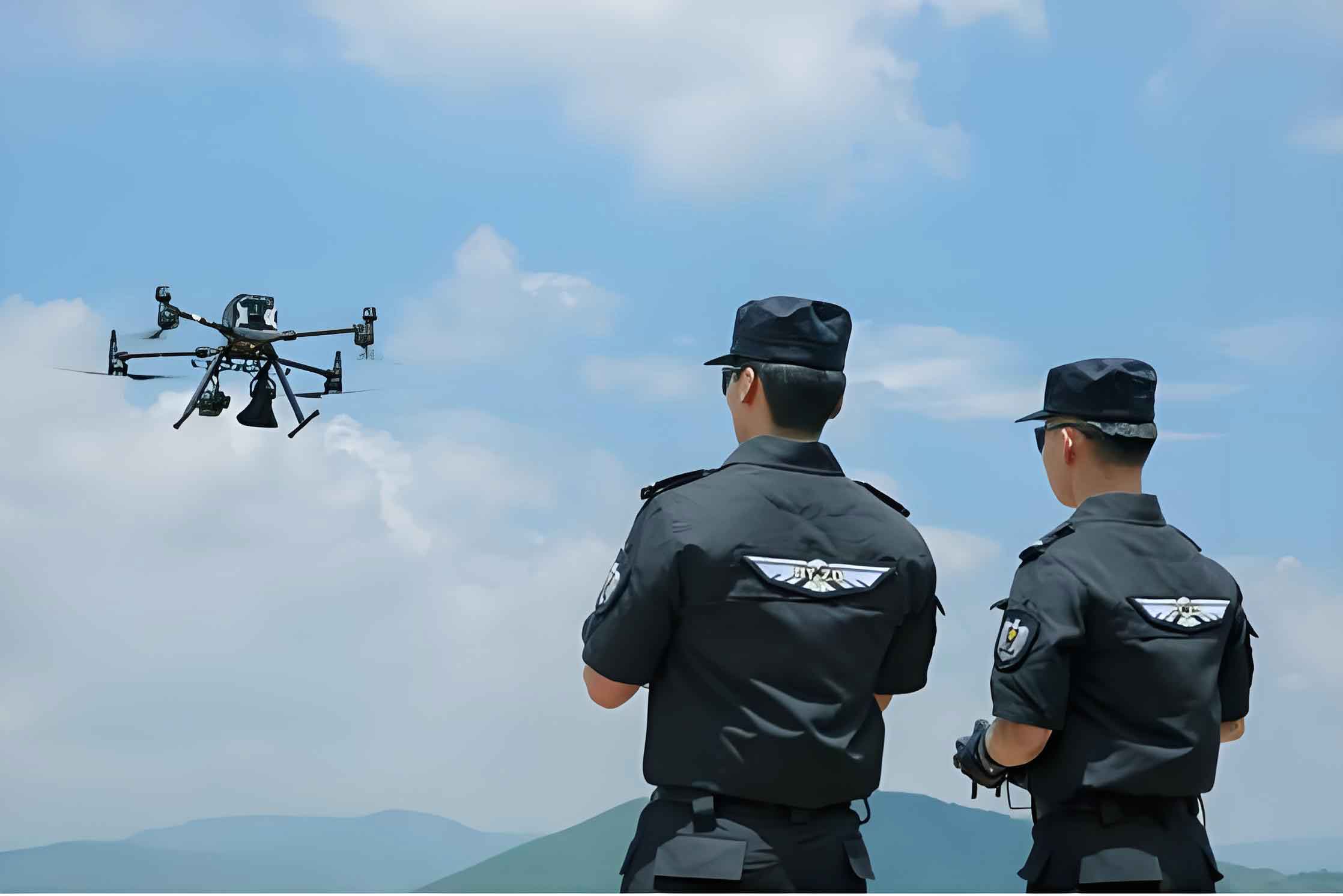
The Logical Starting Point for Innovating the Red vs. Blue Teaching Model
Deep Integration of ITMS Development and Police Drones
Technological Characteristics and Development Trends of ITMS
The ITMS operates as a synergistic whole. At the Perception layer, police drones, equipped with multi-spectral sensors, act as mobile terminals to collect real-time data on congestion, incidents, and pedestrian flow, effectively covering blind spots of fixed surveillance. The Analysis layer utilizes AI algorithms to process this data for violation detection and trend prediction. The Decision layer interfaces with the central ITMS platform to generate traffic疏导 plans and optimize signal timing. Finally, at the Execution layer, police drones can directly intervene in traffic flow via auditory or visual cues. This闭环 can be summarized by the functional relationship:
$$ E_{sys} = f(P_{drone}(S, L), A_{AI}(P), D_{platform}(A), X_{drone}(D)) $$
where $E_{sys}$ is overall system efficacy, $P_{drone}$ is the drone’s perception function dependent on Sensors (S) and Location (L), $A_{AI}$ is the AI analysis of perception data, $D_{platform}$ is the platform’s decision based on analysis, and $X_{drone}$ is the drone’s execution of those decisions.
| ITMS Development Phase | Core Feature | Police Drone Role |
|---|---|---|
| Initial (Isolated Systems) | Basic signal control, limited surveillance | Independent aerial camera; simple reconnaissance |
| Intermediate (Connected Systems) | Data integration from fixed points (cameras, loops) | Mobile data补充 node; basic event reporting |
| Advanced (Intelligent闭环) | “Perception-Analysis-Decision-Execution” loop | Integrated mobile node for perception & execution; part of the decision-making chain |
Efficacy Leap of Police Drones in ITMS
The police drone‘s role has fundamentally changed. During peak hours, drone clusters can be rapidly deployed to congestion nodes, feeding live video to command centers and aiding dynamic疏导 strategy formulation. Post-incident, drones can arrive on scene within minutes, autonomously capturing panoramic imagery, classifying the incident, and pushing structured data to the ITMS platform, significantly shortening处置 time. In emergency response, drones can scout ahead for emergency vehicles, clearing “life channels.” For large-scale event security, they enable an “air-ground integrated” command system for precise crowd management. The performance metrics of a modern police drone fleet can be described by a composite capability index $C_{fleet}$:
$$ C_{fleet} = \alpha \cdot R_{coverage} + \beta \cdot D_{speed} + \gamma \cdot AI_{acc} + \delta \cdot S_{synergy} $$
where $R_{coverage}$ is area coverage rate, $D_{speed}$ is data transmission speed, $AI_{acc}$ is AI recognition accuracy, $S_{synergy}$ is system协同 score, and $\alpha, \beta, \gamma, \delta$ are weighting coefficients reflecting ITMS priorities.
Misalignment Between Traditional Teaching Models and ITMS Demands
Disconnection Between Teaching Content and Practical Scenarios
Current police drone instruction exhibits significant shortcomings. Theoretical teaching overemphasizes basic aerodynamics and piloting skills, neglecting crucial knowledge about ITMS platform interfaces and data standards. Flight training often occurs in confined spaces under ideal conditions, failing to simulate real-world complexities like electromagnetic interference or adverse weather. The assessment system prioritizes operational proficiency, overlooking core ITMS metrics such as data transmission quality and systemic协同 capability.
Unique Challenges of ITMS Scenarios
The ITMS environment presents novel challenges: high demand for multi-source data fusion (drone feed with data from gantries, probe vehicles), stringent real-time requirements for incident response, complexity in system协同 (with traffic lights, electronic police), and elevated safety risks (flying in dense urban areas with interference and obstacles). Traditional teaching models are ill-equipped to cultivate trainee competence for these challenges, necessitating a practice-oriented pedagogical overhaul.
Innovative Design of Police Drone Instruction within the ITMS Framework
Instructional Phase Design: ITMS-Oriented Tiered Competency Development
| Teaching Stage | Core Objective | Key Content/Activity | ITMS Integration Focus |
|---|---|---|---|
| Theoretical Foundation | Build cross-domain cognitive framework | Drone-ITMS协同 logic; data security regulations; ITMS tactical principles (e.g., 5-min response protocol, AI-assisted incident typing, dynamic疏导 planning) | 从 “Technology” to “Technology + Traffic Business” knowledge structure. |
| Red vs. Blue Confrontation | Develop operational & tactical skills in simulated ITMS scenarios | Tier 1: Individual skills (adverse weather landing, tracking moving vehicles with plate recognition). Tier 2: Team-based, multi-drone协同 against simulated system attacks (GPS spoofing, fake congestion data).蓝方 executes real tasks (event security), forming “drone discovery—platform dispatch—ground force response”闭环. |
Transition from individual piloting skill to systemic operational capability within the ITMS workflow. |
| Real-Scene Validation | Verify competency in live traffic environments | Trainees deployed to ITMS frontline posts (e.g., peak hour疏导, accident investigation). Role: police drone operator协同ing with signal controllers, traffic officers. Key performance data (response time, data quality,协同 efficiency) is fed back to teaching system. | Closes the “Teaching—Practice—Optimization” loop with real-world data. |
Mode Innovation Design: A Virtual-Physical Fusion Training System for ITMS Confrontation
The system is built on deep协同 between virtual simulation and physical training grounds.
Virtual Simulation Layer: Utilizes 3D modeling, traffic big data, and AI to create high-fidelity training environments, dynamically fed with real-time city traffic data flows. It generates实战 scenarios like morning peak congestion. The Red team can employ attacks like “signal interference.” AI intelligently assesses the Blue team’s decision paths and outputs quantifiable scores tied to ITMS KPIs (e.g., response时效 $T_{resp}$, data回传完整度 $Q_{data}$):
$$ Score_{virtual} = w_1 \cdot (1 – \frac{T_{resp}}{T_{max}}) + w_2 \cdot Q_{data} + w_3 \cdot C_{route} $$
where $C_{route}$ evaluates the coverage efficiency of the drone’s patrol path against key traffic nodes, and $w_i$ are weights. This layer supports massive concurrent training and feeds data back to optimize ITMS prediction models.
Physical Training Layer: Consists of real ITMS实训 bases on closed roads, integrated with actual traffic devices (smart signals, V2X terminals) and Red vs. Blue apparatus (jamming guns, movable obstacles). A typical training flow: Trainee操控s a police drone for “rapid incident处置” → drone streams video to ITMS platform → platform auto-generates疏导 plan → trainee adjusts drone行动 accordingly. This layer validates virtual training and reinforces muscle memory for ITMS operations.
Hybrid Training Value: The virtual layer addresses “high-frequency, low-cost” foundational training, while the physical layer tackles “real-traffic-environment adaptability.” They connect via a data middleware, forming an ITMS-specific “Train—Feedback—Optimize”闭环.
Constructing High-Immersion Confrontation Scenarios with 5G and Metaverse Technologies
Leveraging 5G’s high bandwidth/low latency and metaverse concepts (VR/AR/MR) enables deeply immersive Red vs. Blue scenarios.
City-Level Digital Twin Construction
Based on a City Information Modeling (CIM) platform, a high-precision digital twin of urban traffic is built. 5G+ edge computing ($E2E latency < 20ms$) ensures real-time transmission of police drone control commands and rapid response.
MR Training Environment
- VR Immersive Training: Trainees in VR headsets control drones within virtual cities.
- AR-Assisted Practical Training: AR glasses overlay digital info (virtual traffic flow, signal status) onto real training grounds.
- MR协同演练: Virtual Red forces confront real Blue forces in a mixed environment, forcing Blue to enhance emergency response.
Technical Value Proposition
This approach enhances realism and safety, reduces costs and civic disruption, enables data-driven instruction optimization, and facilitates cross-regional协同 training. It elevates police drone practical teaching, cultivating new-era law enforcement talent with digital literacy for the ITMS.
Empirical Analysis and Case Study
Experimental Design
A controlled experiment was conducted with two groups of police drone trainees from a provincial police college.
- Control Group (Traditional Teaching): 30 trainees. Focus on theory and basic flight ops; no ITMS scenario simulation.
- Experimental Group (Red vs. Blue): 30 trainees. Taught using the integrated “Teaching-Research-Training-Operation” model with Red vs. Blue, covering ITMS theory, simulated confrontation, and practical application.
- Duration: 120 instructional hours for both groups. No significant pre-existing differences (p>0.05).
A multi-dimensional assessment指标体系 was employed:
| Assessment Dimension | Specific Metrics | Measurement Method |
|---|---|---|
| Task Completion Efficiency | Completion Rate ($R_{comp}$), Average Time Cost ($T_{avg}$) | Statistics on predefined tasks (e.g., target search, area monitoring) |
| Tactical Decision Accuracy | Correct Choice Rate ($R_{correct}$), Emergency Response Speed ($S_{resp}$) | Expert evaluation based on confrontation outcomes |
| Data Transmission Quality | Data Completeness ($C_{data}$), Real-timeliness, Accuracy | Evaluation of drone data匹配度 with ITMS platform (video clarity, geo-accuracy) |
| System协同 Capability | Multi-device联动 Efficiency ($E_{link}$), Information Sharing Quality | Observation of drone协同 with signals, e-police, etc. |
| Team Collaboration Level | Communication Efficiency, Role Rationality,协同 Degree | Behavioral observation & task outcome synthesis |
Typical Case & Analysis: Urban Peak Hour Traffic疏导 Confrontation
Scenario: Simulated morning peak (7:00-9:00) on a city arterial road.
Blue Team (Response): Use a police drone cluster for dynamic monitoring and疏导.
Red Team (Adversary): Simulate various disruptions: a 3-vehicle pile-up causing paralysis, signal light failure, electromagnetic interference affecting drone comms, movable obstacles mimicking illegally parked vehicles.
Training Flow: Warning (drone detects anomaly) → Response (Blue activates预案, dispatches drones) →处置 (drones monitor, feed platform, platform generates plan) → Recovery (drones guide flow恢复).
Data Analysis and Conclusions
1. Significant Enhancement of ITMS Practical Capabilities:
| Metric | Experimental Group (Red vs. Blue) Mean (SD) |
Control Group (Traditional) Mean (SD) |
t-value | p-value | Effect Size (d) |
|---|---|---|---|---|---|
| Task Completion Efficiency ($R_{comp}$, %) | 91.5 (4.8) | 73.2 (7.9) | 5.17 | <0.001 | 1.35 |
| Traffic Data Completeness ($C_{data}$, %) | 88.7% | 65.3% | 4.92 | <0.001 | 1.28 |
| System协同 Capability Score | 89.3 (3.1) | 70.5 (6.8) | 6.24 | <0.001 | 1.62 |
| Team Collaboration Score | 92.1 (3.6) | 76.4 (6.2) | 6.03 | <0.001 | 1.52 |
Conclusion: The Red vs. Blue model significantly提升s core ITMS competencies, especially in data-driven decision-making and system协同 efficiency. The traffic data completeness metric improved by approximately:
$$ Improvement_{C_{data}} = \frac{88.7 – 65.3}{65.3} \times 100\% \approx 35.8\% $$
This provides higher quality data input for the ITMS platform.
2. Training-Exposed Shortcomings & ITMS Improvement Directions: The confrontations revealed technical gaps: 5G signal handover delays (~2.3s) in dense urban areas causing video lag; weak multi-source data fusion capability; insufficient edge computing support (real-time event detection accuracy ~76.5%). This informed clear improvement vectors: industry-side development of lightweight edge AI modules (target accuracy ≥90%); teaching-side addition of “ITMS Data Interface Development” courses; mechanism-side promotion of公安-traffic department data sandbox environments. This forms a positive ITMS cycle: “Training exposes problems → Technology iterates → Teaching upgrades.”
Multi-Dimensional协同 Optimization Path: Technology, Instructors, and Mechanism
Implementation Challenges
- Technical Cost & Simulation Platform Development Difficulty: High R&D costs and complexity in integrating 5G, edge computing, traffic big data, and digital twin technologies to create realistic platforms compatible with regional ITMS systems.
- Instructor Shortage in Adversarial Teaching Experience: Current instructors often lack frontline ITMS实战 experience and proficiency in guiding effective Red vs. Blue对抗 training.
Optimization Pathways
- Industry-Education Collaboration for Cost-Effective Simulators: Deep partnerships between police academies, drone firms, and tech companies to co-develop lightweight hybrid simulation systems focused on ITMS scenarios. Companies contribute 5G/edge tech; academies provide real traffic datasets and teaching feedback.
- Establishing a “Dual-Qualified + ITMS Expert” Composite Instructor Team:
- Technical Expert: From industry, strengthens ITMS tech stack knowledge (AI prediction models, sensor fusion).
- Practical Officer: Frontline traffic police, impart tactical decision logic for traffic scenes.
- ITMS Specialist: From traffic planning/management, guides business logic and data闭环 design.
A三维协同 teaching mechanism is established, integrating “Technology—Tactics—Business” to solve the teaching-practice disconnect.
Ecological Leap from Confrontation Training to Operational Policing Capability
Constructing the Red vs. Blue-Centric Practical Teaching Mode for Police Drones
This mode deeply integrates with ITMS workflows through team对抗 and role-playing. The Red team simulates system attacks, forcing trainees to understand vulnerabilities. The Blue team must operate based on the real (or realistic) ITMS platform, pushing data to command centers and dynamically adjusting tactics based on feedback. Post-training, systems auto-generate KPI-linked assessment reports and feed training data back to optimize ITMS algorithms. This not only fosters competitive spirit but also transforms teaching outcomes into ITMS optimization inputs, achieving dual闭环 fusion: “Teaching-Research-Training-Operation” with “Perception-Analysis-Decision-Execution.”
Future Directions
- Policy Support & Cross-Regional Red vs. Blue League Mechanism: Advocate for dedicated funding and establish national跨区域对抗 leagues to promote the model through competition.
- Expansion to Multi-Police-Branch协同 Operations Training: Extend the model to joint exercises involving traffic police, SWAT, and criminal investigation units using police drones, simulating cross-branch command, information sharing, and协同 operations to cultivate comprehensive joint operational capabilities适应 modern policing needs.
Research Conclusion
The constructed Red vs. Blue-based integrated practical teaching model for police drones has been validated through teaching practice, demonstrating significant effectiveness. It effectively compensates for the lack of实战化和对抗性 in traditional teaching, allowing trainees to accumulate experience in highly simulated adversarial environments, markedly enhancing their problem-solving skills in实战. It represents an effective path to破解 the “training-operation disconnect” in police drone instruction. Simultaneously, by linking teaching, research, training, and operation through adversarial exercises, it achieves an upgraded闭环 talent cultivation model, providing a successful paradigm for reform in public security education.
Conclusion and Outlook
This study constructs a Red vs. Blue-based integrated practical teaching system for police drones within the ITMS development context. Through theoretical framing, mode innovation, and empirical research, we conclude:
- Instructional Model Innovation Value: The Red vs. Blue model effectively addresses the disconnect between traditional teaching and ITMS实战, significantly提升ing trainee performance in core metrics like task efficiency, data quality, and system协同, with a 35.8% improvement in data completeness.
- Technology Fusion Innovation Path: The integration of 5G, metaverse, and edge computing构建s a high-immersion, virtual-physical training environment that ensures realism while reducing costs.
- Ecological Development Paradigm: The model fosters an ecological leap, forming a positive “expose-iterate-upgrade” cycle that promotes continuous ITMS optimization.
Future research may explore swarm intelligence algorithms for police drones in complex traffic scenes, deeper integration paths with vehicle-infrastructure协同 systems, and the construction of LLM-based decision support systems for ITMS. This study provides a replicable and scalable practical paradigm for cultivating police drone talent within the ITMS framework, holding significant reference value for modernizing public security education and enhancing road traffic safety governance capabilities.