
In recent years, the integrative “Post-Course-Competition-Certificate” education model has emerged as a pivotal reform in cultivating technical and skilled talents. From my perspective as an educator deeply involved in this field, this model represents a fundamental shift in pedagogical philosophy. It aligns educational outcomes directly with societal trends, professional post requirements, and the comprehensive competency development needed for personal career growth. For training institutions, particularly those nurturing future police personnel, this model serves as a crucial mechanism for deepening industry-education integration and fostering innovative, application-oriented professionals.
The accelerating wave of technological revolution is fundamentally reshaping policing paradigms. The generation and enhancement of new qualitative police capabilities are increasingly dependent on industrial support and technological empowerment. For academies tasked with police talent development, cultivating specialized, compound, and application-oriented personnel who meet the demands of modern policing is a pressing, contemporary challenge. As the primary vehicle for police education, professional courses must bridge the gap between academic instruction and the evolving needs of the industry and profession. The central question we face is: how can courses be truly designed for the required posts, for building essential capabilities, and to genuinely engage students? This article, drawing from my firsthand experience, explores the teaching reform practices under the “Post-Course-Competition-Certificate” model, using the “Police Drone Reconnaissance Technology and Application” course as a case study. It aims to provide a reference for similar curriculum development and talent cultivation in related domains.
The Connotation of the “Post-Course-Competition-Certificate” Model for Police Drone Curriculum Reform
This integrative model is a response to the new demands of industrial transformation for high-level technical talent. For police drone courses, its significance is threefold, as summarized below:
| Element | Core Principle | Educational Impact |
|---|---|---|
| Post | Course determined by Post requirements. | Enhances targeting of talent cultivation, improving job-role adaptation and meeting frontline police drone personnel needs. |
| Competition | Course promoted by Competition. | Transforms teaching methods, stimulates student initiative and competitive spirit, shifting mindset from passive to active learning. |
| Certificate | Course integrated with Certificate standards. | Promotes resource consolidation, enables effective collaborative education between schools and enterprises, and enhances the practicality of training. |
First, it sharpens the focus on the course’s service orientation, strengthening the targeted nature of talent development. By aligning the course with the needs of police drone-related posts, we can design curriculum content based on the specific departments graduates will join and the competencies they require. This creates a “tailor-made” professional course that significantly improves job readiness. Second, it drives the transformation of teaching methodologies, elevating student agency. Infusing course content with resources from various police drone skill competitions and employing competitive, adversarial teaching modes actively engages students. This process of demonstration and skill切磋 fosters a learning atmosphere of mutual借鉴 and healthy competition, transforming the student mindset from “I am told to learn” to “I want to learn.” Third, it facilitates the integration of educational resources, enhancing the effectiveness of collaborative education. By incorporating the training content and assessment standards of professional police drone skill certificates into the course syllabus, we can effectively merge academic resources with social educational resources. This synergy promotes genuine school-enterprise cooperation in curriculum co-development, unifying the “industry field” and the “education field,” thereby shortening the distance between academia and professional practice.
Pain Points in the Teaching Practice of “Police Drone Reconnaissance Technology and Application”
As a relatively new course launched against the backdrop of rapid industry growth and expanding police application, this course relies heavily on practical post guidance, vocational skill standards, and industrial resource support. From my experience, the teaching practice has encountered several persistent challenges due to insufficient depth in application research and a lack of accumulated teaching resources.
Mismatch Between Course Design and Post Requirements
1. Lack of Foresight in Teaching Philosophy: The teaching often focuses on summarizing existing principles and patterns—what police drones currently do—while neglecting前瞻性 content. We fail to adequately explore how police drone reconnaissance technology might evolve, what new operational scenarios it may suit, and how it could颠覆 existing policing models. This滞后性 weakens the course’s longevity and relevance.
2. Insufficient High-Order Course Objectives: The course goals often lack a cohesive system, with knowledge, skill, and quality objectives treated as relatively independent points without hierarchical progression. The challenge level is typically low, stopping at basic knowledge and operational skills rather than addressing complex problem-solving and advanced thinking. Furthermore, objectives are often vaguely described (e.g., “master” something) instead of specifying concrete, measurable outcomes (e.g., “able to perform” a specific task), lacking a clear output orientation.
3. Lack of Specialized, Practical Content: There’s a tendency towards “setting courses based on instructor expertise.” Without deep prior understanding of police drone applications in police work, course content overemphasizes general drone technology and skills (the “technique”) at the expense of integrating reconnaissance technology with real police operations (the “application”).
Inadequate Support from Educational Resources
1. Scarcity of Teaching Materials: Being a new course, it lacks a rich repository of basic documents and auxiliary resources. Effective instructional design—whether case-based teaching requiring numerous经典战例 or blended learning requiring abundant online resources—is difficult to advance without this foundation.
2. Weak Teaching Faculty: The interdisciplinary nature of the course, spanning engineering (control, communications) and policing (operations, command), poses a challenge. Instructors often have expertise in only one area. Additionally, effective practical training requires instructors to be both skilled pilots and experienced trainers. A shortage of certified police drone教官 severely limits the capacity for high-quality practical instruction.
3. Outdated Training Conditions: Heavy reliance on traditional outdoor flight training is inefficient. It is constrained by airspace regulations, weather, and safety concerns, leading to minimal hands-on time for students. For instance, in a 20-hour practical module, each student might average less than 30 minutes of actual flight time. This poor experience dampens enthusiasm and hinders practical skill development.
Poor Adaptability of Teaching Modes to Learners
1. Fixed Teaching Methods: Over-reliance on one-way lectures, even with engaging content, fails to引导 students into deep classroom participation. This leads to superficial interest without cultivating deeper thinking or capability training.
2. Learning Confined to Class: Teaching often stops when class ends, neglecting the cultivation of self-directed learning habits. The vast scope of knowledge covering drone tech, police business, and tactics cannot be covered in class alone. This over-dependence on in-class guidance stifles the development of independent learning capacity.
3. Lack of Individualization: Practical police drone training demands high levels of hand-eye coordination, quick反应, spatial awareness, and心理素质. Individual differences are significant, yet uniform training进度 and methods are typically applied, widening the gap between students and failing to address individual learning needs.
4. Single Assessment Form: Heavy reliance on summative final exams, with “usual performance” as a vague process evaluation, is common. This approach lacks objectivity and comprehensiveness. It fails to provide multi-angle feedback on the learning process or enable real-time optimization of teaching and learning strategies.
Reform Practice: “Post-Course-Competition-Certificate” Integration in Action
This model is a new exploration of how police education can coordinate societal educational resources. It breaks down barriers between enterprises and schools, industry and profession, and integrates resources from industry, enterprises, universities, and training organizations. The course reform serves as the carrier for innovating the talent cultivation model, aiming to develop high-quality technical police talent that meets industrial and professional demands.
Course Determined by Post: Precise Alignment with Talent Needs
1. Output-Oriented, Backward Design of Objective Framework: We start with the end in mind. Through deep research into police drone post requirements and student learning needs, guided by the overall talent cultivation plan, we follow the logic of “Talent Demand → Cultivation Objective → Graduate Requirements → Course Objectives.” We scientifically map how each course objective supports the graduate requirements, ensuring necessary indicators are covered and key indicators are deeply focused upon.
2. Focus on Learning Outcomes, Constructing a Three-Dimensional Objective System: The endpoint is not just knowledge acquisition but what students can *do* with it. We emphasize cultivating comprehensive abilities by integrating knowledge and skills to solve complex problems. From the dimensions of cognitive thinking, process methodology, and emotional values, we build a concrete, achievable, and measurable objective system centered on the student.
| Dimension | Description | Example Objective for Police Drone Course |
|---|---|---|
| Cognitive & Thinking | Acquisition and application of professional knowledge, development of systematic and critical thinking. | Analyze the advantages, limitations, and tactical implications of different police drone sensor payloads (e.g., EO/IR, LiDAR) for specific reconnaissance scenarios. |
| Process & Methodology | Mastery of operational procedures, technical skills, and problem-solving methodologies. | Plan and safely execute a complex police drone reconnaissance mission模拟, including pre-flight checks, airspace coordination, data acquisition, and post-flight analysis. |
| Emotional & Values | Development of professional ethics, teamwork, safety awareness, and innovative spirit. | Demonstrate rigorous adherence to safety protocols and ethical guidelines during police drone operations, showing responsible command and control in team-based exercises. |
Competition and Certificate Integration: Transforming Resources, Reconstructing Content
1. Leveraging “Competition & Certificate” Resources to Highlight “Advanced, Innovative, and Challenging” Content: We mine resources from innovation contests, sports competitions, and police实战比武. Their project content, judging criteria, and formats are adapted to create extended teaching scenarios, often via simulation, focusing on innovation and high-order skills. Simultaneously, we align course standards with authoritative vocational certificates (e.g., police drone pilot licenses, CAAC, UTC), using them as shared quality benchmarks to bridge academic and professional requirements and increase challenge.
2. Relying on High-Order Teaching Projects to Strengthen Integration: The key is seamless integration, not forced inclusion. Project-Based Learning (PBL) serves as an ideal载体. We transform knowledge and skill points from competitions and certificates into concrete teaching tasks. For example:
- Technical Optimization: “Design a payload configuration to maximize a police drone’s endurance for a 5km2 area search.”
- Operational Planning: “Develop a tactical police drone deployment plan for evidence search in a complex urban environment.”
- Skill Application: “Execute a simulated obstacle course (representing navigation challenges) followed by a precise aerial photography task for scene documentation.”
These projects are executed using interactive seminars, group work, and红蓝对抗 scenarios, achieving a deeply integrated learning experience.
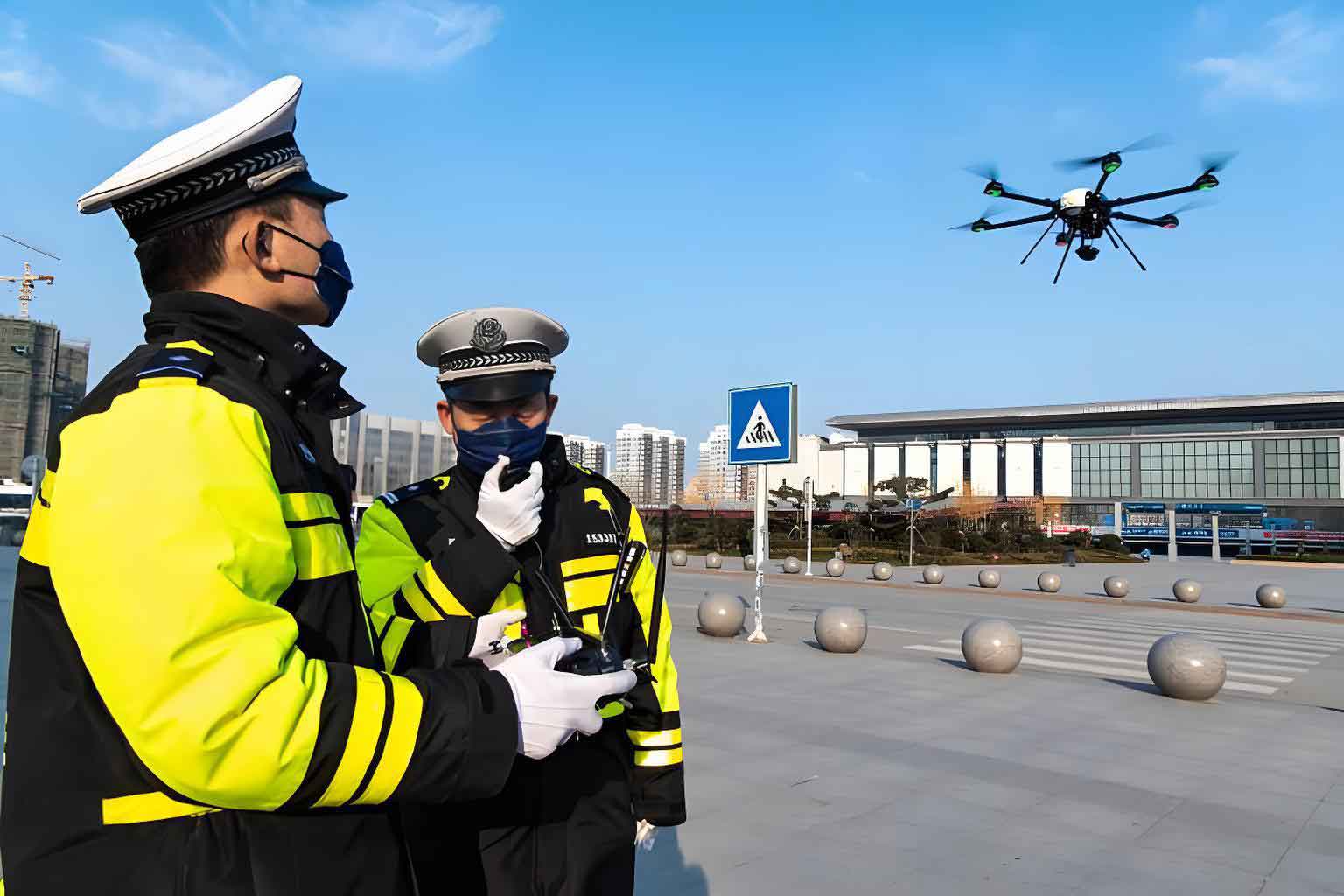
Teaching Promoting Learning: Creating a “Student-Centered” Teaching Model
1. Blended Learning to Enhance Autonomy: We shift focus from “knowledge delivery” to “learning how to learn.” A blended “online-offline” model is crucial. An online platform provides foundational knowledge (pre-class), a virtual仿真 training system allows for unlimited skill practice (post-class), and in-person sessions focus on synthesizing and applying skills to complex problems. This cultivates self-directed and持久 learning capabilities.
2. Process-Oriented Assessment for Continuous Monitoring: A diversified, multi-dimensional evaluation system runs throughout the course. We increase the weight of formative assessment, incorporating online quizzes, homework, in-class performance, and practical tasks. Assessment involves self, peer, and instructor evaluation against clear rubrics. This provides continuous feedback, motivating students and allowing for timely teaching adjustments.
| Assessment Component | Weight | Primary Assessor | Key Dimensions Measured |
|---|---|---|---|
| Online Learning & Quizzes | 15% | System / Instructor | Knowledge acquisition, preparation. |
| Homework & Case Analyses | 20% | Instructor | Analytical thinking, application of theory. |
| In-Class Performance & Participation | 15% | Instructor / Peers | Engagement, communication, teamwork. |
| Practical Skill Modules & Projects | 30% | Instructor / Rubric | Operational skill, procedure adherence, problem-solving. |
| Final Comprehensive Project/Exam | 20% | Instructor | Synthesis of knowledge, skills, and innovation. |
3. Differentiated Instruction Based on Learning Outcomes: Recognizing individual差异, we categorize students into groups. For *dependent* learners (weaker foundation), instruction focuses on the “how-to,” ensuring mastery of basic police drone操控 and safety. For *participatory* learners (competent but lacking initiative), instruction focuses on the “what-to,” giving mission objectives (e.g., “conduct surveillance on this simulated building”) and guiding them to independently figure out the “how,” fostering autonomy and tactical thinking. We can model skill progression using a simplified logistic function:
$$ P(t) = \frac{1}{1 + e^{-k(t – t_0)}} $$
where $P(t)$ represents skill proficiency over time $t$, $k$ is a learning rate constant (which may differ between student groups), and $t_0$ is the inflection point. Differentiated instruction aims to adjust $k$ and provide support around $t_0$ for each learner. Furthermore, mission success $S$ can be conceptualized as a function of multiple competencies:
$$ S = \alpha \cdot C_{piloting} + \beta \cdot C_{sensing} + \gamma \cdot C_{tactics} + \delta \cdot C_{safety} $$
where $C$ represents competency levels and $\alpha, \beta, \gamma, \delta$ are weighting coefficients adjusted for different mission types (e.g., search & rescue vs. tactical reconnaissance).
Multi-Party Collaborative Education: Building School-Police-Enterprise Mechanisms
1. Building an Interdisciplinary Teaching Team: We adopt a “dual introduction and cultivation” strategy. Police drone unit instructors and enterprise trainers are invited to form a跨界融合 team, offering specialized lectures on practical application and industry technology. Concurrently, faculty are sent for advanced training and to observe competitions, developing into dual-qualified instructors.
2. Co-developing Three-Dimensional Teaching Materials: The joint team co-creates textbooks infused with real cases, industry experience, and frontier knowledge. We also build a dynamic digital resource库 containing micro-videos, case studies, regulations, competition rules, and software links, forming a “physical textbook + digital resources + smart interaction”立体化 teaching material system.
3. Integrating “Industry-Study-Research-Application” to Create Multi-Scenario Classrooms: We collaborate with enterprises to build advanced labs for simulation, data analysis, and maintenance.校外 practice platforms are established at police air units, R&D departments, and exhibitions, creating “industry-study integrated, research-application unified” learning environments. This fusion of the talent chain with the application, production, and innovation chains fosters practical and innovative abilities through real-world immersion.
In conclusion, the implementation of the “Post-Course-Competition-Certificate” integrative model in police drone education requires a systemic rethinking of objectives, content, delivery, and resource allocation. It is a dynamic process of aligning educational output with the rigorous and evolving demands of modern police work. Through targeted post alignment, deep integration of competitive and certificated standards, student-centered pedagogical innovation, and robust collaborative mechanisms, we can effectively cultivate the next generation of competent and adaptive police drone professionals. The ultimate效能 $E$ of this educational model can be conceptualized as a product of these aligned factors:
$$ E_{model} = \eta \cdot A_{post} \cdot I_{comp-cert} \cdot Q_{teach} \cdot S_{collab} $$
where $A_{post}$ is the alignment with post requirements, $I_{comp-cert}$ is the degree of competition-certificate integration, $Q_{teach}$ is the quality of student-centered teaching, $S_{collab}$ is the strength of collaborative support, and $\eta$ represents an efficiency constant for the institutional implementation. Our reform practice aims to maximize each of these variables to achieve optimal educational outcomes for police drone operational readiness.