
As a researcher and educator in public security education, I have witnessed the rapid integration of unmanned aerial vehicles (UAVs), commonly known as drones, into law enforcement operations. The police drone has become an indispensable tool in various policing tasks, such as traffic management, public safety monitoring, counter-terrorism, and crowd control. Its ability to provide aerial surveillance, real-time data collection, and rapid deployment has revolutionized modern policing strategies. However, the widespread adoption of police drones has also exposed critical gaps in specialized training and skilled personnel. In this article, I will explore the necessity, current challenges, and strategic pathways for developing comprehensive police drone training courses in public security academies, emphasizing the need for structured curricula, practical methodologies, and collaborative frameworks to foster expertise in this emerging field.
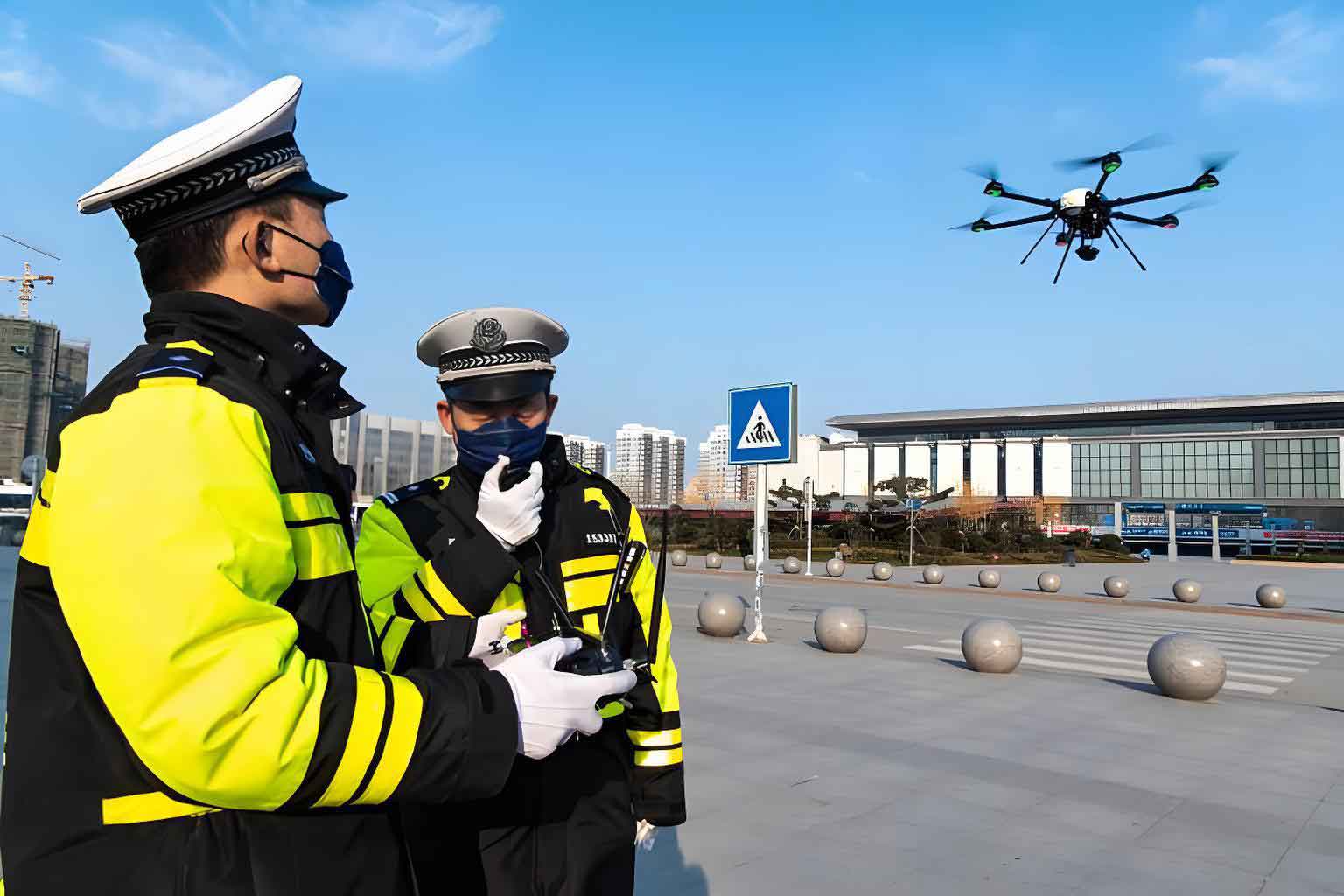
The proliferation of police drone technology stems from its versatility and efficiency in enhancing operational capabilities. For instance, in traffic law enforcement, drones can monitor congested areas, document accidents, and enforce regulations without ground interference. In public security incidents, they offer aerial perspectives for situational awareness, aiding in decision-making and resource allocation. The police drone is not merely a gadget but a strategic asset that aligns with the “smart policing” initiative, leveraging technology to improve response times and reduce risks to officers. Despite these advantages, the lack of standardized training programs has led to inconsistent application and underutilization of police drones in many jurisdictions. As an educator, I believe that public security academies must take the lead in bridging this gap by designing and implementing robust training courses tailored to the unique demands of law enforcement.
To understand the value of police drone training courses, consider the following table summarizing key application areas and their impact:
| Application Area | Role of Police Drone | Impact on Policing |
|---|---|---|
| Traffic Management | Aerial surveillance and accident documentation | Reduces congestion and improves evidence collection |
| Public Safety Monitoring | Real-time video feed for crowd control | Enhances situational awareness and prevents incidents |
| Counter-Terrorism | Reconnaissance and threat assessment | Minimizes officer exposure to danger |
| Disaster Response | Search and rescue operations in hazardous zones | Accelerates response times and saves lives |
| Criminal Investigations | Evidence gathering from aerial perspectives | Supports forensic analysis and case resolution |
The necessity for police drone training courses is further underscored by the shortage of qualified operators. Many current police drone pilots are self-taught or have limited experience, leading to operational inefficiencies and safety concerns. Moreover, tactical methodologies for deploying police drones are still in nascent stages, often relying on ad-hoc approaches rather than systematic protocols. In my experience, this gap hampers the full potential of police drone technology. For example, without proper training, operators may struggle with flight stability in adverse weather or fail to integrate drone data with existing law enforcement systems. Thus, public security academies must develop courses that not only teach technical skills but also foster strategic thinking for police drone applications.
A critical aspect of police drone training involves understanding the performance metrics of these devices. We can model the effectiveness of a police drone in surveillance tasks using a simple formula for coverage area:
$$ A = \pi \times r^2 \times \eta $$
where \( A \) is the effective coverage area, \( r \) is the operational radius of the police drone, and \( \eta \) is the efficiency factor accounting for environmental conditions and drone capabilities. This formula highlights how training can optimize parameters like flight range and data acquisition, ensuring that police drone operations are maximized for law enforcement purposes. By incorporating such mathematical models into curricula, academies can provide a scientific foundation for police drone usage.
Currently, police drone training in public security academies faces several challenges. The table below outlines the main issues and their implications:
| Challenge | Description | Impact on Training |
|---|---|---|
| Insufficient Faculty Expertise | Few instructors with hands-on police drone experience | Leads to theoretical rather than practical teaching |
| Lack of Standardized Curriculum | Varied content across institutions without unified guidelines | Causes inconsistencies in skill development |
| Inadequate Practical Resources | Limited access to police drone equipment and simulation tools | Hinders hands-on training and real-world application |
| Weak Collaboration with Police Agencies | Minimal integration of field insights into courses | Reduces relevance to actual law enforcement needs |
| Outdated Teaching Methods | Reliance on traditional lectures over interactive techniques | Fails to engage students and promote innovation |
From my perspective, these challenges stem from the rapid evolution of police drone technology, which outpaces educational adaptations. For instance, while police drones are increasingly equipped with AI for autonomous flight, many courses still focus on basic manual controls. To address this, we need a dynamic approach that continuously updates training content. Moreover, the absence of certification standards for police drone operators complicates accreditation processes. As an educator, I advocate for a national framework that harmonizes training requirements, ensuring that graduates are proficient in both technical and tactical aspects of police drone operations.
To overcome these hurdles, public security academies should adopt a multi-faceted strategy centered on collaboration, curriculum innovation, and resource enhancement. The first step is deepening partnerships between academies and police bureaus, known as “school-bureau cooperation.” This involves creating joint platforms where educators and practitioners co-develop police drone training modules. For example, academies can invite experienced police drone operators as guest instructors, while students gain internships in active units. Such synergy ensures that training aligns with real-world demands, bridging the gap between theory and practice. In my view, this collaborative model is essential for fostering a holistic understanding of police drone applications in diverse scenarios.
Another key element is strengthening professional teams within academies. This includes recruiting specialized faculty, providing ongoing training, and establishing clear roles for police drone education. A formula for assessing training effectiveness can be useful:
$$ E = \alpha \times S + \beta \times P + \gamma \times C $$
where \( E \) represents overall training effectiveness, \( S \) denotes theoretical knowledge scores, \( P \) stands for practical skill performance, and \( C \) indicates collaboration metrics. The coefficients \( \alpha \), \( \beta \), and \( \gamma \) weigh the importance of each component, with values adjusted based on police drone operational priorities. By regularly evaluating these factors, academies can refine their programs to produce competent police drone operators.
Optimizing teaching content and methods is equally crucial. Police drone training should encompass a range of topics, from basic flight mechanics to advanced data analysis. The table below proposes a modular curriculum structure:
| Module | Content | Learning Objectives |
|---|---|---|
| Fundamentals of Police Drone Operations | Flight principles, safety protocols, and legal regulations | Enable safe and compliant police drone usage |
| Technical Skills Development | Hands-on piloting, maintenance, and troubleshooting | Build proficiency in controlling police drones under various conditions |
| Tactical Applications | Scenario-based training for surveillance, search, and evidence collection | Develop strategic deployment skills for police drone in law enforcement |
| Data Integration and Analysis | Using software for video processing, GIS mapping, and real-time reporting | Enhance decision-making through police drone-derived data |
| Advanced Technologies | AI, machine learning, and swarm tactics for police drones | Prepare for future innovations in police drone systems |
In my teaching practice, I have found that interactive methods, such as simulation exercises and case studies, significantly improve engagement. For example, using virtual reality to simulate high-risk police drone missions allows students to practice without physical risks. Additionally, problem-based learning encourages trainees to solve real policing challenges with police drones, fostering critical thinking. To quantify the impact of these methods, we can use a learning retention formula:
$$ R = R_0 \times e^{-kt} + M \times (1 – e^{-kt}) $$
where \( R \) is the retention rate over time \( t \), \( R_0 \) is the initial knowledge level, \( k \) is the decay constant, and \( M \) represents the maximum retention achievable through effective teaching. This model suggests that innovative approaches can slow knowledge decay, ensuring long-term competency in police drone operations.
Furthermore, the integration of modern tools like MATLAB or Python for data analysis can enhance technical training. For instance, students can learn to program police drones for automated patrols using algorithms that optimize flight paths. A sample optimization problem might involve minimizing energy consumption while maximizing coverage:
$$ \text{Minimize } E = \sum_{i=1}^{n} (c_i \times d_i) $$
$$ \text{Subject to } \sum_{i=1}^{n} a_i \geq A_{\text{target}} $$
where \( E \) is total energy, \( c_i \) is cost per distance, \( d_i \) is segment distance, \( a_i \) is area covered, and \( A_{\text{target}} \) is the desired surveillance area. Such exercises bridge engineering and policing, making police drone training more comprehensive.
To ensure sustainability, public security academies must also focus on continuous improvement through feedback loops. This involves regular assessments of graduate performance in field settings, updating curricula based on technological advancements, and fostering research on police drone applications. For example, academies can establish research centers dedicated to studying police drone efficacy in different environments, publishing findings to guide training standards. In my role, I have initiated pilot projects where students collaborate with local police to test new police drone tactics, resulting in improved response strategies for incidents like traffic accidents or public gatherings.
Looking ahead, the evolution of police drone technology will demand adaptive training frameworks. Emerging trends such as autonomous swarms, enhanced sensors, and 5G connectivity will expand the capabilities of police drones, requiring operators to master complex systems. Public security academies should proactively incorporate these elements into courses, perhaps through partnerships with tech companies. Moreover, ethical considerations, such as privacy and accountability in police drone usage, must be integral to training, ensuring that operators uphold legal and social standards.
In conclusion, the development of police drone training courses in public security academies is not just an educational imperative but a strategic necessity for modern law enforcement. By addressing current challenges through collaboration, curriculum innovation, and practical methodologies, we can cultivate a generation of skilled professionals who leverage police drones to enhance public safety. As an educator, I am committed to advancing this field, and I believe that with concerted efforts, police drone training will become a cornerstone of policing excellence, driving innovation and efficiency across the board. The journey involves continuous learning and adaptation, but the rewards—safer communities and more effective policing—make it a worthy endeavor for all stakeholders involved.