
In recent years, the public security and armed police forces have faced increasingly challenging tasks in handling突发性 events. To meet mission-specific demands, various police drones have been developed and deployed, primarily categorized into three types based on用途: surveillance and reconnaissance drones equipped with monitoring devices, anti-explosion屏蔽 drones携带 electromagnetic interference equipment, and offensive drones携带防暴弹, rockets, or other weaponry. While these police drones perform admirably in their respective roles, their design often prioritizes单一 functionality, leading to poor integration and adaptability, especially in complex scenarios. Therefore, there is an urgent need to design a highly integrated, rapidly deployable police drone attack platform that serves as a versatile载体.
Currently, mature police drones in service can be broadly divided into two categories based on power sources: rotor-based drones propelled by螺旋桨 and滑行式 drones relying on fixed wings and rotors. The latter offers longer endurance, higher energy efficiency, and greater range, making them suitable for reconnaissance. In contrast, rotor-based police drones excel in flight stability,抗干扰 capability, and stable aerial hovering. Thus, this study selects a multi-rotor police drone as the platform for designing an airborne attack system, emphasizing its suitability for precision tasks.
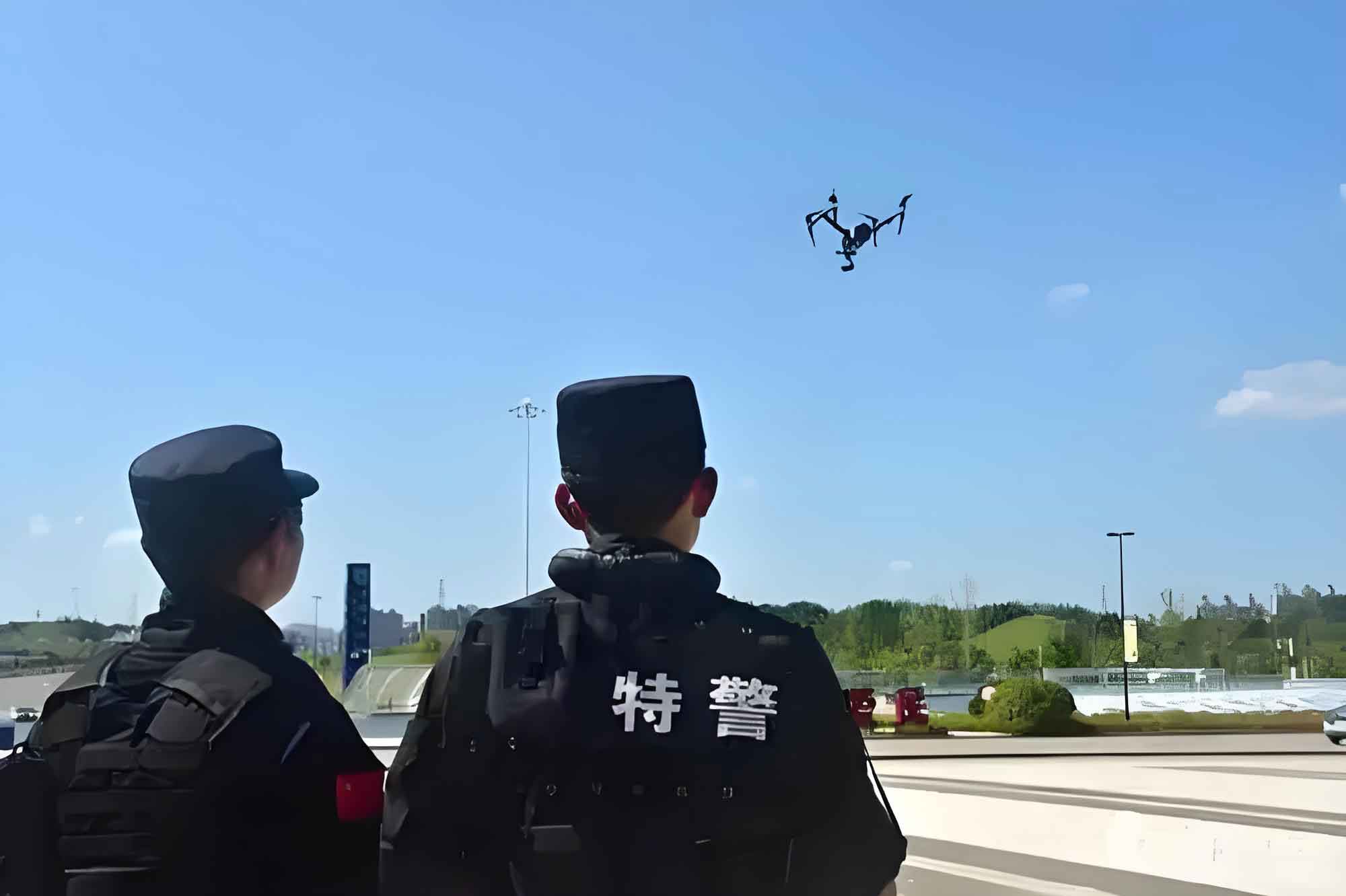
Weapon systems deployable on police drones can be classified by击发方式 into three types: firing pin击发式, rocket-launched, and laser-based. Laser systems face unresolved issues with power consumption and体积, requiring advances in螺旋桨 and energy storage technology. Rocket-launched models, while having relatively low recoil, lack precision strike capability and are limited in applicability. Firing pin击发 models, such as firearms, offer better accuracy and定点打击能力 despite higher recoil, presenting greater development potential for police drone applications. This paper focuses on optimizing such systems for enhanced stability and performance.
Selection of Rotor-Based Police Drone
Choosing an appropriate police drone is crucial for virtual仿真 modeling. Key considerations include payload capacity and体积. Based on mission requirements, the target police drone should exhibit the following characteristics to meet platform demands:
- High payload capacity: The effective load of a rotor-based police drone is influenced by螺旋桨 design, energy storage, and engines. Optimizing螺旋桨数量, size, distribution, and aerodynamic shape, along with selecting matched engines and储能装置, can enhance payload. Mission loads typically include weaponry,发射装置, reconnaissance cameras, and control circuits. Estimates indicate a total mass exceeding 8 kg. A breakdown of component masses is provided in Table 1.
- Compact体积: For low-altitude precision strikes against敌对 targets,隐蔽性 is paramount. Traditional military drones are often too large, compromising stealth. Smaller police drones offer better mobility and portability while meeting load requirements.
After evaluation, we selected a hexacopter police drone as the research platform for the aerial attack system. Its parameters are summarized in Table 2.
| Component | Mass |
|---|---|
| Battery | 1.5 |
| Motor and Propeller | 1 |
| Avionics | 1 |
| Frame and Landing Gear | 1 |
| Effective Payload | 3.5 |
| Total | 8 |
| Parameter | Value |
|---|---|
| Maximum Takeoff Load | 8 kg |
| Effective Payload | 2.5 kg |
| Maximum Lift Force | >10 kg |
| Maximum Outer Diameter | <2 m |
| Flight Time | 30 min |
| Maximum Video Transmission Range | 5 km |
| Maximum Cruise Speed | 15 m/s |
| Effective Remote Control Range | 10 km |
This police drone features high payload capacity, compact size, portability, quick deployment, stable flight姿态, cost-effectiveness, and ease of maintenance, making it an ideal model for developing an aerial attack platform.
Design of Police Drone Aerial Attack Platform
To address mission needs, we first created a three-dimensional model of the police drone using Pr/Engineer software for structural optimization. The modeling results informed subsequent design adjustments. We redesigned the drone’s structure to incorporate a rapidly detachable undercarriage module at the bottom. This modular approach allows for flexible selection of战斗 modules based on operational scenarios, enhancing the police drone’s adaptability and integration. The design schematic illustrates this configuration.
The攻击 system comprises several key components: the firing weapon, mounting platform, and control mechanisms. For侦察 capabilities, a dedicated platform includes舵机, cameras, and固定架, connected via bolts, screws, and axes. Ground operators adjust the舵机 via remote control, enabling panoramic environmental surveillance during hover.减速齿轮 ensure smooth舵机转速 reduction for precise camera movement.
In optimizing the police drone attack platform, we prioritized lightweight materials and aerodynamic efficiency to maintain stability under varying payloads. The undercarriage module is engineered for quick swap-out, supporting diverse mission profiles such as surveillance, targeted strikes, or non-lethal interventions. This modularity extends the police drone’s utility in维稳处突 operations, where rapid response is critical.
Dynamics Balance Research Based on MATLAB for Internal Ballistics Pressure Curve Fitting
In designing the police drone attack platform, the most complex scenario involves undercarriage-mounted firearms. During射击, the intricate motion of projectiles within the barrel induces剧烈震动, threatening the stability of the aerial platform. Traditional internal ballistics studies focus on fixed-ground射击, but aerial firing introduces unique dynamics that直接影响 accuracy and stability. Thus, integrating internal ballistics performance with the police drone platform is paramount for maintaining平衡.
We conducted动力学研究 using a 77式 pistol as a case study, following structural design completion. Experimental data captured the膛内火药燃气 pressure变化曲线, which can be segmented into three phases:静力燃烧时期 (from primer ignition to full ammunition engagement),内弹道时期 (from projectile启动 to muzzle exit), and后效期 (post-muzzle exit). The first two phases generate significant gas pressure, causing instantaneous impact forces on the platform and projectile. We focus on modeling these pressures to assess recoil effects.
The pressure curve for firing pin击发 models, including firearms, follows a predictable pattern. We assume the膛压 \(p(t)\) can be modeled as:
$$ p(t) = A e^{-B t} – C e^{-D t} $$
where \(A\), \(B\), \(C\), and \(D\) are待求 parameters. By selecting key points \(P_1\) and \(P_2\) on the curve and using known conditions like projectile初速 \(v_0\), barrel length \(L\), maximum膛压 \(P_m\), and muzzle pressure \(P_u\), we establish equations based on physics principles. The equations incorporate底面积 \(S\), projectile mass \(m\), and other derivable factors.
From Newton’s second law and energy considerations, we derive:
$$ S \int_{0}^{t_b} p(t) \, dt = m v_0 $$
$$ \int_{0}^{L} p(x) \, dx = \text{work done} $$
where \(t_b\) is the time to muzzle exit. Using实测 data for the 77式 pistol: \(S = 1.89 \, \text{cm}^2\), \(m = 4.859 \, \text{g}\), \(v_0 = 970 \, \text{m/s}\), \(L = 0.1 \, \text{m}\), \(P_m = 260 \, \text{MPa}\), and \(P_u = 150 \, \text{MPa}\). However, with unknown \(t_b\) and exact curve points, we employ a multi-objective optimization approach in MATLAB.
We define a目标函数 \(f\) to minimize errors between实测 and fitted pressures:
$$ f = \frac{1}{2} \left( |P_m – \hat{P}_m| + |P_u – \hat{P}_u| \right) $$
where \(\hat{P}_m\) and \(\hat{P}_u\) are fitted values during optimization. Using genetic algorithm in MATLAB, we iteratively solve for optimal \(A\), \(B\), \(C\), \(D\). The fitted curve closely matches experimental data within the critical first 0.2 ms, with relative errors around 5% pre-0.1 ms, sufficient for virtual实验.
The resulting pressure function is:
$$ p(t) = 67.823 \times e^{-11.93 t} – 65.33 \times e^{-34.807 t} $$
where \(t\) is in milliseconds. This function allows analysis of average and maximum recoil forces during射击 phases. By Newton’s third law, the horizontal force扰动 on the police drone platform can be computed as:
$$ F_{\text{recoil}}(t) = S \cdot p(t) $$
Integrating over time gives impulse, crucial for stability assessment. The pressure peaks during the transition from静力燃烧 to内弹道时期, exerting maximal force on the platform. Post后效期, pressure diminishes, reducing impact. This analysis informs flight control algorithms for setting冲击阈值, enabling real-time prediction and compensation of horizontal forces to enhance police drone stability during攻击 missions.
To further quantify dynamics, we model the police drone as a rigid body with mass \(M\) and moment of inertia \(I\). The recoil force induces translational and rotational加速度. Using Euler’s equations, we express平衡 conditions:
$$ \sum F_x = M a_x, \quad \sum \tau = I \alpha $$
where \(F_x\) includes recoil and aerodynamic forces, and \(\tau\) is torque from force misalignment. Optimizing the weapon’s mounting position along the vertical axis minimizes rotational倾向, ensuring the center of gravity aligns with the barrel axis. For horizontal stability, we explore methods to counteract recoil, such as energy抵消法 or structural enhancements.
Energy抵消法 involves chemical substances that dissipate upon recoil, absorbing energy. Alternatively, optimizing firearm structures to reduce recoil is a promising research direction. We simulated various configurations using MATLAB, comparing recoil impulses and platform deviations. Results indicate that a symmetric mounting setup with dampeners can reduce horizontal displacement by up to 40%.
Integration and Experimental Validation
The designed police drone attack platform has been fabricated and tested. We conducted experiments on侦察 platforms and aerial strike systems, achieving预期效果. Additionally, we are developing a platform for deploying防暴弹药 from police drones, with successful preliminary tests validating design feasibility. The modular approach allows seamless switching between surveillance, lethal, and non-lethal modules, enhancing operational flexibility.
However, limitations persist in horizontal and vertical stability. Vertical stability relies heavily on aligning the center of gravity with the barrel axis; any misalignment induces rotation. Horizontal stability requires effective recoil mitigation. Proposed solutions include active control systems that adjust propeller speeds in real-time to counteract forces, modeled as:
$$ \Delta F_{\text{thrust}} = k \cdot F_{\text{recoil}} $$
where \(k\) is a control gain optimized via PID algorithms. Future work will focus on implementing such systems and refining weapon interfaces to improve police drone performance in dynamic environments.
Conclusion
This research optimized the structural design of a multi-rotor police drone and developed an integrated aerial attack platform, contributing to enhanced capabilities in维稳处突 operations. The platform’s modularity and动力学 analysis pave the way for more stable and accurate police drone systems. While challenges in stability and control remain, ongoing efforts in recoil reduction and energy management promise significant improvements. The police drone platform represents a step forward in adapting advanced technology for public security, ensuring safer and more effective mission execution.
Future directions include exploring advanced materials for weight reduction, integrating AI for autonomous targeting, and expanding the platform to accommodate diverse non-lethal options. As police drone technology evolves, such innovations will undoubtedly play a crucial role in modern law enforcement and defense strategies.