
In the face of increasingly complex public security challenges and the perennial constraint of limited personnel resources, the strategic emphasis on technology-driven policing has become paramount. A pivotal innovation in this domain is the integration of police drones into operational frameworks. My focus centers on the practical, real-world application of these systems for target recognition and tracking, moving beyond theoretical potential to assess their tangible impact on law enforcement efficacy.
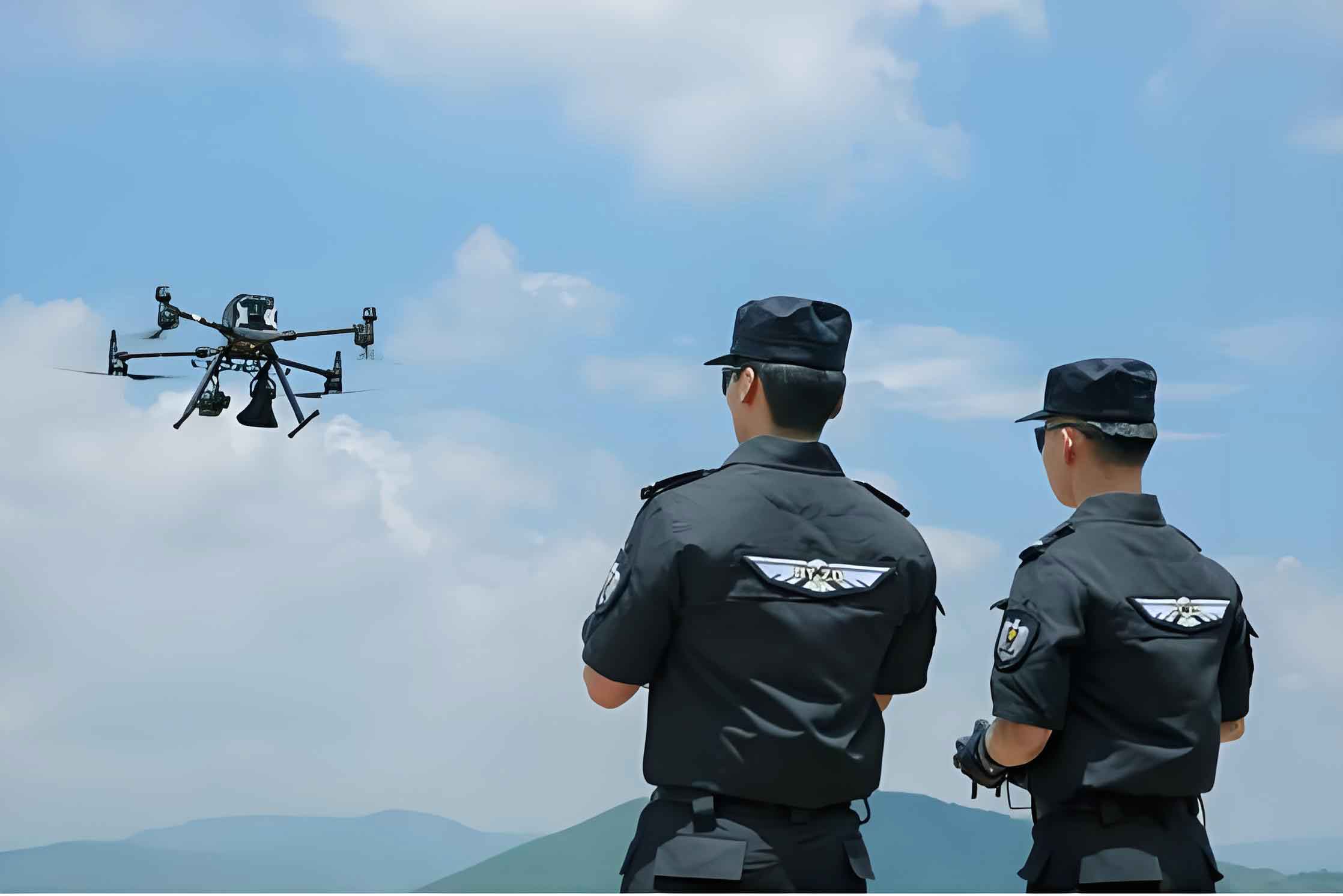
The modern police drone is no longer a simple flying camera; it is a sophisticated data node within a broader intelligence ecosystem. Its value is proven in scenarios like fugitive tracking, large-event crowd monitoring, and search-and-rescue operations, where traditional ground-based surveillance reaches its physical and economic limits. The core of this evolution lies in transitioning from manual, reactive drone piloting to autonomous, intelligent systems capable of persistent, adaptive, and precise target engagement.
Operational Advantages of Police Drones in Target Missions
The deployment of police drones offers transformative advantages over static surveillance infrastructure, fundamentally altering tactical approaches to target identification and pursuit.
1. Swarm Operations and Comprehensive Strategic Layout
Unlike fixed CCTV networks, which are constrained by geography, installation costs, and upgrade cycles, a fleet of police drones provides dynamic, reconfigurable coverage. They circumvent the “re-development” waste associated with expanding physical camera networks. When deployed in coordinated swarms, these drones establish a multi-layered operational hierarchy. Each unit acts as a mobile sensor node, capturing target data from diverse angles and perspectives. The synthesis of this multi-source intelligence allows for a comprehensive “pattern-of-life” analysis, accurately reconstructing a target’s trajectory and behavioral characteristics. This networked approach facilitates integrated operations with ground units, creating a cohesive and formidable tactical force.
| Feature | Static CCTV Network | Police Drone Swarm |
|---|---|---|
| Coverage Flexibility | Fixed, limited by installation points. | Dynamic, on-demand, and reconfigurable. |
| Infrastructure Cost | High initial and expansion cost. | Lower incremental cost for area expansion. |
| Perspective & Data | Single, fixed angle; potential blind spots. | Multiple, immersive angles; 3D geospatial data. |
| System Resilience | Failure of one node creates a permanent blind spot. | Swarm can adapt and re-route to cover gaps autonomously. |
| Tactical Integration | Mostly passive monitoring; delayed response. | Active, real-time data feed enabling immediate command decisions. |
2. Deep Learning for Precision and Environmental Adaptation
The integration of deep learning algorithms is the cornerstone of the modern police drone’s intelligence. These algorithms empower drones to perform robust target recognition under suboptimal conditions—poor lighting, occlusion, or adverse weather (rain, fog). The process involves sophisticated data preprocessing: noise filtering, missing data imputation, and error correction. Mathematically, a deep neural network learns a complex function $f(x)$ that maps raw sensor input $x$ (pixels, LiDAR points) to a target classification $y$ (e.g., “person,” “specific vehicle model”).
$$ y = f(x; \theta) = \sigma(W_n \cdot \sigma(W_{n-1} \cdot … \sigma(W_1 x + b_1)… + b_{n-1}) + b_n) $$
Here, $W$ and $b$ represent the learned weights and biases of the network, and $\sigma$ denotes activation functions (e.g., ReLU). This allows a police drone to distinguish a target from visual clutter with high confidence. Furthermore, by analyzing temporal data sequences, drones can identify anomalous behavior—prolonged stationary periods in unusual locations, sudden changes in movement patterns, or coordinated movement between multiple targets—enabling predictive policing and deeper investigative leads.
3. System Fusion and Grid-Based Data Control
A critical advantage is the bidirectional fusion of the police drone platform with central law enforcement databases and command systems. This creates a powerful “grid” of data control. The drone is not merely a data collector; it is an interactive query terminal. It can, in near real-time, cross-reference captured biometric or vehicular data (e.g., license plate, faceprint) against national databases. Conversely, it can upload newly acquired intelligence to update those very databases.
This integration extends to command and control. A drone swarm forms a secure, mobile communications mesh network. Instructions from headquarters can be relayed through the swarm to officers on the ground, while live situational data flows back to command centers. To ensure security and privacy, advanced police drone systems incorporate robust access control and audit mechanisms. Every data access and command is logged. The system enforces strict protocols to balance effective policing, public safety oversight, and individual privacy rights, which is foundational for sustainable and lawful use.
Practical Challenges and Limitations
Despite the clear advantages, the path to fully autonomous and ubiquitous police drone deployment is fraught with operational, technical, and systemic hurdles.
1. Insufficient Autonomy and Fragmented Operations
Currently, many deployed systems lack deep intelligence. They often function as “flying CCTV,” requiring constant manual piloting and analysis. The integration of deep learning remains superficial, leaving police drones vulnerable to environmental interference. In swarm operations, the lack of sophisticated inter-drone communication and data fusion protocols leads to “data fragmentation.” Each drone captures information, but the swarm lacks the collective intelligence to synthesize a unified, coherent target profile autonomously. The burden of analysis falls on human analysts post-mission, creating delay. Furthermore, swarm resilience is low; the failure of a few key nodes can cripple the entire network’s coverage without an autonomous self-healing protocol.
2. Inadequate Database Support and Security Vulnerabilities
The power of a police drone’s recognition is directly tied to the quality and accessibility of the backend database. Two critical issues persist: isolated “data silos” across different jurisdictions with incompatible standards, and insufficient fusion between drone systems and these databases. This makes cross-regional tracking extremely difficult, as a drone cannot seamlessly query a suspect’s records from another province. Format conversion and access latency waste precious time.
Security is a paramount concern. As wireless, remote devices, police drones are susceptible to jamming, spoofing, and hacking. Inadequate “anti-control” and encryption measures could allow adversaries to intercept, manipulate, or even take control of a drone, leading to mission failure or severe data breaches. The security of the entire police drone ecosystem—from communication links to data storage—requires constant hardening.
| Challenge Category | Specific Issue | Impact on Mission |
|---|---|---|
| Technical & Operational | Low autonomous intelligence; fragmented swarm data. | Delayed response; incomplete target assessment; high human resource burden. |
| Data Infrastructure | Jurisdictional data silos; poor system integration. | Hinders cross-regional tracking; reduces identification accuracy and speed. |
| Security | Susceptibility to electronic warfare & hacking. | Risk of mission compromise, data theft, and loss of asset control. |
| Administrative | High cost, complex maintenance, lack of trained operators. | Low adoption rate at grassroots level; assets underutilized or non-functional. |
3. Imperfect Management and Low Routine Adoption
The “build it and forget it” mentality plagues technological adoption in many organizations. Police drones require specialized, regular maintenance, software updates, and skilled pilots/analysts. Given existing staffing pressures, dedicated support units are often under-resourced. The high procurement cost, operational complexity, and maintenance overhead discourage widespread, routine use at the grassroots level. In many cases, officers revert to reviewing existing CCTV footage, deploying police drones only for high-profile operations or when specialists are present, drastically underutilizing their potential.
Development Pathway for Enhanced Practical Application
To transcend these challenges and fully realize the potential of the police drone, a multi-faceted development strategy focused on integration, intelligence, and institutional support is essential.
1. Building a “Seamless Perception” Network: A New “Command Chain + Combat Flow” Model
The future lies in treating a swarm of police drones as a single, adaptive “sensor web.” This web must be capable of autonomous reconfiguration. Using algorithms that monitor network “hop counts” and data flow integrity, the swarm can detect a malfunctioning node. Neighboring drones can then automatically adjust their flight paths and communication links to fill the coverage gap, maintaining an unbroken perception field. The target tracking function can be formally expressed as an optimization problem, where the swarm aims to maintain a composite confidence score $C(t)$ on target location:
$$ C(t) = \sum_{i=1}^{N} w_i \cdot c_i(\mathbf{p}_t, \mathbf{s}_i(t)) $$
Subject to: $$ \text{Coverage}(\bigcup \mathbf{s}_i(t)) \geq \text{Threshold}, \quad \text{and} \quad \text{Connectivity}(G(t)) = \text{True} $$
Here, $N$ is the number of drones, $w_i$ is a weighting factor for drone $i$, $c_i$ is its individual confidence function for target position $\mathbf{p}_t$ given its own sensor state $\mathbf{s}_i(t)$, $G(t)$ is the communication graph of the swarm, and connectivity must be preserved.
This intelligent web feeds a unified operational picture to a central command, which then disseminates targeted instructions. A hierarchical command structure within the swarm allows a lead drone (a “root node”) to allocate tasks—some drones focus on close tracking, others on wide-area search or communication relay—creating a synergistic “combat flow” with ground units for multi-layered, grid-based interdiction.
2. Fusing “Deep Learning” Algorithms: Constructing a “Big Platform + Cloud Police” System
Advancements in core algorithms are non-negotiable. Research must focus on developing robust Convolutional Neural Networks (CNNs) and Recurrent Neural Networks (RNNs) specifically for the police drone environment. These models must be trained on vast, diverse datasets simulating real-world challenges: occlusions, lighting variations, and adversarial camouflage. The goal is to maximize the environmental adaptation function $A(E, M)$, where a drone’s performance degrades minimally under non-ideal environment $E$ compared to its baseline model performance $M$.
$$ A(E, M) = 1 – \frac{\text{Performance}_M(\text{Ideal}) – \text{Performance}_M(E)}{\text{Performance}_M(\text{Ideal})} $$
Concurrently, a unified national “Big Platform” law enforcement database is crucial. This platform must feature standardized data formats and open, secure APIs to allow any authorized police drone system to perform real-time, cross-jurisdictional queries. The drone then becomes a true “Cloud Police” officer—an extension of the collective intelligence and authority of the force, capable of autonomously accessing, analyzing, and acting upon integrated police resources.
| Strategic Pillar | Core Objective | Key Technologies & Actions |
|---|---|---|
| Networked Perception | Create resilient, self-healing drone swarms. | Mesh communication protocols; distributed AI for swarm control; dynamic coverage algorithms. |
| Deep Intelligence | Achieve high accuracy in real-world, adversarial conditions. | Domain-specific CNN/RNN models; adversarial training datasets; on-edge processing hardware. |
| Data Ecosystem Fusion | Enable seamless data flow between drone and all police systems. | National data standards; secure, low-latency APIs; federated learning for privacy. |
| Institutional Empowerment | Ensure widespread, effective use at the frontline. | Cost-reduction R&D standardized training curricula; simplified maintenance protocols. |
| Security & Countermeasures | Protect the drone system from compromise. | Quantum-resistant encryption; GPS spoofing detection; automated threat response protocols. |
3. Perfecting “Empower the Frontline” Systems: Forging New “High Ground + Anti-Control” Capabilities
Technology must be accessible. This requires R&D aimed at reducing the acquisition and maintenance costs of police drones. Parallel to this, comprehensive and常态化 training programs must be institutionalized for frontline officers, turning drone operation into a basic skill. Standardized maintenance and data-sharing protocols across regions are vital to ensure a suspect tracked by a police drone in one district does not become invisible at a jurisdictional border.
While claiming the informational “high ground,” we must also fortify it. This involves building a multi-layered “anti-control” defense for the police drone system:
- Physical/E-Layer: Geofencing, signal authentication, and anti-jamming waveforms.
- Network Layer: End-to-end encryption and intrusion detection systems (IDS).
- Application Layer: Strict access control, audit trails, and automated anomaly response.
An intrusion attempt $I$ should trigger an automated containment protocol $R(I)$ that isolates the compromised node, alerts the network, and initiates forensic tracing:
$$ R(I) = \{ \text{Isolate}(I_{\text{node}}), \text{Alert}(\text{Network}), \text{Trace}(I_{\text{source}}), \text{Deploy Countermeasure} \} $$
By systematically addressing these technological, systemic, and human factors, the police drone can evolve from a niche tool to a cornerstone of modern, intelligent, and effective law enforcement, ensuring precise target recognition and tracking that meets the stringent demands of real-world public safety operations.