
In recent years, the integration of unmanned aerial vehicles (UAVs) into law enforcement has revolutionized policing strategies globally. As a researcher deeply immersed in this field, I have observed the rapid evolution of police drones, driven by advancements in artificial intelligence and automation technologies. These devices are no longer mere tools for aerial photography; they have become indispensable assets in public safety, offering capabilities ranging from surveillance to emergency response. However, the journey of police drone adoption is fraught with challenges that hinder their full potential. This article aims to provide a detailed, first-person perspective on the current state of police drone applications, identify persistent issues, and explore future directions. Throughout this analysis, I will emphasize the keyword “police drone” to underscore its centrality in modern law enforcement. The discussion will be enriched with tables and mathematical formulas to summarize key concepts, ensuring a comprehensive understanding of this dynamic technology.
The utilization of police drones has expanded significantly, with various functionalities being developed to meet diverse operational needs. From my research and field observations, I categorize the core functions of police drones into several critical areas. First, high-altitude aerial surveying and photography allow police drones to capture real-time video footage from designated areas, transmitting it back to command centers for decision-making support. This capability is enhanced by advanced camera systems, including infrared and thermal imaging, which enable operations in low-light conditions. Second, item delivery is facilitated by precise satellite positioning systems, enabling police drones to carry and drop essential supplies, such as medical kits or communication devices, to remote or inaccessible locations. Third, information collection involves large-scale data acquisition through sensors and cameras, supporting tasks like mapping and scene reconstruction. For instance, police drones can gather geospatial data for urban planning or crime scene analysis, significantly reducing time and improving accuracy. Fourth, 3D modeling leverages image stitching techniques to create detailed reconstructions of environments, useful in forensic investigations or disaster response. Fifth, night operations are possible with infrared equipment, allowing police drones to conduct patrols and identify threats during darkness. Sixth, automatic target tracking integrates AI systems to lock onto and follow individuals or vehicles, enhancing pursuit capabilities. Seventh, long-distance communication modules enable officers to broadcast messages or negotiate with suspects from a safe distance. To summarize these functions, I present the following table:
| Function | Description | Typical Use Case |
|---|---|---|
| Aerial Surveying | Real-time video capture and transmission via high-resolution cameras. | Monitoring large public events or traffic congestion. |
| Item Delivery | Precise dropping of payloads using GPS navigation. | Delivering emergency supplies in disaster zones. |
| Information Collection | Data acquisition from sensors for mapping and analysis. | Crime scene documentation or environmental monitoring. |
| 3D Modeling | Image processing to create three-dimensional scene reconstructions. | Forensic investigations or accident reconstruction. |
| Night Operations | Infrared and thermal imaging for low-light surveillance. | Nighttime patrols in high-crime areas. |
| Target Tracking | AI-driven locking and following of moving objects. | Pursuing suspects in urban or rural settings. |
| Long-Distance Communication | Broadcast of audio messages via mounted speakers. | Crowd control or negotiation during crises. |
In addition to these functions, data sharing is a crucial aspect of police drone operations. From my experience, the integration of wireless image transmission systems allows for real-time data flow between police drones and command centers. This facilitates a multi-source information ecosystem, where data from drones, patrol cars, and other devices are combined to enhance situational awareness. The effectiveness of this sharing can be modeled using communication theory formulas. For example, the data rate R for video transmission from a police drone can be expressed as:
$$R = B \log_2\left(1 + \frac{S}{N}\right)$$
where B is the bandwidth, S is the signal power, and N is the noise power. This formula highlights the technical challenges in maintaining high-quality data links, especially in urban environments with interference. Moreover, the integration of police drones with existing law enforcement systems, such as computer-aided dispatch (CAD) or geographic information systems (GIS), requires robust protocols to ensure data security and interoperability. I have seen cases where encrypted channels are used to protect sensitive information, but inconsistencies in implementation often lead to gaps. To illustrate the data flow, consider the following table summarizing key components of police drone data sharing:
| Component | Role | Challenge |
|---|---|---|
| Wireless Transmitter | Transmits live video and sensor data to command centers. | Signal degradation over long distances or in crowded spectra. |
| Ground Control Station | Processes and analyzes incoming data for decision support. | Integration with legacy police databases and software. |
| Cloud Storage | Archives data for future reference and analysis. | Cybersecurity risks and data privacy concerns. |
| Inter-agency Networks | Facilitates data exchange between different law enforcement units. | Lack of standardized protocols leading to “information silos”. |
The application scenarios for police drones are diverse, reflecting their adaptability to various law enforcement tasks. Based on my observations, I can detail several common use cases. High-altitude治安巡逻, or治安巡逻, involves using police drones for routine patrols in areas with limited camera coverage. This not only reduces officer workload but also provides a bird’s-eye view for monitoring public safety. In traffic management, police drones assist in monitoring flow, responding to accidents, and even illuminating scenes at night. For example, during major incidents, a police drone can quickly survey the area, collect evidence, and guide responders, minimizing secondary accidents. Event security leverages the wide视角 of police drones to oversee crowds, track suspicious activities, and facilitate communication. In反恐 operations, police drones can be deployed for reconnaissance, target tracking, and even non-lethal interventions like deploying flashbangs or tear gas. Finally, in侦察追捕 scenarios, police drones excel in navigating complex terrains, such as mountains or forests, to locate hideouts or monitor fugitives. The versatility of police drones is evident in their ability to adapt to these roles, but their effectiveness depends on proper integration and training. To encapsulate these scenarios, I present the following table:
| Scenario | Description | Benefits |
|---|---|---|
| 治安巡逻 | Aerial patrols in urban or rural areas to deter crime and monitor activity. | Enhanced coverage and reduced人力 costs. |
| Traffic Management | Monitoring roads, managing accidents, and supporting traffic control. | Quick response times and improved safety. |
| Event Security | Surveillance of large gatherings like concerts or protests. | Real-time threat assessment and crowd management. |
| 反恐 Operations | Reconnaissance and intervention in terrorist incidents. | Minimized risk to officers and precise行动. |
| 侦察追捕 | Tracking suspects in difficult terrains or during pursuits. | Increased成功率 in apprehensions. |
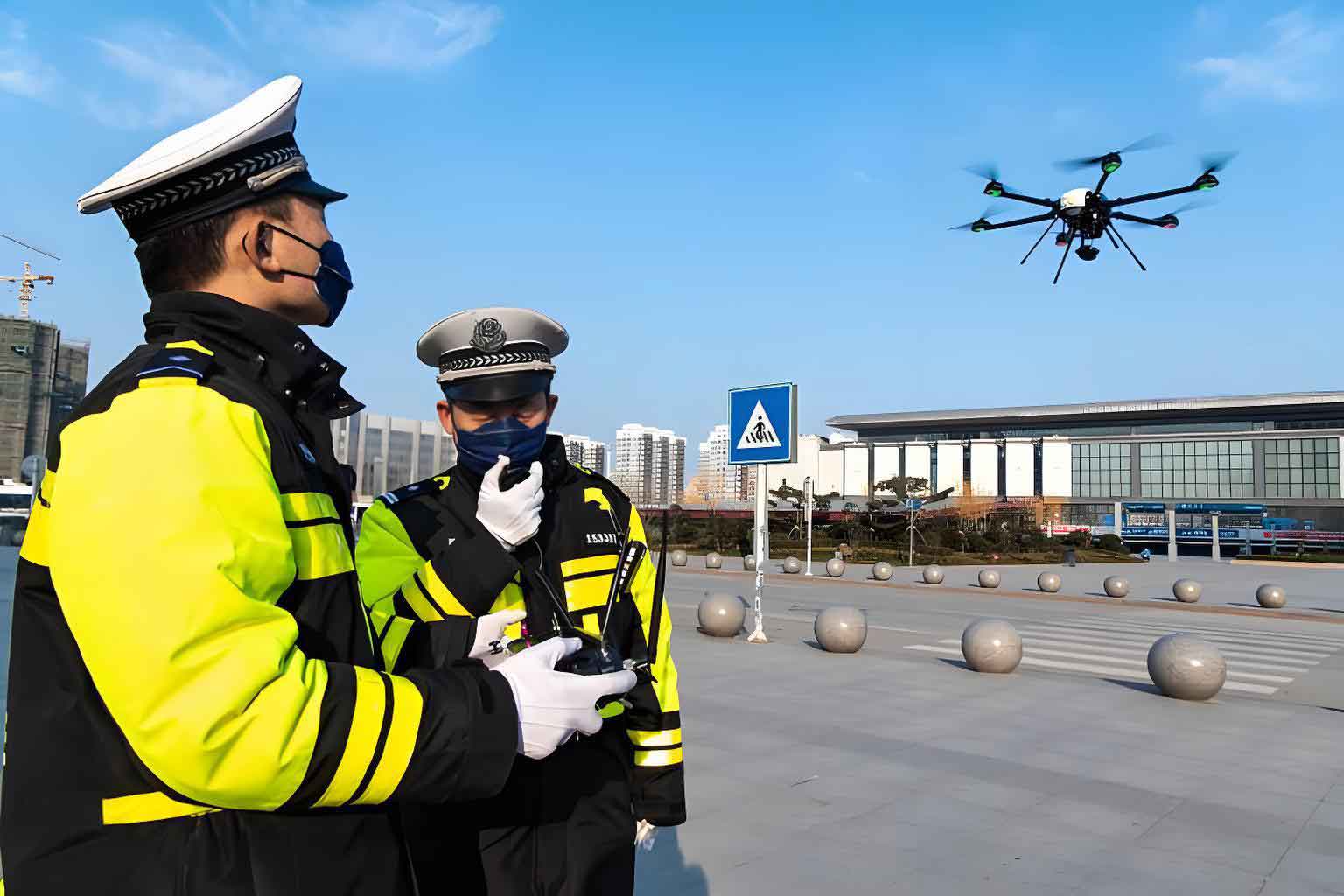
Despite these advancements, the application of police drones faces several significant problems that I have identified through research and practical engagement. First, the integration of police drones with警务 applications remains low. Many departments use police drones primarily for basic tasks like aerial photography, without leveraging their full potential for complex operations. This is partly due to a lack of standardized operating procedures and a deep understanding of警务 needs among operators. For instance, in some cases, police drones are deployed without clear protocols for data analysis or coordination with ground units, leading to inefficiencies. Second, the effectiveness of police drone applications is often suboptimal. The融合 of drone platforms with mission payloads and decision-making systems is incomplete, resulting in a disconnect between technology and公安业务. I have observed that police drones may fail to provide timely data in emergencies or struggle with interoperability in multi-agency responses. Third, training for police drone operators is inconsistent. Programs vary widely in quality, focusing on basic flight skills rather than实战 applications. This creates a gap where operators are certified but lack the expertise to handle real-world scenarios, such as high-speed chases or critical incident management. The demand for skilled personnel is growing, yet training curricula have not kept pace. Fourth, there is a pronounced “孤岛效应” in装备 and application systems across regions. Different police departments use diverse types of police drones, leading to compatibility issues and fragmented resources. This hampers collaboration and data sharing, as systems cannot communicate effectively. For example, a police drone from one jurisdiction may be unable to integrate with another’s command center, reducing overall operational coherence. To quantify these issues, I propose a simple formula to measure integration effectiveness E:
$$E = \frac{C \times I}{T \times D}$$
where C is compatibility with existing systems, I is interoperability, T is training quality, and D is diversity of drone types. A low E value indicates poor integration, highlighting areas for improvement. The following table summarizes these problems and their impacts:
| Problem | Description | Impact |
|---|---|---|
| Low Integration | Police drones are not fully embedded in警务 workflows and systems. | Reduced utility and wasted resources. |
| Poor Effectiveness | Inability to meet operational demands due to technical or procedural gaps. | Failed missions or delayed responses. |
| Inconsistent Training | Varying levels of operator proficiency and实战 preparedness. | Increased risk of errors or accidents. |
| 孤岛 Effect | Fragmented equipment and systems across regions hinder collaboration. | Inefficient use of police drone fleets and data silos. |
Looking ahead, the research and development of police drones must address these challenges to unlock their full potential. From my perspective, several key areas require focused attention. First,实战研究 should be prioritized to enhance执法 effectiveness. This involves studying “多机”合成作战, where multiple police drones of the same or different types cooperate on missions, and “人机”合成作战, where police drones synergize with human officers. For instance, a swarm of police drones could cover a large area for search and rescue, while a single police drone provides overwatch for a tactical team. The dynamics of such operations can be modeled using coordination algorithms, such as:
$$f(x) = \sum_{i=1}^{n} w_i \cdot \text{coord}(d_i, o_i)$$
where f(x) represents the overall effectiveness, w_i are weights for each police drone, d_i are drone parameters, and o_i are officer inputs. Second, talent cultivation should start at公安院校, where comprehensive programs can train future officers in police drone theory, maintenance, and实战 applications. I advocate for specialized courses or even degrees in police drone technology, coupled with internships in警航 departments. This will bridge the skill gap and ensure a steady pipeline of experts. Third, legal frameworks must evolve to support police drone operations. Officers need to熟悉 existing regulations, such as those governing airspace and data privacy, while contributing to updates that address emerging issues. For example, laws on autonomous tracking or weaponized police drones require careful scrutiny to balance safety and efficacy. Fourth, technological innovation is the backbone of police drone进步. Advances in platforms, like倾转旋翼机 that combine vertical take-off with fixed-wing efficiency, will expand capabilities. Additionally, the integration of 5G通信 can revolutionize data transmission for police drones, offering higher speeds and lower latency. The data rate improvement with 5G can be expressed as:
$$R_{5G} = B_{5G} \log_2\left(1 + \frac{S_{5G}}{N_{5G}}\right) + \Delta R$$
where ΔR represents gains from advanced modulation and network slicing. Furthermore, modular payloads will allow police drones to adapt to diverse missions, from surveillance to delivery. The following table outlines these research directions:
| Direction | Focus Area | Expected Outcome |
|---|---|---|
| 实战研究 | Multi-drone and human-drone协同作战 for enhanced执法. | Improved mission success rates and officer safety. |
| Talent Cultivation | Education and training programs at公安院校 and beyond. | A skilled workforce capable of leveraging police drone technology. |
| Legal Evolution | Updating regulations to address police drone-specific challenges. | Clear guidelines for ethical and effective use. |
| Technological Innovation | Development of new platforms, payloads, and communication systems. | More versatile and reliable police drone systems. |
In conclusion, the journey of police drone integration into law enforcement is marked by significant achievements and ongoing hurdles. As I have detailed, police drones offer a wide array of functions, from aerial surveillance to紧急响应, but their effectiveness is tempered by issues like poor integration and training gaps. The future of police drones hinges on a holistic approach that combines实战 research, education, legal refinement, and technological advancement. By addressing these areas, we can ensure that police drones become seamless components of modern policing, enhancing public safety and operational efficiency. The continued evolution of police drone technology will undoubtedly reshape law enforcement landscapes, and it is our responsibility to guide this progress with careful analysis and innovation. Throughout this discussion, the repeated emphasis on “police drone” underscores its critical role, and I hope this article contributes to a deeper understanding of its potential and challenges.