
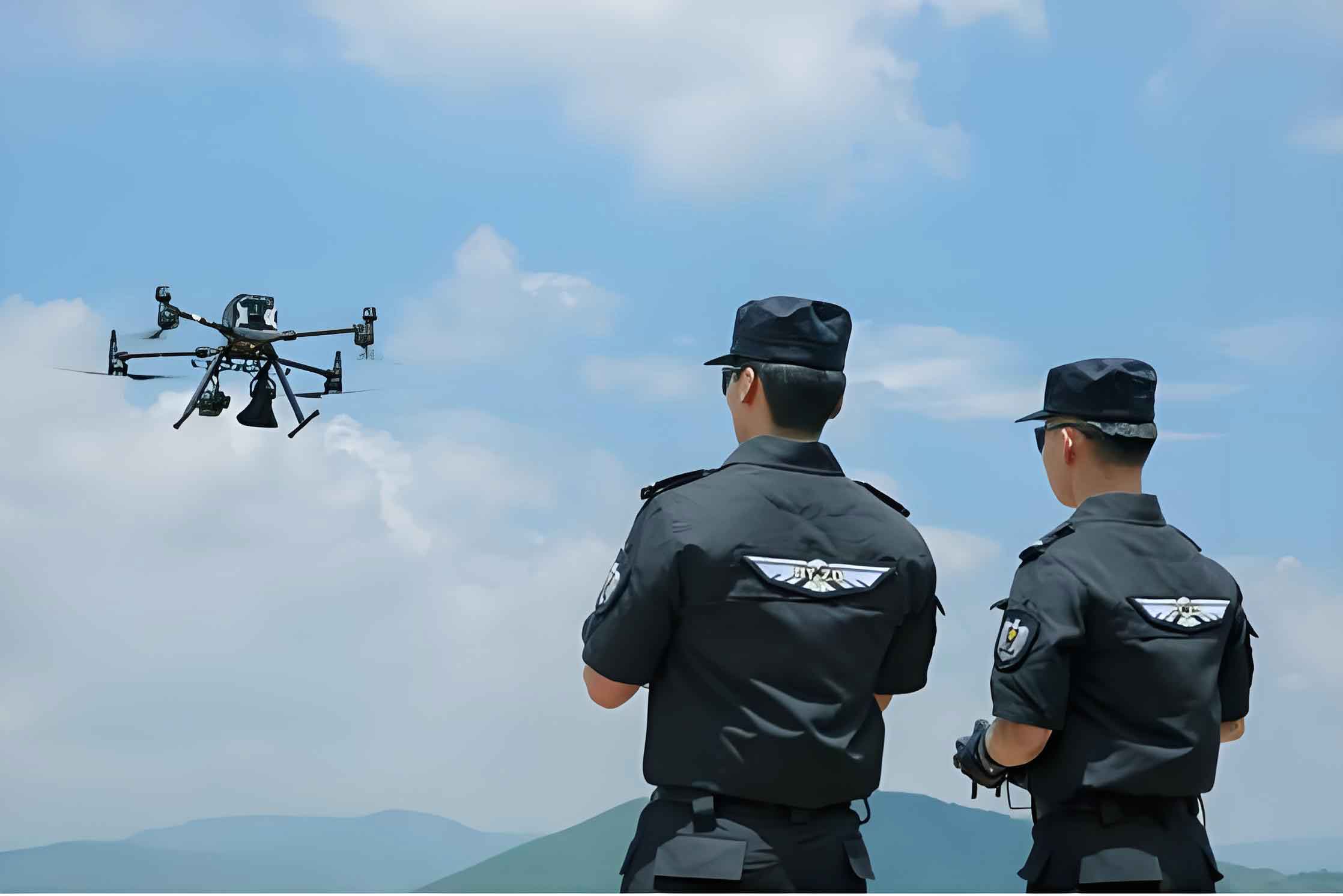
In recent years, police drone technology has emerged as a pivotal tool for law enforcement agencies worldwide, owing to its cost-effectiveness, ease of operation, flexibility, and stability. As a high-tech equipment, police drone systems have become a new driver for modernizing policing, enabling tasks such as aerial surveillance, routine patrols, search and tracking. This advancement underscores the urgent need for specialized talent cultivation and educational frameworks. In this article, I explore the current state, challenges, and future directions for police drone人才 development, drawing from research methods like literature review, interviews, and surveys. My focus is on aligning training programs with the evolving demands of public security work, emphasizing the cultivation of versatile, application-oriented professionals who can leverage police drone technology to enhance警务 efficiency and safety.
The integration of police drone units into law enforcement has progressed significantly. Many agencies have established dedicated drone squads, incorporated drones into command platforms, and utilized them for critical operations. Below is a table summarizing key applications and benefits of police drone deployment:
| Application Area | Benefits | Examples |
|---|---|---|
| Aerial Surveillance | Real-time monitoring and追踪 of suspects | Crime scene oversight, crowd management |
| Emergency Response | Rapid deployment for incidents | Disaster assessment, search and rescue |
| Traffic Management | Enhanced flow monitoring and enforcement | Accident investigation, congestion control |
| Public Safety | Proactive threat detection | Event security, hazard identification |
These applications have led to measurable improvements. For instance, police drone efficiency can be modeled using a performance metric: $$ E = \frac{T_a}{T_m} $$ where \( E \) represents efficiency gain, \( T_a \) is the time taken with drone assistance, and \( T_m \) is the time for manual methods. Studies show that \( E \) often exceeds 1.5, indicating a 50% or higher improvement in task speed. Moreover, the cost-benefit ratio for police drone operations is favorable: $$ CBR = \frac{B}{C} $$ with \( B \) being benefits like reduced manpower and enhanced accuracy, and \( C \) as operational costs. Typically, \( CBR > 2 \), underscoring the value of police drone investments.
Despite these advancements, several challenges hinder the optimal use of police drone technology. The integration between drones and警务 applications remains low, often limited to basic data collection without seamless analysis. This creates a bottleneck in decision-making. Additionally, personnel素质 issues persist, with many operators lacking advanced skills in multi-drone coordination or payload management. A critical concern is data security and privacy; without robust encryption, transmissions are vulnerable, and privacy breaches may occur. The table below outlines these problems in detail:
| Problem Category | Specific Issues | Impact |
|---|---|---|
| Technical Integration | Poor linkage with backend systems, lack of standards | Reduced operational effectiveness |
| Personnel Skills | Inadequate training, lag in tech updates | Underutilization of police drone capabilities |
| Data Security | Weak encryption, privacy意识 gaps | Risks to information and公民 rights |
| Talent Structure | Imbalance between operators and commanders | Limited innovation and战术 application |
In my analysis, the talent landscape for police drone professionals is underdeveloped.队伍建设 started late, with uneven growth across regions. Many agencies face a “drones without people” scenario, where equipment is purchased but not effectively used due to skill shortages. The personnel structure is skewed, often relying on auxiliary staff with technical expertise but limited警务 knowledge. Moreover, education systems lag; most police academies have introduced police drone courses, but comprehensive degree programs are nascent. This misalignment is reflected in training that focuses on飞行 control rather than实战 application, leading to a gap between certification and practical competence.
To address these issues, I conducted a需求 analysis based on student feedback and实战 unit inputs. From student surveys (over 62 responses), key insights emerged: 75.8% preferred实战-oriented training over technical theory, 51.6% advocated for more hands-on courses, and 79% found application skills more valuable than纯 technology classes. This highlights a shift toward practical, scenario-based learning for police drone人才. Meanwhile,实战 units emphasized the need for professionals familiar with industry trends and capable of跨部门 collaboration. The following table summarizes岗位需求 across various公安 departments:
| Department | Core Police Drone Responsibilities | Required Skills |
|---|---|---|
| Patrol and Surveillance | Aerial monitoring, urban governance | Flight control,地理 data collection |
| Criminal Investigation | Search, evidence gathering | 侦查 techniques, payload operation |
| Traffic Police | Enforcement, accident analysis | Video analytics, real-time reporting |
| Anti-Terror Units | Reconnaissance, strike support | 协同指挥, threat neutralization |
| Technology Divisions | System integration, data management | IT skills, innovation in police drone apps |
Based on this, I propose a培养目标 framework for police drone人才, centered on knowledge,能力, and素质 goals. These targets aim to produce复合型 professionals who can navigate both technological and警务 challenges. For knowledge, essential areas include Marxist theory, legal norms, and specialized police drone理论. The能力 goals stress实战 skills, such as drone操控 and应急处置, while素质目标 focus on political loyalty and innovation. To quantify these, consider a competency model: $$ C = w_k K + w_s S + w_a A $$ where \( C \) is overall competency, \( K \) is knowledge score, \( S \) is skill proficiency, \( A \) is attitude/素质 rating, and \( w \) are weights (e.g., \( w_k = 0.3, w_s = 0.5, w_a = 0.2 \)). This formula helps institutions assess police drone人才 development outcomes.
Delving deeper into knowledge objectives, police drone professionals must grasp foundational theories. This includes understanding无人机 dynamics, such as flight stability governed by equations like: $$ \tau = I \alpha $$ where \( \tau \) is torque, \( I \) is moment of inertia, and \( \alpha \) is angular acceleration—key for troubleshooting. They should also master legal frameworks, e.g., regulations on airspace management for police drone operations. A structured curriculum might cover topics from basic electronics to advanced警务 tactics, ensuring a blend of theory and practice. The table below outlines core knowledge domains:
| Knowledge Domain | Key Components | Relevance to Police Drone |
|---|---|---|
| Legal and Policy | National laws, aviation rules, privacy standards | Ensures compliant and ethical drone use |
| Technical Theory | Aerodynamics, sensor tech, data transmission | Enables effective equipment handling |
| 警务 Science | Crime prevention, emergency management | Contextualizes drone applications in policing |
| Innovation Trends | AI integration, swarm robotics | Fosters adaptability in evolving police drone tech |
For能力 objectives, police drone人才 must demonstrate practical prowess. This includes飞行 control skills, often assessed through metrics like accuracy in hovering: $$ A_h = \frac{1}{n} \sum_{i=1}^n (x_i – x_t)^2 $$ where \( A_h \) is hover accuracy, \( x_i \) are position readings, and \( x_t \) is the target. Lower \( A_h \) indicates better control. Additionally, they need指挥 abilities for multi-drone coordination, which can be modeled as a network efficiency problem: $$ \eta = \frac{N_{success}}{N_{total}} $$ with \( \eta \) as mission success rate. Training should emphasize scenario-based drills, such as using police drone for crowd monitoring or evidence collection, to bridge the gap between skill and实战. The following table lists critical能力 elements:
| Ability Type | Specific Skills | Assessment Methods |
|---|---|---|
| Technical Operation | Drone piloting, payload usage, maintenance | Flight tests, simulation exercises |
| Tactical Application | Scenario adaptation,协同作战 | Field演练, performance reviews |
| Strategic Thinking | Risk assessment, decision-making | Case studies,指挥 simulations |
| Innovation Capacity | Tech customization, problem-solving | Project designs, feedback from police drone units |
素质 objectives are equally vital for police drone人才. These encompass political steadfastness, ethical conduct, and physical fitness. For instance, psychological resilience can be gauged through stress indices: $$ S_i = \frac{P_e}{P_a} $$ where \( S_i \) is stress index, \( P_e \) is perceived event pressure, and \( P_a \) is coping ability. Lower \( S_i \) values correlate with better performance in high-risk police drone missions. Furthermore, fostering innovation精神 ensures that professionals can drive advancements, such as developing new drone-based战术. The integration of these素质 into training programs is essential for building a robust workforce capable of handling complex执法 environments with police drone technology.
Looking ahead, the demand for police drone talent will only grow as technology evolves. My research indicates that future training must emphasize interdisciplinary approaches, blending engineering with警务 studies. Institutions should establish standardized curricula, promote industry-academy collaboration, and regular实战演练 to keep pace with changes. For example, incorporating AI algorithms for autonomous police drone operations could be a focus, with mathematical models like: $$ P(detection) = 1 – e^{-\lambda t} $$ where \( \lambda \) is the detection rate parameter. This公式 helps optimize surveillance strategies. Additionally, addressing privacy concerns through technical safeguards, such as encryption protocols, will be crucial for sustainable police drone deployment.
In conclusion, the cultivation of police drone人才 is a multifaceted endeavor requiring alignment with实战 needs, educational innovation, and continuous adaptation. By setting clear knowledge,能力, and素质 targets, and leveraging tools like tables and formulas for assessment, agencies can develop professionals who maximize the potential of police drone systems. As I advocate in this article, a focus on application-oriented training, coupled with ethical and technical rigor, will ensure that police drone technology remains a cornerstone of modern policing, enhancing public safety and operational efficiency worldwide.