
The landscape of criminal investigation is undergoing a profound transformation, driven by technological innovation and the increasing demands of judicial reform. In this evolving paradigm, the police drone has emerged as a pivotal tool, particularly in the high-stakes arena of violent and emergency criminal cases. From my perspective as a researcher and practitioner at the intersection of technology and law enforcement, the integration of these unmanned aerial systems represents not merely an upgrade in equipment, but a fundamental shift from a two-dimensional, ground-bound investigative model to a dynamic, three-dimensional, and intelligent operational framework.
The traditional modus operandi for handling violent incidents—relying heavily on the physical presence, courage, and instinct of first responders—faces significant limitations in today’s complex urban environments. Cases involving armed assaults, kidnappings, public disturbances, or explosive threats demand rapid response, precise situational awareness, and evidence collection under potentially hazardous conditions. Here, the police drone, with its unique blend of agility, speed, and technological payload, proves to be indispensable. It serves as an aerial scout, a mobile command post, and a forensic eye, all while keeping human officers at a safer distance during the critical initial phase. This article explores the conceptual foundation, strategic value, practical applications, and future trajectory of police drone deployment in the investigation of violent and sudden-onset crimes.
Police Drones: A Conceptual and Functional Overview
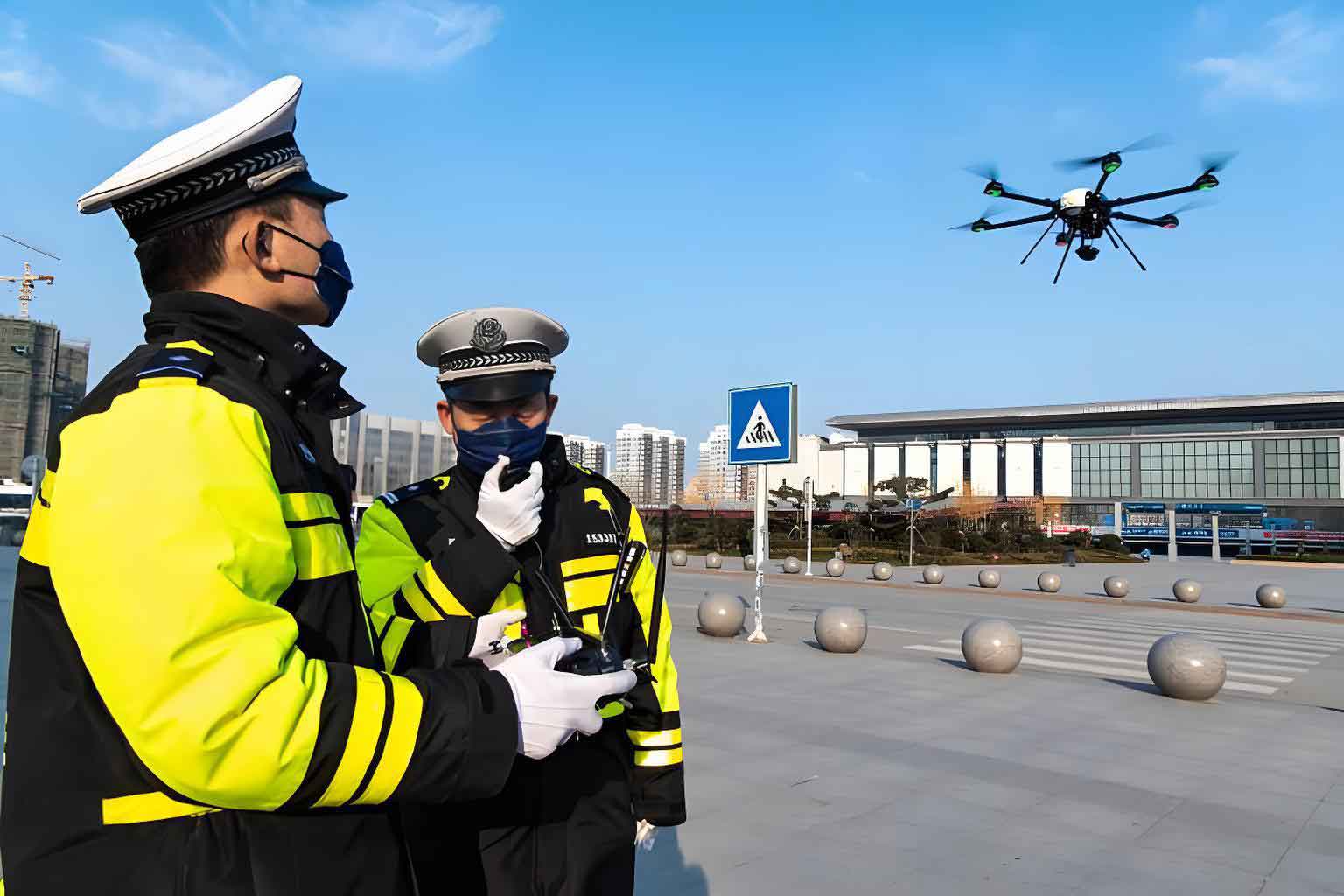
A police drone, or Unmanned Aerial System (UAS) configured for law enforcement, is more than a remote-controlled aircraft. It is an integrated platform comprising the aerial vehicle, a ground control station, data links, and specialized mission payloads. Its development, paralleling advancements in consumer electronics and aerospace, has accelerated from niche experimental use to a core component of modern policing tactics.
The classification of drones suitable for police work often centers on multi-rotor platforms (quadcopters, hexacopters) due to their vertical take-off and landing (VTOL) capability, hovering stability, and operational flexibility in confined spaces. For tactical field response, micro and small categories are most prevalent. Their specifications can be summarized as follows:
| Classification | Empty Weight | Maximum Take-off Weight | Typical Role |
|---|---|---|---|
| Micro Police Drone | ≤ 4 kg | ≤ 7 kg | Covert surveillance, indoor reconnaissance |
| Small Police Drone | 4 – 15 kg | 7 – 25 kg | Tactical response, evidence collection, pursuit |
The transformative power of a police drone lies in its payload—the suite of sensors and devices that extend human capabilities. This functional matrix turns the platform into a multi-role asset.
| Core Function | Technical Implementation | Investigative Utility |
|---|---|---|
| High-definition Reconnaissance | 4K/8K gimbal-stabilized cameras with optical & digital zoom | Live aerial overview, detailed scene documentation, suspect tracking. |
| Real-time Bi-directional Communication | 5G/secure mesh network data links for video/audio streaming | Real-time situational feed to command, direct communication with suspects/victims. |
| Biometric Identification | Onboard AI processing or link to cloud-based facial recognition systems | Real-time suspect identification in crowds or during pursuits. |
| Thermal Imaging & Night Vision | Long-wave infrared (LWIR) sensors, low-light cameras | Locating suspects in darkness, foliage, or obscured environments; detecting residual heat signatures. |
| Non-lethal/Lethal Intervention | Payload mechanisms for deploying irritants, tasers, or, in extreme cases, small munitions.* | Incident containment, disabling threats from a distance to protect officers. |
| Logistics & Payload Delivery | Lightweight cargo release systems | Delivering medical supplies, communication devices, or tactical equipment. |
* Note: The weaponization of police drones is a subject of significant legal and ethical debate and is highly regulated. Its mention here is for comprehensive functional analysis.
From an operational taxonomy, we can categorize police drone missions specifically for criminal investigation:
$$ M_{drone} = \{ S_{recon}, S_{warn}, S_{evidence}, S_{pursuit}, S_{rescue} \} $$
where $M_{drone}$ is the mission set, $S_{recon}$ denotes scene security and reconnaissance, $S_{warn}$ represents warning and containment, $S_{evidence}$ is for forensic evidence collection, $S_{pursuit}$ stands for tracking and pursuit support, and $S_{rescue}$ covers emergency assistance.
The Irreplaceable Strategic Value in Violent/Emergency Scenarios
The imperative for deploying a police drone in volatile situations stems from its ability to mitigate the fundamental risks and inefficiencies of traditional response. Its strategic value can be quantified across three critical dimensions: temporal advantage, risk reduction, and evidentiary integrity.
1. Temporal Dominance and Situational Command: Time is the most critical factor in active violence. Ground response is hindered by traffic, terrain, and perimeter establishment delays. A police drone achieves decisive time-saving. Its response time $T_{response}$ can be modeled as a function of distance $d$ and average speed $v_{drone}$, significantly lower than ground units $v_{ground}$ for the same distance in complex urban grids.
$$ T_{response}^{drone} = \frac{d}{v_{drone}} \ll T_{response}^{ground} = f(d, traffic, obstacles) $$
Upon arrival, it provides an immediate “God’s-eye view,” streaming real-time intelligence that allows command to make informed decisions before the first patrol car arrives, potentially de-escalating situations or guiding tactical approaches.
2. Enhanced Officer Safety and Risk Mitigation: Violent encounters pose the highest direct threat to officer safety. The police drone acts as a force multiplier and a risk absorber. It can enter potentially lethal environments—armed barricades, chemically contaminated zones, unstable structures post-explosion—without risking human life. This creates a safer stand-off distance for officers. The risk reduction $R_{reduction}$ can be conceptualized as directly proportional to the intelligence gathered $I_{drone}$ before physical engagement.
$$ R_{reduction} \propto I_{drone}(t) $$
where $I_{drone}(t)$ is the intelligence function over time provided by the drone.
3. Preserving Evidentiary Integrity and Procedural Rigor: The modern judicial system, centered on trial, demands impeccable evidence. Crime scenes, especially in public spaces, are incredibly fragile. A police drone dispatched ahead secures the scene virtually, broadcasting footage that deters contamination and provides an immutable, timestamped, panoramic record of the scene’s initial state. It documents crowd dynamics, suspect movements, and evidence location before any human interaction. This aerial log forms a foundational layer of objective evidence, minimizing allegations of evidence tampering or procedural error. The evidentiary quality $Q_{evidence}$ is enhanced by the drone’s orthogonal perspective and early documentation.
$$ Q_{evidence} = f(Completeness, Objectivity, Timestamp) $$
The drone maximizes all three variables from a unique aerial vantage point at $t \approx 0$.
Application Workflow in the Investigative Process
The integration of a police drone into the investigative workflow for a violent/emergency incident follows a logical, phased progression, enhancing each step from dispatch to resolution.
| Phase | Drone Action | Outcome/Advantage |
|---|---|---|
| 1. Immediate Dispatch & Rapid Response | Automated launch from station/vehicle upon call classification. Pre-programmed or piloted flight to GPS coordinates. | Beats ground units to scene by minutes, providing the first live intelligence. |
| 2. Initial Scene Assessment & Containment | High-altitude orbit for broad assessment. Use of loudspeaker for warnings/instructions. Virtual perimeter marking via light/laser. | Commands the scene from the air, prevents suspect escape, deters evidence contamination, initiates crisis negotiation. |
| 3. Dynamic Investigation & Evidence Collection | Low-altitude, detailed filming of the scene. Thermal scan for hidden suspects/weapons. Photogrammetry for 3D scene reconstruction. | Creates a comprehensive, searchable digital twin of the crime scene. Locates hidden threats or victims (e.g., in brush, rubble). |
| 4. Covert Surveillance & Pursuit Support | Silent operation at a distance using zoom/thermal. Tracking of fleeing suspects from altitude. Relay of real-time position to ground teams. | Maintains constant surveillance without alerting suspects (“persistent stare”). Enables strategic containment and safe apprehension. |
| 5. Tactical Assistance & Resolution | Live feed for SWAT team breaching. Delivery of tactical gear (e.g., gas canisters). Deployment of non-lethal measures if authorized. | Provides real-time interior layout during dynamic entries. Resolves situations with minimized direct confrontation. |
| 6. Post-Incident Analysis & Documentation | High-resolution mapping of the entire area. Archiving of all flight telemetry and video feeds. | Generates exhibits for court, supports after-action reviews, and creates training material. |
This workflow demonstrates how the police drone transitions seamlessly between roles. For instance, in a reported armed robbery, the drone is first a responder, then a scene guard, then a pursuit asset if the suspect flees, and finally a forensic tool. Its versatility addresses the multi-faceted challenges of violent crime.
Future Trajectory: Integration, Autonomy, and Swarm Intelligence
The current capabilities of the police drone are merely the foundation. The future points toward deeper system integration, increased autonomy, and collaborative operations that will further revolutionize tactical response.
1. AI-Powered Predictive Analytics and Automated Response: Future systems will leverage Artificial Intelligence and Machine Learning (AI/ML) not just for object recognition, but for predictive behavioral analysis. A police drone could analyze crowd footage in real-time to predict the eruption of violence or identify pre-attack indicators in an individual’s posture. Response protocols could be partially automated based on predefined rules of engagement assessed by the AI.
2. The Dawn of Drone Swarms and Heterogeneous Teams: A single drone has limitations in coverage and endurance. The next leap involves coordinated swarms of police drones. A swarm $S$ of $n$ drones could blanket a large area, with communication governed by algorithms for area division and target handover.
$$ S = \{ drone_1, drone_2, …, drone_n \} $$
$$ Coverage(S) \approx \sum_{i=1}^{n} A_i \quad \text{where } A_i \text{ is the effective coverage of drone i, with minimal overlap} $$
Furthermore, we will see heterogeneous teams combining aerial drones with ground-based UGVs (Unmanned Ground Vehicles). An aerial police drone would guide a UGV to deliver a rescue package or to enter a structure too dangerous for any human, creating a truly multi-domain robotic first responder team.
3. Advanced Sensor Fusion and Extended Endurance: Payloads will evolve to include more sophisticated sensors like multispectral imagers, ground-penetrating radar for locating buried evidence, or advanced chemical “sniffers” for detecting explosives or narcotics. The perennial challenge of battery life will be addressed through hybrid power systems, automated wireless charging stations on light poles, or even hydrogen fuel cells, dramatically extending on-station time.
4. Institutional Integration and Standardization: For this potential to be fully realized, police drone operations must move beyond specialized units. We will see the establishment of standardized protocols, dedicated UAS divisions within departments, and their integration into everyday patrol functions. Training will become mandatory, and legal frameworks will mature to clearly define operational boundaries, data handling, and privacy protections.
Conclusion
The advent of the police drone marks a pivotal moment in law enforcement technology. In the context of violent and emergency criminal investigations, it is not a mere gadget but a strategic necessity. By providing unmatched speed of response, unparalleled situational awareness, robust evidence collection, and a significant force-protection advantage, it directly addresses the most pressing challenges in modern policing. The transition from a ground-centric, reactive model to an integrated, air-ground, intelligent, and proactive one is already underway.
Looking forward, the trajectory is clear: increased autonomy, deeper AI integration, and collaborative robotic systems will define the next generation of police drone capabilities. To harness this potential fully, law enforcement agencies must proactively invest in technology, training, and legal-ethical frameworks. The police drone has proven its value on today’s front lines; it is poised to become the cornerstone of tomorrow’s intelligent, effective, and safe public safety infrastructure. The three-dimensional battlespace of future crime prevention and response will undoubtedly be commanded from the air.