
The ever-growing demand for safe and efficient transportation on freeways continuously challenges the capabilities of public security traffic management departments. The tension between public needs for smooth travel and safety, and the current capacity of law enforcement, necessitates the adoption of innovative technological solutions to improve traffic conditions and elevate management standards. In this context, the police drone emerges as a transformative tool. My analysis posits that police drones offer a three-dimensional, dynamic solution capable of preventing incidents through early hazard detection, aiding law enforcement via investigation and evidence collection, and supporting critical operations like security details. This article explores the vast application potential of police drones in freeway traffic management, systematically examining their advantages, practical deployment scenarios for both routine and emergency situations, and the significant technical and regulatory constraints that must be addressed for their effective integration.
The operational advantages of police drones are best understood through their core functions: prevention, enforcement support, and operational cooperation.
A Systemic Framework for Police Drone Advantages
Traditional freeway patrols and fixed CCTV networks are inherently limited by their planar, localized perspectives. Police drones break these constraints by providing an elevated, mobile vantage point. The fundamental advantage can be modeled as an expansion of the effective monitoring volume $V_{eff}$:
$$V_{eff}^{drone} = \int_{A} h(x,y) \cdot f_{sensor}(r) \,dA \gg V_{eff}^{ground} = \int_{L} w \cdot f_{sensor}(r) \,dL$$
where $A$ is the area covered, $h(x,y)$ is the variable operational altitude, $f_{sensor}(r)$ is the sensor’s range function, $L$ is the linear path of a ground unit, and $w$ is the effective road width. This volumetric superiority translates into concrete benefits.
1. Proactive Accident Prevention
Statistical analyses consistently identify human error (e.g., speeding, fatigue, improper maneuvers) as the primary causative factor in 80-90% of freeway accidents, followed by vehicle failures, road conditions, weather, and traffic volume. Police drones act as force multipliers for proactive detection. By conducting aerial reconnaissance, they can identify static and dynamic hazards—such as illegally parked vehicles, erratic driving patterns, debris on the roadway, or poor visibility zones—long before they escalate into collisions. Upon detection, the police drone can immediately alert the command center, direct ground units, or even initiate on-site warnings. For impending crises like sudden恶劣天气 (severe weather) or other突发事件 (emergencies), drones equipped with specialized sensors can provide real-time, first-hand data, enabling early warning systems for both drivers and traffic police to activate contingency plans.
2. Enhanced Law Enforcement Support
Freeway law enforcement operates through on-site and non-on-site (e.g., speed camera) modalities. Police drones enhance both. For on-site operations—whether routine checks or specialized crackdowns—a police drone provides aerial surveillance, gathering comprehensive evidence of violations while simultaneously recording the entire enforcement process for transparency and dispute resolution. All data can be livestreamed to the command center as electronic evidence.
In non-on-site enforcement, which relies on fixed or vehicle-mounted technical monitoring, police drones introduce spatial flexibility. They are not confined to the road surface; they can perform定点监控 (fixed-point monitoring) or活动监控 (mobile monitoring) from the sky, filling coverage gaps and working synergistically with existing ground-based systems. The operational matrix below summarizes this enhanced capability:
| Enforcement Mode | Traditional Limitation | Police Drone Enhancement |
|---|---|---|
| On-site Patrol & Checkpoint | Limited field of view; evidence limited to ground perspective. | Aerial overview for context; discreet evidence collection; full-process recording. |
| Non-on-site / Technical Monitoring | Fixed or linearly mobile assets; blind spots between devices. | Dynamic area coverage; flexible positioning to target violations; complementary aerial data layer. |
| Post-Accident Investigation | Time-consuming manual scene documentation; traffic disruption during investigation. | Rapid aerial mapping and 3D modeling of the scene; accurate measurement of skid marks, vehicle positions. |
3. Critical Operation Coordination
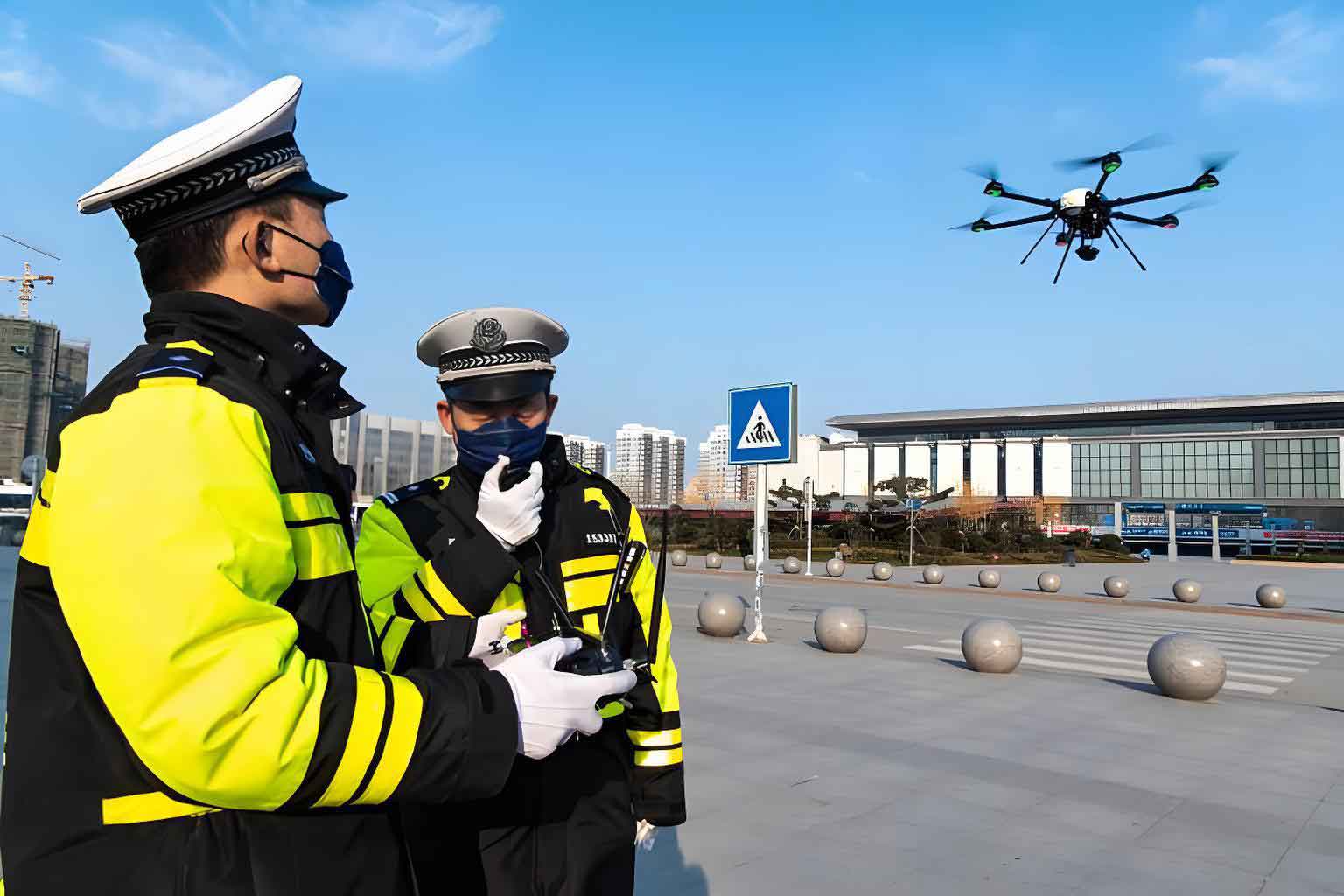
Beyond routine traffic management, freeway police are tasked with警戒 (security cordons), 保卫 (protection details), and 护送 (escort missions). The traditional “officer + patrol car” model focuses attention on the principal, potentially overlooking the broader traffic environment. Integrating a police drone creates a “drone + officer + patrol car” triad. In this model, the drone provides a persistent overhead view of the surrounding traffic flow and environmental conditions, while the ground units focus on the immediate protectee. The commanding officer synthesizes this dual-perspective data, enabling dynamic adjustment of the operation’s route and tactics to ensure both mission success and minimal disruption to freeway traffic.
Practical Application Scenarios and Configurations
The theoretical advantages of the police drone materialize in specific operational configurations tailored for daily law enforcement and emergency response.
I. Daily Law Enforcement Operations
For daily duties, police drones should be deployed to automate and enhance monitoring in high-risk zones. A typical configuration matrix for a freeway patrol unit might include:
| Mission Profile | Recommended Drone Type/Feature | Key Payload/Module | Operational Benefit |
|---|---|---|---|
| Illegal Parking & Hazard Detection | Multi-rotor (e.g., DJI Matrice series) with high-zoom camera | Optical Zoom Camera (e.g., 30x+) | Clear identification of vehicle plates and driver activity at distance. |
| Nighttime Patrol & Incident Response | Multi-rotor with thermal imaging capability | Radiometric Thermal Camera (e.g., FLIR Tau2) | Detects heat signatures of vehicles/persons in darkness, through light fog/smoke. |
| Aerial Warning & Communication | Medium-lift multi-rotor | High-power Directional Speaker | Projects audible instructions over 500m-1km radius, directing drivers safely. |
| Routine Area Surveillance | Fixed-wing or Hybrid VTOL | Standard 4K Visual Camera | Long endurance (60+ mins) for covering large stretches of freeway efficiently. |
The effectiveness of nighttime operations, crucial for freeways, can be quantified. A thermal camera’s detection range depends on the Instantaneous Field of View (IFOV) and the target’s temperature differential. The Noise Equivalent Temperature Difference (NETD), a measure of thermal sensitivity, is critical. A lower NETD (e.g., < 40 mK) allows a police drone to detect smaller temperature differences, making it easier to identify a stalled vehicle’s engine heat against the cool road surface. The Johnson’s criteria for detection can be loosely applied: $$N = \frac{R \cdot \text{IFOV}}{H_{target}}$$ where $N$ is the number of pixels on target, $R$ is range, and $H_{target}$ is target height. For reliable vehicle detection, $N$ typically needs to be > 1.5.
II. Emergency Response and Incident Management
Here, the police drone transitions from a monitoring tool to a central command, control, and communications (C3) node. Its role aligns with standard incident command system (ICS) functions.
A. Major Traffic Accident Response: The primary goal is rapid situational assessment and resource optimization. A police drone can be first on scene, providing a live feed to the Incident Commander. The aerial view helps determine the scale of the incident ($S$), the number of vehicles involved ($N_v$), apparent injuries ($I_a$), and road blockage status ($B$). This data feeds a simple initial severity index: $$SI_{initial} = \alpha \cdot N_v + \beta \cdot I_a + \gamma \cdot B$$ where $\alpha, \beta, \gamma$ are weighting factors based on local protocol. This index guides the dispatch of appropriate medical, fire, and tow resources.
B. Complex Freeway Emergencies: These include natural disasters, hazardous material spills, public disorder, or pursuit interventions. Police drone configurations become mission-specific:
- Persistent Surveillance: Using a tethering system, a drone can remain aloft for 12+ hours, providing uninterrupted video for the Situation Unit.
- Communications Relay: Drones equipped with mesh radio or cellular repeater payloads can restore communications in areas where infrastructure is damaged or overloaded, directly supporting the Operations Section.
- Non-lethal Intervention: For managing dangerous suspects, drones can be fitted with loudspeakers for negotiation or, in extreme cases, specialized modules for launching containment nets or non-lethal projectitles (e.g., tear gas, flash-bang) from a safe stand-off distance. The kinetic energy of a net can be approximated by $KE = \frac{1}{2} m v^2$, where deployment parameters are designed for safe suspect incapacitation.
- Search and Rescue (SAR): Over water or difficult terrain adjacent to freeways, drones can drop auto-inflating life rings or use thermal cameras to locate missing persons. The probability of detection ($P_d$) in SAR improves with altitude $h$ and sensor resolution, but is subject to a geometric dilution: $$P_d \propto \frac{\text{Resolution}_{sensor}}{h \cdot \tan(\text{FOV}/2)}$$
Constraining Factors and Implementation Bottlenecks
Despite the compelling use cases, the integration of police drones into freeway traffic management is not without significant hurdles, which I categorize as technical and institutional.
Technical Constraints
The performance envelope of a police drone system is defined by several interrelated technical parameters. The ultimate utility is a function of these factors: $$U_{drone} = f(B, E, A, C, T)$$ where $B$=Battery Life, $E$=Environmental Resilience, $A$=Autonomy, $C$=Camera/Comms quality, and $T$=Turnkey Operation.
| Factor | Challenge | Current State & Requirement |
|---|---|---|
| Battery Endurance (B) | Freeway corridors require long range and time on station. | Typical multi-rotor: 25-40 mins. Need: 60+ mins for effective patrol. Hybrid VTOL/fixed-wing offers 90-120 mins. |
| Environmental Resilience (E) | Operations in rain, wind, and temperature extremes are necessary. | Requires at least IP54 rating for rain/dust resistance. Operational wind speed tolerance should exceed 12 m/s (Beaufort 6). |
| Autonomous Operation (A) | Reducing pilot workload for routine missions. | Need advanced path planning, automatic obstacle avoidance (using vision/radar), and reliable “Return-to-Home” failsafes. |
| Camera & Comms (C) | Data link stability and image clarity are vital for evidence and command decisions. | Require low-latency HD video transmission (1080p/30fps) over ranges >5km. Integration with 4G/LTE/5G networks for backup. |
| Payload Integration (T) | Quick-swap, plug-and-play modules for speakers, lights, sensors. | Standardized mounting interfaces (e.g., DJI SkyPort, Gremsy quick-release) are essential for rapid mission re-tasking. |
Institutional and Regulatory Constraints
Technology alone is insufficient. Its effective adoption requires a supportive institutional framework.
1. Standard Operating Procedures (SOPs): The lack of standardized protocols for police drone deployment is a major barrier. Comprehensive SOPs must define:
- Authority to Launch: Clear criteria for who can authorize a flight and under what circumstances (e.g., pursuit, accident, routine patrol).
- Flight Protocols: Pre-planned routes, altitude restrictions, communication procedures with air traffic control for operations near airports.
- Data Management: Policies for video storage, retention, labeling as evidence, and public release to ensure privacy compliance and chain of custody.
2. System Integration and Interoperability: The police drone cannot be a standalone “toy.” Its value multiplies when integrated into the existing technology ecosystem:
$$ \text{Synergy Value} = \frac{\text{Drone Data} \cap (\text{CCTV Data} \cup \text{Patrol Car Data} \cup \text{License Plate Reader Data})}{\text{Siloed Data}} > 1$$
This requires open Application Programming Interfaces (APIs) to feed drone video and telemetry directly into the central Traffic Management Center’s software platform, allowing operators to view all data sources on a single Common Operating Picture (COP).
3. Regulatory and Legal Compliance: The regulatory landscape for unmanned aircraft is evolving. Key concerns include:
- Airspace Integration: Compliance with national aviation authority rules (e.g., FAA Part 107 in the U.S., EASA regulations in EU) regarding pilot certification, visual line-of-sight (VLOS) vs. beyond visual line-of-sight (BVLOS) operations, and flight over people.
- Privacy Law: Balancing public safety surveillance with individual privacy rights. This necessitates clear policies on when and where recording is permissible, and how data is anonymized or redacted for non-evidentiary uses.
- Liability and Insurance: Establishing clear guidelines for liability in case of a drone malfunction causing property damage or injury.
Conclusion and Forward-Looking Perspective
The application of police drones in freeway traffic management represents a paradigm shift from reactive, ground-bound policing to proactive, intelligence-led, and spatially dominant operations. My analysis confirms their significant potential in preventing accidents through early detection, substantially aiding both on-site and non-on-site law enforcement modalities, and providing critical overhead support for complex operational missions. The practical deployment scenarios are rich and varied, spanning from automated nighttime patrols with thermal imaging to acting as a communications and intervention hub during major freeway emergencies.
However, realizing this potential is contingent upon overcoming substantial challenges. The technical limitations of endurance, weatherproofing, and autonomy are being actively addressed by the industry but remain key procurement considerations. More critically, the institutional bottlenecks—the lack of standardized procedures, the challenge of seamless integration with legacy systems, and the need for a clear and supportive regulatory framework—require deliberate and focused effort from public security agencies. They must work in concert with aviation regulators and legal experts to develop the necessary policies.
The future evolution will likely see police drone operations becoming increasingly automated and networked. Swarms of drones could collaboratively monitor vast freeway segments, with AI analyzing video feeds in real-time to flag anomalies. BVLOS regulations will unlock the ability to deploy drones from a central hangar to incidents dozens of kilometers away. Ultimately, the police drone is not merely a new gadget but the cornerstone of a future “smart freeway” enforcement ecosystem, where aerial awareness seamlessly merges with ground operations and data analytics to create a safer, more efficient transportation network. The journey towards this future begins with strategic investment, rigorous testing, and the thoughtful development of the human and institutional frameworks to support the technology.