
The rapid proliferation of Unmanned Aerial Vehicles (UAVs), or drones, across civilian sectors presents both significant opportunities and formidable challenges for public safety and airspace management. For police and law enforcement agencies, drones have become invaluable tools for tasks ranging from surveillance and crowd monitoring to search and rescue and traffic accident reconstruction. However, this very utility, when extended to unregulated or malicious actors, poses a substantial threat to critical infrastructure, public events, and general security. The absence of a comprehensive, real-time monitoring and management framework for drone operations creates a significant blind spot. This gap hinders not only the security apparatus’s ability to safeguard protected airspace but also restricts the legitimate, large-scale application of drone technology due to unmanaged risks. Therefore, the development and deployment of a robust Police Drone Dynamic Monitoring Platform is not merely an operational enhancement; it is a critical necessity for modern policing and the foundational step towards a regulated, safe, and efficient low-altitude airspace ecosystem.
From a first-person design perspective, our primary objective was to create a system that provides police operators with complete situational awareness and command authority over drone activities within their jurisdiction. The platform must seamlessly integrate monitoring, identification, communication, and control functions. The core challenge lies in establishing a reliable, wide-area communication link between the moving drone (the aerial node) and the ground-based command center, especially in diverse urban and rural environments. Our design philosophy emphasized scalability, openness, and independence from any single proprietary technology. We aimed to leverage existing communication infrastructure where possible while integrating emerging technologies to ensure future-proofing and cost-effectiveness.
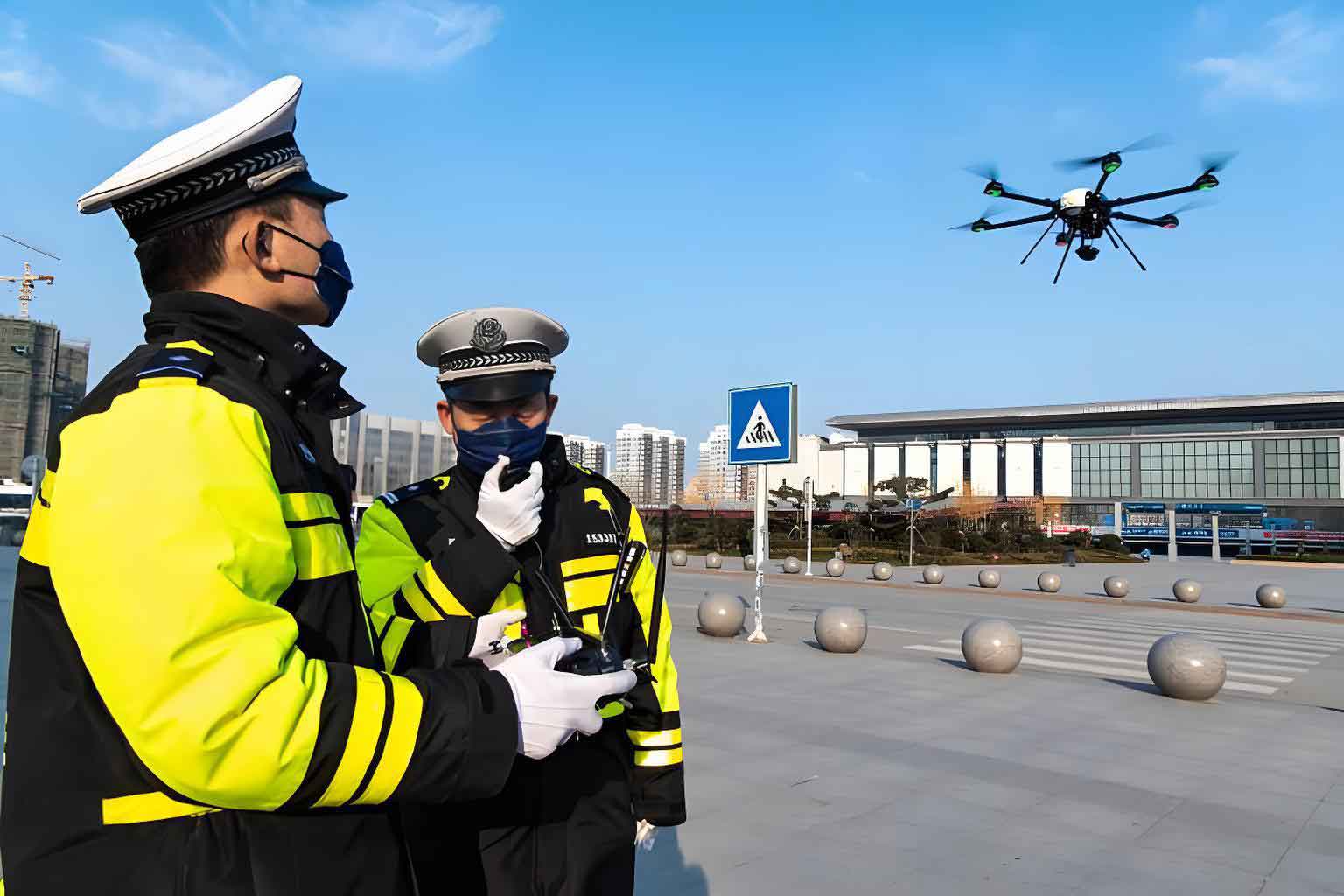
The operational model of the police drone monitoring system involves several key actors and subsystems. The police drone itself is the primary object of monitoring. The Drone Pilot (who could be a police officer or an authorized civilian operator) manually controls the police drone via a direct radio link. The Police Controller at the monitoring station oversees all active police drone flights, receiving telemetry data, issuing mission directives via voice communication to the pilot, and, crucially, possessing the capability to transmit override flight commands directly to the police drone in emergencies. The Onboard System equips the police drone with the necessary avionics, while the Ground-Based System serves as the central processing and visualization hub for the controller.
System Architecture Design
The overall architecture is modular, comprising five major segments: the Onboard System, the Ground Control System, the Ground Communication System, the Network & Support System, and the Perimeter Integration System. This segmentation ensures that upgrades or modifications in one domain (e.g., communication technology on the police drone) do not necessitate a complete overhaul of the entire platform.
1. Onboard System (Police Drone Payload)
The design of the onboard module for the police drone prioritized miniaturization, low power consumption, and ease of integration. We employed a system-on-chip (SoC) and modular design philosophy based on software-defined radio principles. The core components are integrated onto a single monitoring board:
- Dual-Mode GNSS Receiver (GPS/BeiDou): Provides high-precision positional and timing data. Redundancy from two constellations improves reliability and accuracy, which is critical for tracking a police drone. The positioning error $\epsilon_{pos}$ can be modeled as a function of satellite geometry (Dilution of Precision – DOP) and measurement noise $\sigma$:
$$ \epsilon_{pos} = \text{DOP} \times \sigma $$ - Microcontroller Unit (MCU): The computational core that aggregates sensor data (position, altitude, speed, battery status), formats it into telemetry packets, and manages the communication protocol with the ground.
- Cellular Communication Module (2G/4G/LTE Cat-M/NB-IoT capable): This is the primary data bridge. It contains a SIM card and connects to public or private cellular networks to uplink telemetry and downlink commands.
- Power Management Unit (PMU): Ensures stable and efficient power delivery from the police drone‘s battery to all onboard electronics.
The data flow on the police drone can be summarized by the following processing chain:
$$ \text{GNSS Data} + \text{Status Data} \xrightarrow[\text{Aggregation}]{\text{MCU}} \text{Telemetry Packet} \xrightarrow[\text{Transmission}]{\text{Cellular Module}} \text{Ground Station} $$
2. Ground Control System (Command Center)
The Ground Control System is the brain of the operation. Its software architecture is layered to ensure maintainability and scalability:
- Interface Layer: Provides the human-machine interface (HMI) for controllers, displaying real-time police drone tracks on a digital map, alert dashboards, and command interfaces. It also handles external data feeds (e.g., weather, airspace restrictions).
- Core Layer: The operating system and foundational middleware that manage hardware resources, process scheduling, and inter-service communication.
- Service Layer: Hosts high-level services like database management systems (for logging all police drone flight data), GIS servers, and web application servers. This layer provides the APIs for the application layer.
- Application Layer: Contains the specific business logic software modules:
- Flight Monitoring Module: Visualizes the real-time position, track, and status of every registered police drone.
- Alert & Geofencing Module: Generates alarms if a police drone enters a no-fly zone (geofence) or deviates from its flight plan. A geofence breach condition can be defined as:
$$ \text{If } \text{Distance}(\text{Drone}_{pos}, \text{Geofence}_{center}) \leq \text{Geofence}_{radius} \rightarrow \text{Trigger Alarm} $$ - Command & Control Module: Allows the controller to send direct flight commands (e.g., “Return-to-Home,” “Land Immediately”) to a specific police drone, overriding the pilot if necessary.
- Identity & Registry Module: Manages the database of certified police drone units, their hardware IDs, and authorized pilots.
3. Network & Support System (The Communication Backbone)
This is arguably the most critical subsystem, determining the operational range and reliability of the entire police drone monitoring platform. Our design adopts a hybrid network strategy to balance coverage, cost, and data rate.
A. Cellular Network (Primary Wide-Area Link):
Initially, we leverage ubiquitous public 2G/4G networks. The police drone‘s onboard module acts as a standard IoT device, transmitting small, periodic telemetry packets. The advantages are immediate nationwide coverage and low cost. However, challenges exist:
- Coverage at Altitude: Cellular networks are optimized for ground users. Base station antennas are downtilted, causing signal strength to decay rapidly above 200m, which is within the operating envelope of many police drone units. The received signal strength $P_r$ at the police drone can be estimated using a modified path loss model:
$$ P_r(dBm) = P_t + G_t + G_r – PL_0 – 10n \log_{10}\left(\frac{d}{d_0}\right) – L_{\text{tilt}} $$
where $L_{\text{tilt}}$ represents the additional loss due to antenna vertical pattern mismatch. - Network Sunset: 2G networks are being phased out, necessitating a migration path.
B. LPWAN Supplement (LoRa for Coverage Gaps):
For operations in remote areas devoid of cellular coverage or for dedicated, secure police operations, we integrate LoRa (Long Range) technology. LoRa offers exceptional link budget and sensitivity (down to -148 dBm), enabling communication over several kilometers with very low power consumption. A portable LoRa gateway can be deployed rapidly to create a local monitoring bubble for police drone activities. The link budget equation highlights its advantage:
$$ \text{Link Budget} = P_{Tx} – \text{Receiver Sensitivity} = \text{Path Loss}_{max} $$
With LoRa’s high sensitivity, the maximum allowable path loss is significantly higher than traditional cellular, extending range.
C. Future Evolution towards NB-IoT:
Our architecture is designed to smoothly transition to Narrowband IoT (NB-IoT), a 3GPP-standardized LPWAN technology deployed within existing cellular bands. NB-IoT offers the best of both worlds: the managed security and quality-of-service of a licensed spectrum network, coupled with the deep penetration, long battery life, and massive connection density ideal for widespread police drone fleet monitoring.
The technical evolution path and comparison are summarized in the table below:
| Feature | GSM/GPRS (Current) | LoRa (Gap-Filler) | NB-IoT (Target) |
|---|---|---|---|
| Technology Type | Cellular (2G) | Spread Spectrum (Chirp) | Cellular LPWAN (4G/5G) |
| Spectrum | Licensed (900/1800 MHz) | Unlicensed (e.g., 470-510 MHz) | Licensed (In-band/Guard-band) |
| Data Rate | ~100-200 kbps | < 50 kbps | < 200 kbps |
| Range | Medium (limited at high altitude) | Long (10+ km rural) | Long (1-10 km, better indoor) |
| Battery Life | Days | Years | Years (10+) |
| Network Management | Carrier-operated, wide coverage | Self-deployed, local network | Carrier-operated, wide coverage |
| Security | Standard SIM-based (good) | Network-key based (requires careful management) | Strong (SIM-based, integrated with mobile core) |
| Deployment Model | Leverage existing infrastructure | Ad-hoc, on-demand deployment | Leverage evolving 4G/5G infrastructure |
4. Perimeter Integration System (Secure Connection to Police Networks)
For the police drone monitoring data to be actionable, it must be integrated into the secure police intranet (e.g., for correlation with other surveillance systems or dispatch). This requires a secure perimeter gateway designed according to the principle of defense-in-depth. The architecture consists of distinct security zones:
- Routing & Access Zone: The external interface that accepts connections from the cellular/LoRa networks and the public monitoring platform front-end.
- Boundary Protection Zone: This zone enforces security policy. It performs rigorous authentication of devices and users, strips protocols, and inspects content for threats using firewalls and intrusion prevention systems (IPS). All external IP addresses are translated to internal ones here.
- Application Service Zone: Hosts the proxies and application-level gateways that facilitate data exchange between the external monitoring platform and internal police databases. It prevents direct access to core police systems.
- Security Monitoring & Management Zone: A dedicated segment for auditing, log management, and security information and event management (SIEM), providing oversight of all cross-perimeter data flows related to police drone operations.
Access control between zones follows a default-deny, allow-by-exception policy, mathematically ensuring that only explicitly permitted data flows $F_{perm}$ are transmitted from zone $Z_i$ to zone $Z_j$:
$$ \text{Transmit}(F, Z_i, Z_j) = \begin{cases} \text{Allow}, & \text{if } F \in \{F_{perm}\} \\ \text{Deny}, & \text{otherwise} \end{cases} $$
Implementation Insights and Future Trajectory
The implementation of this platform is envisioned as a phased migration, aligning with the evolution of public communication networks to maximize cost-efficiency and technological relevance for police drone management.
Phase 1 (Foundation): Deploy the system using existing GSM/GPRS/4G networks for primary data backhaul. This provides immediate, wide-area functionality for monitoring police drone fleets. In coverage gaps, portable LoRa gateways or cellular应急 vehicles provide temporary, mission-specific coverage.
Phase 2 (Coexistence & Transition): As mobile network operators roll out NB-IoT coverage, new police drone units or retrofit modules can be equipped with NB-IoT capabilities. The ground system is upgraded to support dual connectivity (legacy cellular and NB-IoT), allowing for a gradual transition.
Phase 3 (Consolidation): Once NB-IoT coverage is ubiquitous and mature, it becomes the standardized, primary communication bearer for all police drone monitoring. The legacy GSM modules are phased out. The platform fully capitalizes on NB-IoT’s advantages: deep coverage, ultra-low power consumption for extended police drone mission times, enhanced security inherited from the mobile core network, and massive scale suitable for managing not just police units but potentially integrating civilian drone registries.
Looking further ahead, the platform’s architecture is open to incorporating 5G features. Network Slicing could allow the police department to have a dedicated, virtualized slice of the public 5G network with guaranteed latency and bandwidth for command and control of critical police drone operations, such as drone swarms for large-area search.
Conclusion
The designed and implemented Police Drone Dynamic Monitoring Platform establishes a critical command and control infrastructure for safe and effective drone utilization in law enforcement. By adopting a hybrid, evolvable communication strategy and a modular, secure system architecture, it addresses the immediate need for oversight of police drone operations while laying a scalable foundation for the future. The platform’s true potential extends beyond policing; it serves as a blueprint for a broader societal framework for UTM (UAS Traffic Management). Once proven and standardized within the rigorous public safety domain, the technological and procedural framework can be extended to regulate and integrate commercial and recreational drone traffic, transforming the low-altitude airspace from a chaotic frontier into a safe, efficient, and managed resource. The journey begins with securing each individual police drone flight, culminating in the safe integration of all unmanned aerial vehicles into our shared skies.