
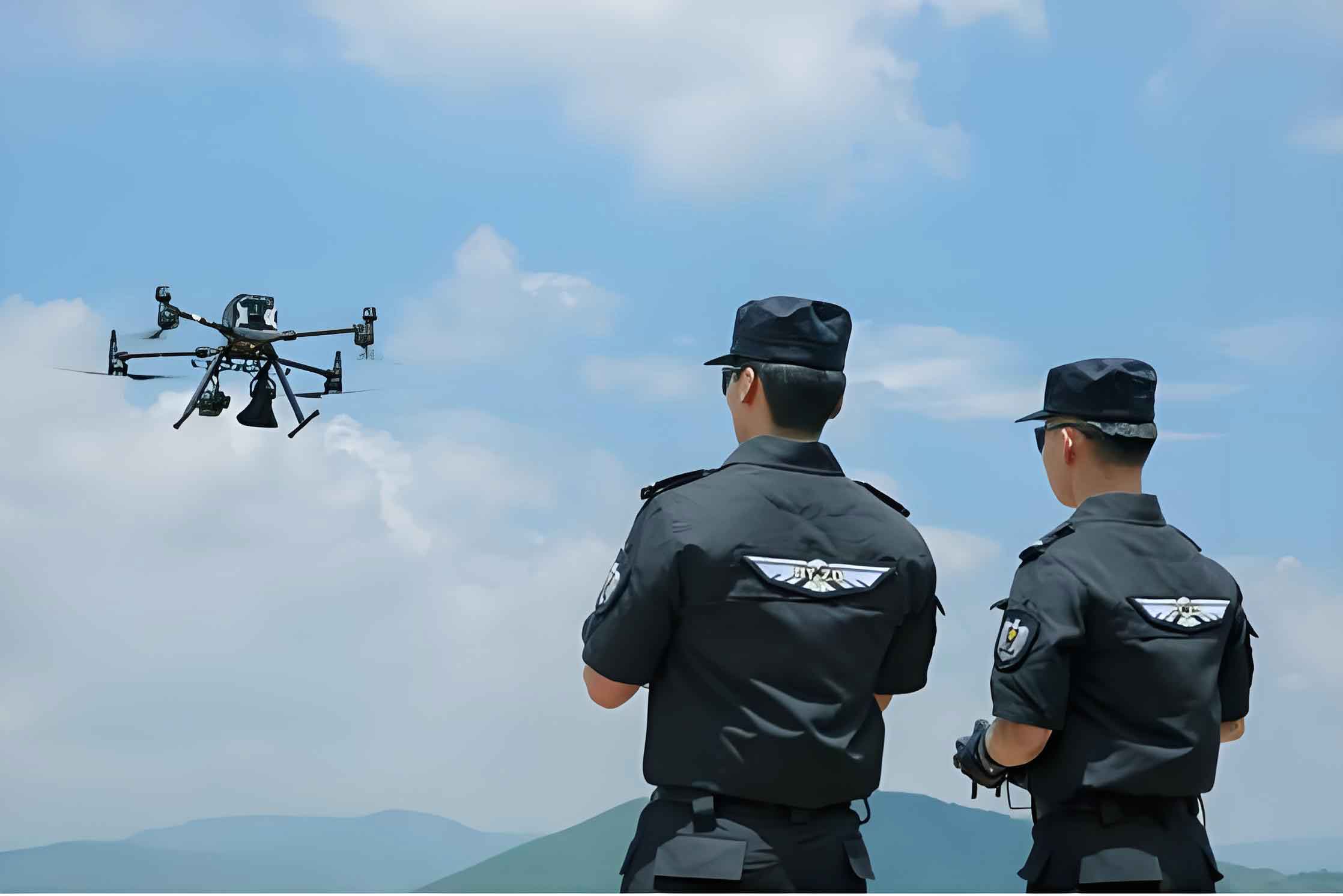
The rapid advancement of unmanned aerial vehicle (UAV) technology has led to its widespread adoption in various civilian sectors. When equipped with different payloads, UAVs can perform complex tasks in agriculture, disaster inspection, power line maintenance, forestry, meteorology, and mapping. However, a significant gap remains in the application of UAVs for professional public safety roles, particularly within urban management contexts. In domestic markets, the development and deployment of police drones for urban scenarios—such as patrol, emergency response, and surveillance—are still in their nascent stages. This highlights a critical need for innovative design methodologies tailored to the specific, demanding requirements of law enforcement operations in complex city environments.
Urban police duties are multifaceted, encompassing crime prevention, maintaining public order, managing traffic, and overseeing fire safety. A police drone designed for this environment must be more than just a flying camera; it must be a reliable, versatile, and rapidly deployable tool that integrates seamlessly into existing operational protocols. Traditional design approaches often struggle to systematically translate these high-level mission needs into precise technical specifications and to resolve the inherent contradictions that arise (e.g., between long endurance and agile maneuverability). To address this, a holistic innovation process is required.
The integration of the Theory of Inventive Problem Solving (TRIZ) with other design methods has emerged as a powerful trend for driving comprehensive product innovation. For instance, researchers have combined TRIZ with Axiomatic Design (AD) to manage functional coupling, or with Design for Six Sigma (DFSS) for quality-controlled innovation processes. Particularly relevant is its integration with Quality Function Deployment (QFD), a method designed to translate customer needs (CNs) into engineering characteristics (ECs). QFD uses the House of Quality (HOQ) as its core matrix to define “what” to do. However, traditional QFD relies on discrete scoring, which can be imprecise and subjective, especially when dealing with the vague, qualitative information typical of early design stages and small sample sizes from expert surveys.
This is where Grey System Theory proves invaluable. It is adept at handling systems characterized by “small samples” and “poor information.” By applying Grey Relational Analysis (GRA) within the QFD framework—creating a Grey QFD (GQFD) approach—we can model relationships with limited data, reducing the interference of human bias in determining the importance weights of needs and technical features. This paper proposes and demonstrates an integrated innovation design model that combines GQFD with TRIZ for the conceptual design of a police drone. The GQFD phase accurately identifies and prioritizes key technical conflicts from user needs, while the TRIZ phase provides systematic principles to resolve these conflicts, answering “how” to achieve the design goals.
The GQFD-TRIZ Integrated Methodology
The proposed integrated model follows a structured, four-step process designed to move logically from problem definition to inventive solution generation for the police drone.
- Step 1: Calculate the Grey Comprehensive Relationship Matrix. Expert evaluations are collected for Customer Needs (CNs, reference series X_i) and Engineering Characteristics (ECs, comparison series Y_j). The grey relational degree, which measures the geometric proximity between these series, is calculated using a generalized model, resulting in a comprehensive relationship matrix.
- Step 2: Determine the Absolute Weight of Customer Needs. Based on the grey relational matrix, a dominance relationship between different CNs is established. This allows for the ranking of CNs and the calculation of their absolute importance weights (λ_i), moving beyond simple subjective rankings.
- Step 3: Construct the Enhanced House of Quality (HOQ). The calculated CN weights (λ_i) and the grey relationship matrix are populated into the HOQ. The roof of the HOQ is used to identify correlations (positive or negative) between the ECs. The analysis yields a prioritized list of ECs by importance and, crucially, identifies the negative correlations (technical contradictions) that must be solved.
- Step 4: Resolve Contradictions using TRIZ. The negative correlations from the HOQ roof are formulated as specific engineering problems. These are then mapped to the 39 Standard Engineering Parameters of TRIZ to define technical or physical contradictions. The TRIZ contradiction matrix or separation principles are employed to find relevant Inventive Principles, which are then interpreted into concrete design concepts for the police drone.
The mathematical core of the GQFD phase involves the following calculations. Let $X_i=(x_i(1), x_i(2),…, x_i(n))$ for $i=1,2,…,s$ be the customer need reference sequences and $Y_j=(y_j(1), y_j(2),…, y_j(n))$ for $j=1,2,…,m$ be the engineering characteristic comparison sequences. After zeroing and other transformations, the grey absolute relational degree $ε_{ij}$ and the grey relative relational degree $γ_{ij}$ are computed. The comprehensive relational degree $ρ_{ij}$ is a weighted combination:
$$ρ_{ij} = θ ε_{ij} + (1-θ) γ_{ij} \quad \text{(typically with } θ=0.5\text{)}$$
This forms the comprehensive relationship matrix $Ψ = (ρ_{ij})_{s×m}$. The customer need weights are then derived through a dominance analysis of the rows in this matrix. If $X_k$ is superior or quasi-superior to $X_i$, its weight $λ_k$ is assigned a higher value, for example:
$$λ_{i_l} = n – l + μ \quad \text{(for quasi-superiority, often with } μ=0.5\text{)}$$
where $i_l$ denotes the CN at the $l$-th position in the dominance ranking.
Conceptual Design of an Urban Police Drone Using the Integrated Method
The methodology is applied to develop a new concept for an urban police drone. Through literature review, market analysis, and expert surveys with police officers and designers, key Customer Needs (CNs) and preliminary Engineering Characteristics (ECs) were identified.
| Customer Need (CN) | Symbol | Engineering Characteristic (EC) | Symbol |
|---|---|---|---|
| Aerial Patrol | X1 | Long Endurance | Y1 |
| Communication & Command | X2 | Maneuverability & Agility | Y2 |
| Pursuit & Intervention | X3 | Multi-purpose Payload Capacity | Y3 |
| Fire & Rescue Support | X4 | Information Collection Capability | Y4 |
| Comprehensive Logistics Support | X5 | Robustness & Stability | Y5 |
| Reconnaissance & Surveillance | X6 | Portability & Ease of Transport | Y6 |
Twenty professionals rated each item on a 1-9 scale. Applying the GRA calculations (Step 1) to this data yielded the following comprehensive relationship matrix (example values):
$$
Ψ = \begin{bmatrix}
0.8403 & 0.7228 & 0.6652 & 0.7315 & 0.9476 & 0.6388\\
0.6210 & 0.5787 & 0.5587 & 0.8658 & 0.6841 & 0.5457\\
0.7493 & 0.8810 & 0.9740 & 0.5806 & 0.6590 & 0.8904\\
0.9180 & 0.8269 & 0.7429 & 0.6567 & 0.8166 & 0.6985\\
0.7927 & 0.9468 & 0.9146 & 0.5928 & 0.6845 & 0.8506\\
0.9191 & 0.7737 & 0.7034 & 0.6870 & 0.8793 & 0.6656
\end{bmatrix}
$$
The dominance analysis (Step 2) produced the customer need ranking: $X5 \geq X3 \geq X4 \geq X6 \geq X1 \geq X2$, with corresponding absolute weights: $λ = (1.5, 3.5, 2.5, 0.5, 5.5, 4.5)$. These weights and the $Ψ$ matrix were used to build the HOQ (Step 3). The analysis revealed the priority order of Engineering Characteristics and, critically, the negative correlations between them, which represent the core design conflicts for the police drone.
| EC Ranking | Engineering Characteristic | Key Negative Correlations (From HOQ Roof) |
|---|---|---|
| 1 | Maneuverability & Agility (Y2) | With Long Endurance (Y1), With Multi-purpose Payload (Y3) |
| 2 | Long Endurance (Y1) | With Portability (Y6), With Multi-purpose Payload (Y3) |
| 3 | Multi-purpose Payload Capacity (Y3) | With Long Endurance (Y1), With Maneuverability (Y2) |
| 4 | Robustness & Stability (Y5) | – |
| 5 | Portability & Ease of Transport (Y6) | With Long Endurance (Y1) |
| 6 | Information Collection Capability (Y4) | – |
Moving to Step 4, the top contradictions were analyzed using TRIZ. The conflict between “Long Endurance” (requiring a larger, heavier battery) and “Maneuverability & Agility” was formulated as a technical contradiction between TRIZ parameters #9 Speed and #1 Weight of Moving Object. The contradiction matrix suggested Inventive Principles: #2 (Extraction), #8 (Anti-weight), #13 (The Other Way Round), #38 (Strong Oxidants).
The conflict between “Multi-purpose Payload” and “Long Endurance” was mapped to #15 Action Time of Moving Object vs. #1 Weight of Moving Object, yielding principles: #19 (Periodic Action), #5 (Merging), #34 (Discarding and Recovering), #31 (Porous Materials).
The conflict between “Long Endurance” and “Portability” was identified as a physical contradiction: the battery needs to be large (for flight) and small (for transport). Applying the Separation in Time principle led to associated inventive principles including #15 (Dynamics), #10 (Preliminary Action), and #34 (Discarding and Recovering).
Synthesizing the most frequently suggested and contextually relevant principles from this analysis, three key principles were selected for the police drone concept: #2 Extraction, #5 Merging, and #15 Dynamics.
| TRIZ Principle | Explanation | Application in Police Drone Concept |
|---|---|---|
| #2 Extraction | Extract the “disturbing” part or necessary property from an object. | Extract the primary battery mass from the drone itself. Design a dedicated docking/launch platform that houses spare batteries. The drone swaps its depleted battery for a fresh one at the platform, dramatically increasing operational endurance without permanently weighing down the airframe. |
| #5 Merging | Merge identical or similar objects; assemble operations in time. | Design mission-specific payloads (e.g., loudspeaker, spotlight, delivery mechanism, specialized sensors) as modular units. These modules can be quickly merged/attached to the drone via a standardized interface, enabling multi-role functionality without the complexity and weight of a permanently integrated, all-in-one system. |
| #15 Dynamics | Make an object or environment adjustable; divide an object into parts capable of relative movement. | Make the entire drone system dynamic by integrating the docking platform with the police vehicle (e.g., as a roof-mounted unit). The platform and drone become a mobile, rapidly deployable system, eliminating manual transport and setup, thereby enhancing operational agility and response time. |
The Proposed Police Drone System Concept
The application of these principles led to a two-part police drone system concept: 1) the Drone Airframe, and 2) the Vehicle-Integrated Docking & Launch Platform.
The Drone Airframe: Designed around modularity (Principle #5, Merging), it features a quick-release interface on its underside for hot-swapping mission modules. To aid reconnaissance (a high-ranking CN), it incorporates multiple gimbal-mounted cameras for comprehensive visual coverage. Its structure is designed for robustness while minimizing unnecessary weight, as the primary battery is no longer a permanent, large component (Principle #2, Extraction).
The Docking & Launch Platform: This is the cornerstone of the innovation, embodying Principles #15 (Dynamics) and #2 (Extraction). It is designed as a roof-mounted unit for police vehicles, making the entire system mobile. The platform features:
- A protective, openable canopy.
- Precision landing guidance using UWB (Ultra-Wideband) positioning technology for autonomous, reliable recovery.
- An internal battery management system with slots for multiple spare batteries.
- A robotic mechanism that automatically swaps the drone’s depleted battery with a charged one from the platform’s reserve (Principle #34, Discarding and Recovering).
The operational workflow resolves the key contradictions: The police drone takes off from the mobile platform, performs its mission, and returns. For extended missions, it lands on the platform, where its battery is automatically exchanged in seconds, effectively solving the endurance-agility and endurance-portability conflicts. The platform’s integration with the vehicle solves the portability and rapid-response challenge.
Conclusion
This study successfully developed and applied an integrated GQFD-TRIZ methodology for the innovative conceptual design of an urban police drone. The GQFD phase, empowered by Grey Relational Analysis, effectively translated qualitative user needs into quantified, prioritized engineering targets under conditions of limited expert data, minimizing subjective bias. It precisely identified the critical technical contradictions hindering optimal performance, such as those between endurance, agility, and payload capacity.
The subsequent TRIZ phase provided a systematic toolkit to resolve these contradictions. By mapping the conflicts to standard parameters and applying inventive principles like Extraction, Merging, and Dynamics, a coherent and innovative police drone system concept was generated. The proposed solution—a modular drone paired with a smart, vehicle-integrated docking and resupply platform—directly addresses the core conflicts and aligns with the highest-priority user needs identified in the HOQ.
The GQFD-TRIZ integration proves to be a powerful framework for complex product innovation, compensating for the limitations of each individual method. It provides a clear, structured path from vague requirements to inventive solutions, which is particularly valuable for advanced equipment like police drones. Future work will focus on detailed engineering design, prototyping, and integrating deeper operational requirements such as secure data links and interoperability with command systems. This methodology offers a robust foundation for the research and development of next-generation public safety UAVs.