
In recent years, I have observed a rapid expansion in the industrial drone market, with global growth rates hovering around 20% annually and domestic markets surging at approximately 50%. This trend underscores the increasing adoption of unmanned aerial vehicles across various sectors, particularly in law enforcement. As a professional closely monitoring this evolution, I believe that police drones are revolutionizing public safety operations, offering solutions to previously insurmountable challenges. From surveying and agriculture to power inspection and public security, drones have demonstrated immense potential. With continuous technological advancements, police drones are poised to play pivotal roles in disaster relief, agricultural monitoring, and environmental protection, among other fields. Their integration into警务 work has enabled efficient completion of tasks that were once difficult, yielding significant social and economic benefits in counter-terrorism, event security, and emergency response. In this article, I will delve into the market development and product applications of police drones, providing insights from a first-person perspective.
The market for police drones has flourished under政策 guidance and support. In 2017, I noted a positive upward trajectory in transaction volumes. According to公开招投标 data, there were 332 procurement cases involving police drones (including border defense and firefighting) nationwide, with over 721 units purchased and a total amount of around 2.5 billion RMB. This growth is not merely numerical; it reflects a maturation of the industry. A key milestone in 2017 was the “National Police Drone Tactical Exercise” held in Nanjing, which showcased the实战 capabilities of 139 teams from 26 provinces. Additionally, the release of the “Police Unmanned Aerial Vehicle System” standards in August 2017 filled regulatory gaps,规范 technical requirements and performance metrics. The subsequent designation of training institutions further规范化 usage. These developments have profound implications for the future of police drones, reinforcing their legitimacy and effectiveness in law enforcement.
To quantify the market dynamics, I present the following table summarizing the 2017 procurement data:
| Metric | Value | Notes |
|---|---|---|
| Procurement Cases | 332 | Covering police, border, and fire departments |
| Number of Police Drones Procured | 721+ | Minimum estimate based on公开 data |
| Total Procurement Amount | 2.5 billion RMB | Approximate value in Chinese currency |
| Global Industrial Drone Growth Rate | 20% per year | Average annual increase |
| Domestic Industrial Drone Growth Rate | 50% per year | Reflects rapid adoption in China |
The growth in police drone adoption can be modeled using a compound annual growth rate (CAGR) formula. Let $S_t$ represent the market size at time $t$, $S_0$ be the initial market size, and $r$ the growth rate. Then, the market size after $n$ years is given by:
$$S_n = S_0 (1 + r)^n$$
For instance, if the domestic market for police drones starts at a base size $S_0$, with $r = 0.50$, the projected size after 3 years would be $S_3 = S_0 (1.5)^3 = 3.375S_0$. This exponential growth highlights the accelerating integration of police drones into law enforcement frameworks.
In my analysis, the application scenarios for police drones are diverse and expanding. I have categorized them into six primary areas, each with unique operational requirements. The following table outlines these scenarios and their key characteristics:
| Application Scenario | Key Functions | Operational Benefits |
|---|---|---|
| Emergency Response | Real-time aerial monitoring, crowd dispersal, communication relay | Rapid situational awareness, effective处置 in complex environments |
| Event Security | Wide-area surveillance, facial recognition, automatic tracking | Enhanced crowd control, proactive threat detection |
| Investigation and Pursuit | Aerial patrol, thermal imaging, night operations | Extended coverage, efficient suspect tracking |
| Traffic Management | Accident scene assessment, traffic flow monitoring, violation capture | Quick clearance of congestion, improved road safety |
| Emergency Rescue | Disaster assessment,定位 of stranded individuals, delivery of supplies | Access to inaccessible areas, timely lifesaving interventions |
| Narcotics Eradication | Aerial reconnaissance of remote areas, precise定位 of illegal crops | Efficient detection and eradication in difficult terrain |
Each scenario leverages the inherent advantages of police drones, such as高空视野 and flexibility. For example, in emergency response, police drones can be equipped with loudspeakers or non-lethal weapons to manage crowds. The effectiveness of such operations can be quantified using a utility function. Let $U$ represent the utility of deploying a police drone, which depends on factors like coverage area $A$, response time $T$, and accuracy $Acc$. A simplified model could be:
$$U = \alpha \cdot \frac{A}{T} + \beta \cdot Acc$$
where $\alpha$ and $\beta$ are weighting coefficients based on operational priorities. This formula underscores the importance of optimizing police drone parameters for maximum utility.
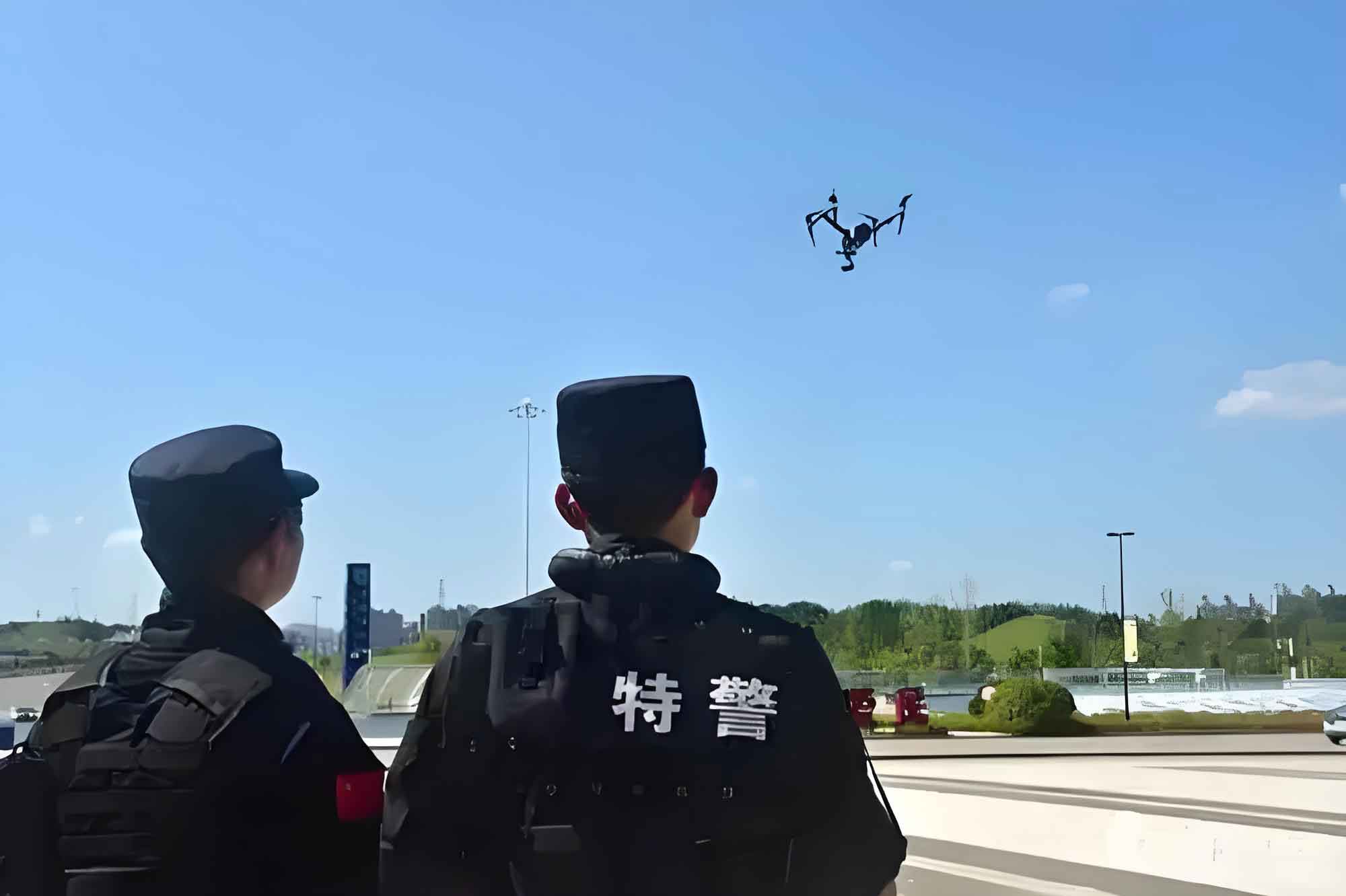
In practice, I have seen police drones become indispensable in scenarios like large-scale events. During marathons or international competitions, police drones provide a bird’s-eye view, enabling real-time monitoring of crowd densities and movements. The integration of AI technologies, such as facial recognition, allows for automatic tracking of suspicious individuals. Mathematically, the probability of detecting a threat can be expressed as:
$$P_{\text{detect}} = 1 – e^{-\lambda \cdot t \cdot r_{\text{scan}}}$$
where $\lambda$ is the threat density, $t$ is the time spent monitoring, and $r_{\text{scan}}$ is the scanning rate of the police drone. This exponential relationship highlights how extended patrols with police drones enhance security coverage.
Looking ahead, the需求 and trends for police drones are evolving toward greater实战化 and sophistication. Based on my observations, I identify seven key areas of development. The table below summarizes these trends and their implications:
| Trend | Current State | Future Direction |
|---|---|---|
| Practical Application | Limited to drills and simple tasks | Integration into daily警务 work with complex functionalities |
| Performance Enhancement | Basic flight parameters | Longer endurance, wider control radius, higher precision |
| Functional Richness | Primarily aerial photography | Multi-role capabilities for diverse missions |
| Rapid Deployment | Manual setup required | Automatic起飞 and mission execution |
| Data Security | Standard transmission protocols | Encrypted data links for secure communication |
| Structured Data Processing | Raw video feeds | AI-driven extraction of actionable insights |
| Product Morphology | Fixed-wing and multi-rotor designs | Specialized platforms for specific tasks |
To address performance enhancement, let’s consider the flight time of a police drone. The endurance $E$ can be modeled as a function of battery capacity $C$, power consumption $P$, and environmental factors like wind resistance $W$. A basic formula is:
$$E = \frac{C}{P + k \cdot W^2}$$
where $k$ is a constant. Improving $E$ requires optimizing $C$ and minimizing $P$ and $W$, which is a focus for manufacturers. Similarly, for data security, encryption algorithms play a crucial role. The security strength $S$ of a transmission can be related to key length $L$ using:
$$S \propto 2^L$$
This exponential relationship emphasizes the need for robust encryption in police drone communications to prevent data breaches.
In terms of functional richness, police drones must adapt to various payloads. The total weight capacity $W_{\text{total}}$ can be expressed as:
$$W_{\text{total}} = W_{\text{drone}} + W_{\text{payload}}$$
where $W_{\text{drone}}$ is the base weight and $W_{\text{payload}}$ includes附加设备 like loudspeakers or sensors. Balancing this equation is essential for maintaining flight stability. Moreover, rapid deployment involves minimizing the time from arrival to operational status. If $t_{\text{setup}}$ is the setup time and $t_{\text{flight}}$ is the time to reach the target, the total response time $T_{\text{response}}$ is:
$$T_{\text{response}} = t_{\text{setup}} + t_{\text{flight}}$$
Automating these processes can reduce $T_{\text{response}}$, enabling quicker interventions by police drones.
Structured data processing is another critical trend. With the advent of big data in law enforcement, police drones generate vast amounts of video footage. The efficiency of extracting useful information can be measured by the processing rate $R_{\text{process}}$, defined as:
$$R_{\text{process}} = \frac{N_{\text{detections}}}{t_{\text{analysis}}}$$
where $N_{\text{detections}}$ is the number of relevant objects (e.g., faces, vehicles) identified in time $t_{\text{analysis}}. Improving $R_{\text{process}}$ through AI algorithms allows police drones to contribute meaningfully to investigative workflows. For instance, in traffic management, police drones can automatically识别 license plates, with accuracy $A$ modeled as:
$$A = \frac{\text{Correct Identifications}}{\text{Total Attempts}} \times 100\%$$
High $A$ values ensure reliable enforcement actions.
Product morphology also evolves with mission requirements. Large police drones, often fixed-wing, excel in long-range patrols, while multi-rotor police drones offer maneuverability for urban environments. The choice depends on operational parameters like range $D$ and loiter time $L_t$. A decision matrix can be formulated:
| Drone Type | Typical Range (km) | Loiter Time (hours) | Best For |
|---|---|---|---|
| Fixed-wing Police Drone | 50-100 | 5-10 | Large-area surveillance |
| Multi-rotor Police Drone | 5-10 | 1-2 | Close-quarters operations |
| Hybrid Police Drone | 20-50 | 3-6 | Versatile missions |
The optimal selection can be guided by a cost-benefit analysis. Let $B$ represent the benefit of using a police drone, which includes factors like area covered and data quality, while $C$ denotes the cost, including procurement and maintenance. The net value $V$ is:
$$V = B – C$$
Maximizing $V$ for different scenarios ensures efficient resource allocation in police drone fleets.
In conclusion, I foresee police drones becoming increasingly intelligent, transcending their current role as remotely piloted devices. The future of police drones lies in autonomous capabilities, where artificial intelligence enables them to make real-time decisions in complex environments like disaster zones. This autonomy can be represented by a decision function $D(s)$, where $s$ is the sensor input state:
$$D(s) = \arg\max_{a \in A} Q(s, a)$$
Here, $Q(s, a)$ is the value of taking action $a$ in state $s$, learned through machine learning algorithms. Such advancements will elevate the utility of police drones, allowing them to perform tasks like search and rescue with minimal human intervention. Additionally, the integration of swarm technology could further enhance their efficacy. The collective behavior of multiple police drones can be modeled using particle swarm optimization, where each drone adjusts its position $x_i$ based on individual and group bests:
$$x_i(t+1) = x_i(t) + v_i(t+1)$$
$$v_i(t+1) = w v_i(t) + c_1 r_1 (p_{\text{best}} – x_i(t)) + c_2 r_2 (g_{\text{best}} – x_i(t))$$
where $v_i$ is velocity, $w$ is inertia, and $c_1, c_2$ are learning factors. This approach could enable coordinated missions, such as area scanning or perimeter defense, making police drones even more versatile.
Ultimately, the trajectory of police drones is set toward deeper integration into law enforcement ecosystems. As I reflect on the market growth and application breadth, it is clear that police drones are not just tools but transformative assets. They enhance operational efficiency, improve officer safety, and deliver public value. However, challenges remain in standardization, training, and ethical use. By addressing these through continuous innovation and collaboration, the potential of police drones will be fully realized, ushering in a new era of smart policing. The mathematical frameworks and trends discussed herein provide a foundation for future development, ensuring that police drones remain at the forefront of technological adoption in public safety.