
In modern warfare, military drones have emerged as a decisive factor, transforming operations in fire calibration, battlefield reconnaissance, surveillance, and targeted strikes. The large-scale deployment of military UAVs demands not only advanced hardware but also a highly skilled operator force. For example, conflicts like those in Ukraine highlight how tens of thousands of operators can be trained rapidly to leverage unmanned systems. As a researcher focused on optimizing personnel development, I have analyzed global practices to propose a scalable training model. This ensures that military forces can maintain superiority by producing operators who expertly control unmanned aerial platforms, data links, and mission payloads via remote devices or ground stations. The urgency stems from the exponential growth in military drone usage; without systematic training, nations risk ceding tactical advantages in an era where unmanned capabilities define battlefield outcomes.
The U.S. military, a pioneer in military UAV integration since the late 1990s, offers valuable insights through its service-specific approaches. Each branch tailors recruitment and training to its operational needs, reflecting the diversity in military drone applications.
| Service | Recruitment Sources | Training Stages | Key Components | Duration |
|---|---|---|---|---|
| Air Force | Experienced pilots, graduates with flight backgrounds, non-pilot officers | 5 stages: Basic flight knowledge, simulator training, system familiarization, application theory, practical control | Focus on flight safety and mission execution; experienced personnel skip initial stages | 10 months for novices |
| Army | Non-pilot personnel (e.g., NCOs, officers) | 3 stages: Ground preparation, simulator exercises, practical drone/radio operation | Emphasis on doctrine, navigation, and tactical use; high throughput | 24 weeks average |
| Navy | Pilots for tactical UAVs; non-pilots for smaller drones | Specialized phases: Ground theory, flight school, role-specific training | Includes ship-based operations and emergency procedures; distinct tracks for roles | 18 weeks for flight operators, 8 weeks for payload operators |
These programs underscore that effective training must adapt to the heterogeneity of military UAV fleets. The complexity of operator development can be quantified using a formula that accounts for multiple variables:
$$Training\ Complexity\ (C) = \sum_{i=1}^{M} \left( \alpha \cdot S_i + \beta \cdot T_i \right)$$
Here, $M$ represents the number of mission types (e.g., reconnaissance, strike), $S_i$ denotes drone size categories (micro to large), and $T_i$ signifies task difficulty. Coefficients $\alpha$ and $\beta$ adjust for service-specific factors like technology intensity. This equation highlights why standardized approaches often fail: as military drone missions diversify—from micro-UAVs for infantry support to large UAVs for strategic strikes—training must be equally multifaceted. Key characteristics include high-stakes operational requirements, where errors in payload handling or navigation could compromise missions, and rapid technological evolution, necessitating curricula that evolve with new military UAV capabilities. For instance, a small military drone used for surveillance demands different operator skills than a large military UAV executing electronic warfare, amplifying training resource needs.
To address these challenges, I propose a training model based on classification, grading, staging, and specialization. This framework ensures that military drone operators achieve proficiency through structured, efficient pathways.
Classification Training: Operators are categorized into flight operators and mission operators to align with distinct responsibilities. Flight operators handle drone movement—takeoff, landing, and in-flight maneuvers—using control interfaces like joysticks or keyboards. Mission operators include link controllers, who manage communication systems to maintain air-ground data flow, and payload controllers, who operate sensors, weapons, or jamming equipment. This separation allows for targeted skill development, as flight control for a military UAV often requires aeronautical knowledge, while mission control emphasizes payload-specific expertise. For example, a payload controller on a large military drone might specialize in radar systems, whereas a link controller focuses on secure data transmission under jamming conditions.
Graded, Staged, and Specialized Training: This approach tailors programs to drone size and operator role, incorporating progressive stages to build competency. Flight operators undergo size-based grading:
- Micro Military Drones: Short-term, intensive programs (e.g., 1-2 weeks) focusing on basic remote control, akin to hobbyist models. No prior experience is needed, and training emphasizes quick deployment for tasks like close-range reconnaissance.
- Small Military UAVs: Two-stage process. Stage 1: “Basic theory → Flight practice → Certification” for civilian-grade proficiency. Stage 2: “Professional theory → Operational training → Certification” for military applications, including threat evasion. The transition between stages ensures operators adapt to combat-specific scenarios.
- Medium/Large Military Drones: Training varies by background. For operators with small UAV experience: “Theory conversion → Practical training → Certification.” For novices: “Basic training → Theory conversion → Practical training → Certification.” The training duration for large military UAVs can be modeled as:
$$T_{large} = T_{base} + \int_{0}^{t} \left( \frac{dS}{dt} \right) dt$$
Here, $T_{base}$ covers fundamentals, and $\frac{dS}{dt}$ represents the rate of skill acquisition during conversion and practice phases. This formula ensures scalability; for instance, adding simulator time reduces $T_{large}$ by accelerating $\frac{dS}{dt}$.
Mission operators follow role-specific staging:
- Link Controllers: “Professional theory → Practical training → Certification,” covering data-link protocols and fault recovery. Training duration depends on system complexity, with military UAV links requiring advanced cybersecurity modules.
- Payload Controllers: Specialized by function (e.g., radar/EO, EW, comms) using “Professional theory → Practical training → Certification.” The certification process includes performance metrics:
$$Pass\ Rate = \frac{N_{success}}{N_{total}} \times 100\%$$
where $N_{success}$ is operators achieving accuracy thresholds in simulated engagements. Specialization allows, for example, EW operators to master jamming techniques without redundant flight training.
Standardized and Systematic Training: To support large-scale, high-quality output, this pillar integrates resources and processes. Professional instructor teams combine theoretical experts (e.g., retired pilots) and practical mentors with combat experience. Systematic materials include modular curricula updated biannually to reflect military UAV advancements, such as AI-assisted navigation. Equipment provisioning is critical; flight operators use models, simulators, and actual drones, while mission operators rely on simulators and task systems. For instance, modern military drone training incorporates virtual reality to replicate high-risk environments. Essential facilities encompass flight bases with obstacle courses, classrooms for theory, and maintenance hangars.
Supporting infrastructure includes regulatory frameworks for operator certification and digital management systems. These systems track progress using algorithms:
$$Training\ Efficiency = \frac{Output_{operators}}{Input_{resources}}$$
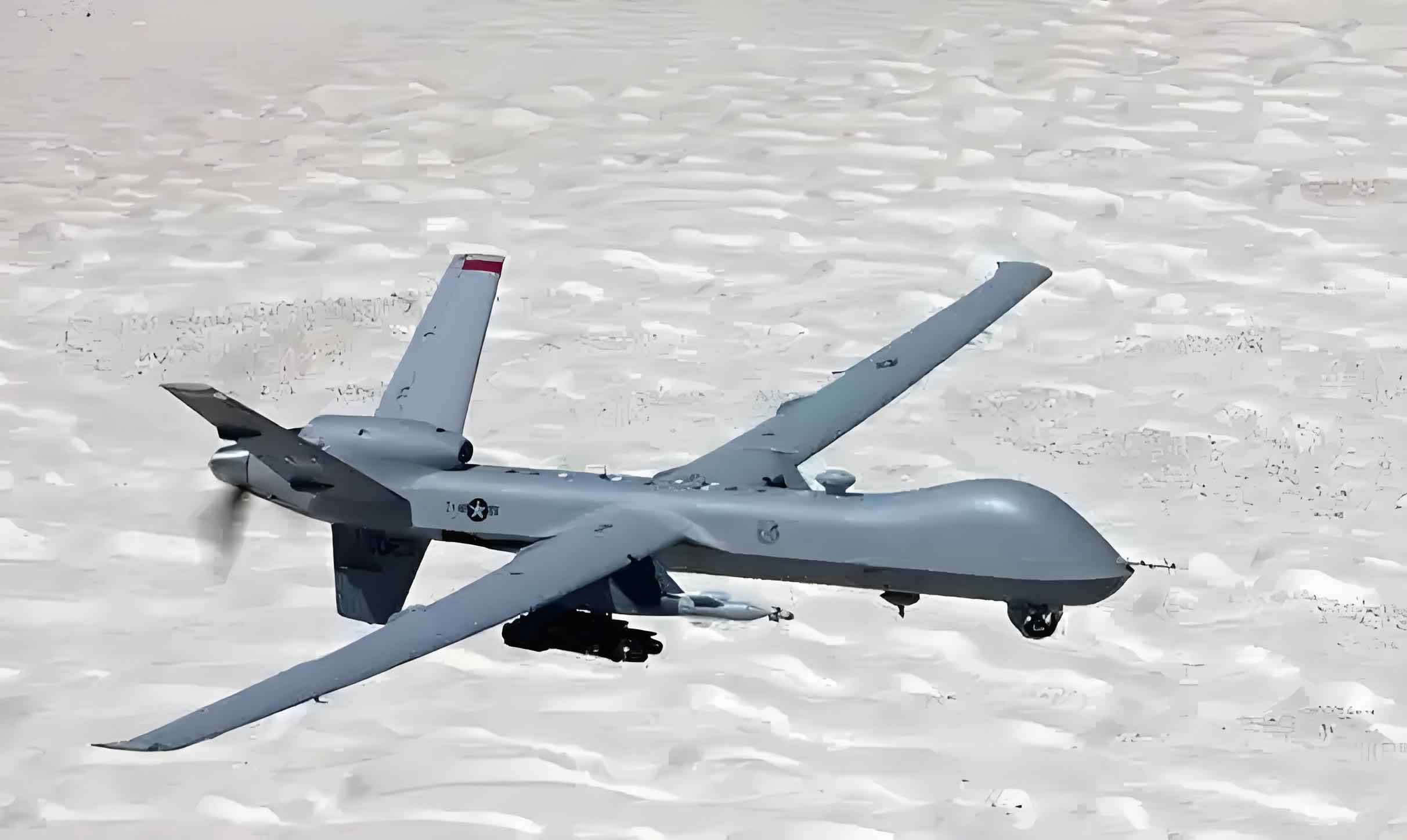
where $Output_{operators}$ is certified personnel per cycle, and $Input_{resources}$ includes time, simulators, and instructors. Software optimizes scheduling, ensuring resources like the military drone in the image above are utilized fully during field exercises.
This holistic model addresses the exponential demand for military UAV operators. By classifying roles, grading by drone size, staging progressions, specializing in functions, and standardizing resources, forces can achieve high throughput without compromising quality. As military drones evolve—becoming more autonomous or integrated with AI—the model’s adaptability will be crucial. Ultimately, superior training transforms military UAVs from mere tools into force multipliers, decisively shaping modern warfare landscapes.