
In modern warfare, the security and rapid recovery of airfields after attacks are critical for maintaining operational capabilities. One of the most hazardous tasks in this context is the disposal of unexploded ordnance (UXO) that may be scattered or embedded in runways and surrounding areas. Traditional methods involve personnel approaching these dangerous zones, posing significant safety risks. As a researcher in military technology, I have observed that the evolution of military drones offers a transformative solution to this challenge. In this article, we delve into the development of military drones and their potential application in airport UXO disposal, leveraging tables and formulas to summarize key insights and proposing new directions for innovation.
The concept of using unmanned systems in high-risk environments is not new, but its integration into airport保障 has been underexplored. Military drones, with their versatility and decreasing costs, present an opportunity to revolutionize how we handle UXO. We begin by examining the current trends in military drone technology, then analyze the existing problems in airport排弹, and finally outline specialized drone systems tailored for this mission. Throughout, we emphasize the keyword “military drone” to highlight its centrality in this discourse.
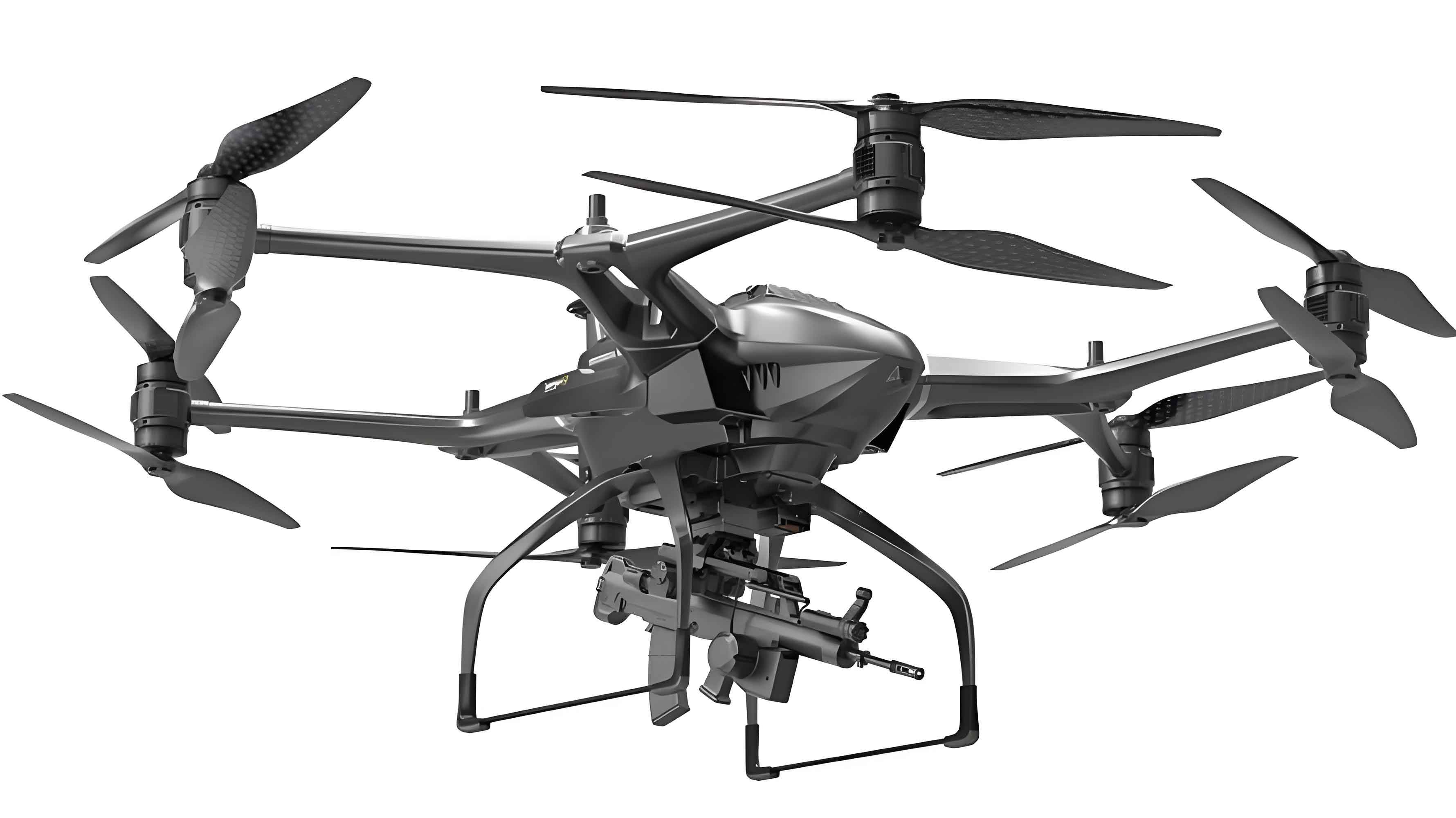
Military drones have evolved from simple reconnaissance tools to sophisticated multi-role platforms. Their autonomy, endurance, and payload capabilities have expanded dramatically, driven by advances in microelectronics, satellite communications, and artificial intelligence. We categorize the development directions of military drones into several key areas, each with distinct characteristics and applications. The table below summarizes these directions, illustrating how they contribute to broader military operations and could be adapted for UXO disposal.
| Drone Type | Key Features | Primary Military Applications | Potential UXO Disposal Role |
|---|---|---|---|
| Unmanned Loyal Wingman | 协同 with manned aircraft, high survivability | Close air support, reconnaissance | Escorting排弹 teams, providing real-time data |
| Reconnaissance-Strike Integrated Drone | Combines surveillance and attack capabilities | Targeting, intelligence gathering | Detecting and neutralizing UXO from a distance |
| High-Altitude Long-Endurance (HALE) Drone | Extended flight time, wide area coverage | Strategic reconnaissance, communication relay | Monitoring airport post-attack, assessing damage |
| Aerial Refueling Drone | Autonomous fueling, enhances mission range | Extending operational reach of aircraft | Supporting long-duration排弹 operations |
| Single-Soldier Drone | Portable, covert, easy to deploy | 特种 operations, urban warfare | Precise UXO inspection in confined areas |
The advancement of these military drone types is underpinned by mathematical models that optimize their performance. For instance, the endurance of a HALE drone can be expressed using the Breguet range equation, which relates fuel efficiency to flight parameters. We can formulate this as:
$$ E = \frac{L}{D} \cdot \frac{1}{g} \cdot \ln \left( \frac{W_{\text{initial}}}{W_{\text{final}}} \right) $$
where \( E \) is the endurance, \( L/D \) is the lift-to-drag ratio, \( g \) is gravitational acceleration, and \( W_{\text{initial}} / W_{\text{final}} \) is the weight ratio. This equation highlights how design improvements in military drones enhance their suitability for prolonged missions like airport surveillance. Similarly, the autonomy of a military drone can be modeled using control theory, such as:
$$ \dot{x} = f(x, u) $$
where \( x \) represents the state vector (e.g., position, velocity) and \( u \) is the control input. These formulas underscore the technological sophistication that makes military drones reliable for hazardous tasks.
Turning to airport UXO disposal, the current process involves several steps that are fraught with inefficiencies and dangers. Based on my analysis, the standard workflow includes: (1) runway surface assessment, (2) emergency landing strip planning, (3) UXO detection, (4) UXO disposal, and (5) withdrawal and restoration. Each step relies heavily on human intervention, exposing personnel to potential explosions. The table below outlines the main methods and their limitations, emphasizing why a shift to military drone-based approaches is necessary.
| Disposal Step | Current Methods | Key Problems | Risk Level |
|---|---|---|---|
| Surface Assessment | Manual inspection by personnel | High danger, incomplete coverage, slow | Extreme |
| UXO Detection | Digital detectors, cesium magnetometers | Low accuracy due to operator error, instrument limits | High |
| UXO Disposal | Non-contact shaped charges, TNT诱爆 | Requires close proximity, inefficient for cluster munitions | Extreme |
The problems are particularly acute with cluster munitions, which scatter numerous submunitions over wide areas. The probability of successfully clearing these with traditional methods can be modeled using a Poisson distribution, where the number of detected UXOs \( N \) follows:
$$ P(N = k) = \frac{\lambda^k e^{-\lambda}}{k!} $$
Here, \( \lambda \) represents the expected number of UXOs, but due to detection inaccuracies, \( \lambda \) is often underestimated, leading to residual risks. Moreover, the time required for manual disposal scales linearly with the number of UXOs, whereas a military drone system could parallelize tasks, reducing time exponentially. We can express the efficiency gain as:
$$ T_{\text{drone}} = \frac{T_{\text{manual}}}{n \cdot \eta} $$
where \( T_{\text{manual}} \) is the manual disposal time, \( n \) is the number of drones deployed, and \( \eta \) is the efficiency factor (typically >1 due to automation). This formula illustrates how军事无人机 can transform排弹 operations.
To address these challenges, we propose three specialized military drone systems for airport UXO disposal. Each system is designed to tackle specific aspects of the problem, leveraging the advancements in军事无人机 technology. The development of these drones requires interdisciplinary integration, from sensor fusion to robotic manipulation. Below, we detail each type, supported by formulas that quantify their expected performance.
First, the Long-Endurance Observation Military Drone. This drone would be tasked with monitoring ammunition impacts on airfields in real-time or shortly after an attack. Equipped with high-resolution cameras, synthetic aperture radar (SAR), and multispectral sensors, it can identify UXO types, positions, and surface conditions. The data collected can be processed using computer vision algorithms, such as convolutional neural networks (CNNs), to classify UXOs. The detection accuracy \( A \) can be modeled as:
$$ A = \frac{TP + TN}{TP + TN + FP + FN} $$
where \( TP \) is true positives, \( TN \) true negatives, \( FP \) false positives, and \( FN \) false negatives. By flying at high altitudes, this军事无人机 minimizes risk while providing comprehensive assessments. Its endurance, derived from the earlier Breguet equation, ensures continuous coverage during critical phases.
Second, the UXO勘察 and Detection Military Drone. This system focuses on precise localization of both surface and subsurface UXOs. It would carry advanced sensors like ground-penetrating radar (GPR) and magnetometers, fusing data to generate accurate 3D maps. The fusion process can be formulated using Bayesian estimation:
$$ P(\text{UXO} | \text{data}) = \frac{P(\text{data} | \text{UXO}) P(\text{UXO})}{P(\text{data})} $$
This allows for probabilistic mapping of UXO locations, reducing false alarms. The drone’s autonomy enables it to follow pre-planned search patterns, optimizing coverage. We can define a search efficiency metric \( S \) as:
$$ S = \frac{A_{\text{covered}}}{A_{\text{total}}} \cdot \frac{1}{t} $$
where \( A_{\text{covered}} \) is the area scanned, \( A_{\text{total}} \) is the total area, and \( t \) is time. This军事无人机 would significantly speed up the detection phase, addressing one of the major bottlenecks.
Third, the UXO Disposal Military Drone. Perhaps the most innovative, this drone would physically neutralize UXOs by placing disposal charges or using directed energy weapons. It requires precise manipulation capabilities, often through robotic arms or specialized payloads. The success rate \( R \) of disposal can be expressed as a function of positioning accuracy \( \sigma \) and charge effectiveness \( \epsilon \):
$$ R = 1 – e^{-k \cdot \epsilon / \sigma^2} $$
where \( k \) is a constant. This军事无人机 eliminates the need for personnel to approach UXOs, dramatically lowering casualties. For cluster munitions, a swarm of such drones could work collaboratively, with coordination modeled using multi-agent systems:
$$ \min \sum_{i=1}^{n} \left( \| p_i – t_i \|^2 + c \cdot \text{collision avoidance} \right) $$
where \( p_i \) is the drone position, \( t_i \) the target UXO location, and \( c \) a penalty term. This approach ensures rapid and safe clearance of large areas.
The integration of these军事无人机 systems into airport排弹 operations would require a networked command-and-control infrastructure. Data from observation and detection drones would feed into a central processor, which then dispatches disposal drones. The overall system reliability \( \Phi \) can be calculated using reliability block diagrams, but simplified as:
$$ \Phi = \prod_{i=1}^{3} \Phi_i $$
where \( \Phi_i \) are the reliabilities of observation, detection, and disposal drones, respectively. Given the high reliability of modern军事无人机 components, \( \Phi \) can approach 1, ensuring mission success.
In conclusion, the application of military drones in airport UXO disposal represents a paradigm shift in保障 operations. By leveraging the发展 trends in军事无人机 technology, we can overcome the limitations of current methods, enhancing both safety and efficiency. The proposed drone systems—long-endurance observation,勘察-detection, and disposal—each address critical aspects of the排弹流程, supported by mathematical models that quantify their benefits. As military drones continue to evolve, their autonomy, sensing, and manipulation capabilities will only improve, making them indispensable for future airport security. We urge further research and development in this niche, as it holds the key to saving lives and maintaining operational readiness in conflict zones. The journey from concept to deployment will involve challenges, but the potential rewards justify the investment in军事无人机 innovation.
Throughout this discussion, we have emphasized the term “military drone” to reinforce its centrality. The tables and formulas provided serve as a foundation for engineers and strategists to build upon. As we look ahead, the convergence of artificial intelligence with军事无人机 platforms will likely yield even more advanced solutions, perhaps fully autonomous排弹 systems that require minimal human oversight. The future of airport保障 is unmanned, and military drones are at the forefront of this transformation.