
In my extensive analysis of modern warfare, I have observed that military drones have fundamentally transformed combat strategies. As an unmanned aerial vehicle (UAV), a military drone is a powered, reusable aircraft operated without a human pilot onboard. Since the first military drone was developed in 1917, these systems have evolved from simple target drones to sophisticated unmanned combat systems, playing pivotal roles in conflicts from Vietnam to Iraq. Today, military drones are integral to reconnaissance, surveillance, target acquisition, and even direct attacks, making them a true force multiplier. The proliferation of military drones underscores their strategic value, and in this article, I will delve into their classifications, characteristics, trends, and future potential, using tables and formulas to summarize key aspects.
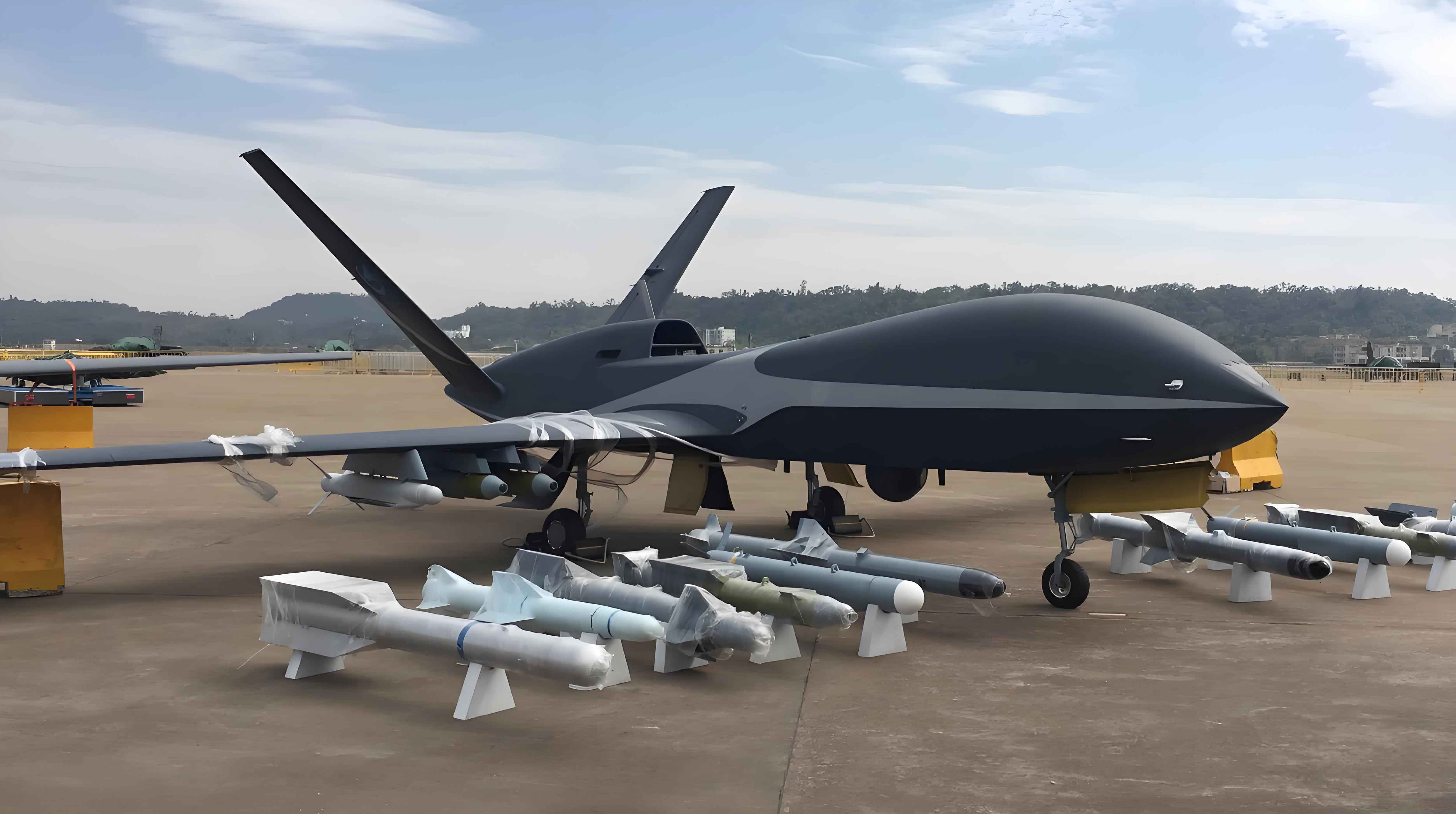
From my perspective, the classification of military drones is crucial for understanding their operational utility. Military drones can be categorized based on range, role, and performance. For instance, by range, they include short-range, medium-range, and long-range drones; by role, they encompass tactical, operational, and strategic drones; and by function, they are divided into reconnaissance, jamming, and attack drones. To illustrate, I present a table summarizing common classifications:
| Category | Sub-Category | Typical Range | Primary Role |
|---|---|---|---|
| By Range | Short-Range | ≤ 150 km | Tactical reconnaissance |
| By Range | Medium-Range | 150–650 km | Operational surveillance |
| By Range | Long-Range | > 650 km | Strategic strikes |
| By Role | Tactical | Varies | Company-level support |
| By Role | Operational | Varies | Theater-wide missions |
| By Role | Strategic | Varies | Global reach operations |
| By Function | Reconnaissance | Varies | Intelligence gathering |
| By Function | Jamming | Varies | Electronic warfare |
| By Function | Attack | Varies | Direct combat engagement |
The characteristics of military drones make them uniquely advantageous. In my assessment, these include cost-effectiveness, survivability, and adaptability. For example, the low cost of military drones stems from simple designs and minimal maintenance, which can be expressed through a cost-benefit formula. Let me define the cost-effectiveness ratio \( C_{eff} \) as:
$$ C_{eff} = \frac{M_{capability}}{C_{total}} $$
where \( M_{capability} \) represents mission capability (e.g., surveillance hours) and \( C_{total} \) is the total lifecycle cost. For military drones, \( C_{eff} \) is typically high due to low production and operational expenses. Additionally, the survivability of a military drone can be modeled using probability theory. The probability of survival \( P_s \) against threats is given by:
$$ P_s = e^{-\lambda t} $$
where \( \lambda \) is the threat encounter rate and \( t \) is mission time. Military drones often have low \( \lambda \) values due to stealth features and small radar cross-sections. To further summarize, I provide a table of key characteristics:
| Characteristic | Description | Impact on Operations |
|---|---|---|
| Low Cost | Simple design, reduced manufacturing and maintenance costs | Enables mass deployment without significant financial burden |
| High Survivability | Stealth coatings, agile maneuvers, and low observability | Reduces attrition rates in high-threat environments |
| Flexible Deployment | Multiple launch methods (e.g., catapult, runway-independent) | Enhances operational adaptability in diverse terrains |
| Long Endurance | Extended flight times due to efficient propulsion systems | Provides persistent surveillance and strike capabilities |
| Zero Casualty Risk | No onboard crew, eliminating human loss | Allows for missions in extremely hazardous zones |
As I explore the trends, military drones are evolving rapidly. The development directions include miniaturization, high-altitude long-endurance (HALE) capabilities, stealth, enhanced survivability, sensor integration, and offensive roles. For instance, miniaturization of military drones addresses the need for tactical-level reconnaissance. The size reduction can be quantified by scaling laws; for a military drone, the weight \( W \) scales with length \( L \) as \( W \propto L^3 \), but miniaturization often uses advanced materials to maintain performance. Similarly, HALE military drones require optimized aerodynamics and propulsion. The endurance \( E \) of a military drone is governed by:
$$ E = \frac{F_{fuel}}{C_{fuel}} $$
where \( F_{fuel} \) is fuel capacity and \( C_{fuel} \) is fuel consumption rate. Advances in engine technology, such as turbocharged piston engines or turbofans, boost \( E \) significantly. I summarize these trends in a table:
| Trend | Key Features | Technological Drivers |
|---|---|---|
| Miniaturization | Small size, lightweight, low cost for tactical use | Micro-electromechanical systems (MEMS), composite materials |
| High-Altitude Long-Endurance | Flight above 15 km, endurance > 24 hours | Efficient engines (e.g., turbofans), solar power |
| Stealth | Low radar cross-section, infrared signature reduction | Radar-absorbent materials, shaping techniques |
| High Survivability | Reduced loss rates, cost-effective designs | Redundant systems, electronic countermeasures |
| Sensor Integration | Multi-sensor payloads (EO/IR, SAR, SIGINT) | Data fusion algorithms, modular architectures |
| Attack Capabilities | Armed with missiles or direct-attack warheads | Precision guidance, autonomous targeting |
In my view, the attack role of military drones is particularly transformative. Attack military drones can be categorized into three types: as weapon carriers, direct-attack systems, and air-combat platforms. For example, a direct-attack military drone may use a kinetic impact strategy, where its destructive power \( D \) is given by:
$$ D = \frac{1}{2} m v^2 $$
with \( m \) as mass and \( v \) as velocity at impact. Reusable attack military drones, on the other hand, employ guided missiles; the probability of hit \( P_h \) can be modeled as:
$$ P_h = \frac{1}{1 + \left(\frac{d}{\alpha}\right)^2} $$
where \( d \) is target distance and \( \alpha \) is guidance accuracy. The evolution toward air-combat military drones involves complex control algorithms for dogfighting, which I will discuss later. The versatility of military drones in attack missions underscores their growing dominance.
From a technical standpoint, the performance metrics of military drones are often evaluated using aerodynamic and operational formulas. For instance, the range \( R \) of a military drone can be derived from the Breguet range equation:
$$ R = \frac{V}{g \cdot \text{SFC}} \cdot \frac{L}{D} \cdot \ln \left( \frac{W_{initial}}{W_{final}} \right) $$
where \( V \) is velocity, \( g \) is gravitational acceleration, SFC is specific fuel consumption, \( L/D \) is lift-to-drag ratio, and \( W \) weights. This equation highlights how efficiency improvements extend the reach of military drones. Additionally, the communication reliability for military drones is critical. The data transmission success rate \( S \) over a noisy channel is:
$$ S = 1 – \left( \frac{N_0}{E_b} \right)^{-\frac{B}{R}} $$
with \( N_0 \) as noise power, \( E_b \) as energy per bit, \( B \) bandwidth, and \( R \) data rate. Military drones employ diverse data links (e.g., satellite, line-of-sight) to maximize \( S \). To encapsulate, I present a table of common performance parameters:
| Parameter | Symbol | Typical Value Range | Importance |
|---|---|---|---|
| Maximum Endurance | \( E_{max} \) | 1 to 40+ hours | Determines mission persistence |
| Operational Radius | \( R_{op} \) | 50 to 5000+ km | Defines area of influence |
| Service Ceiling | \( H_{max} \) | 3 to 20+ km | Affects survivability and coverage |
| Payload Capacity | \( P_{load} \) | 5 to 2000+ kg | Enables diverse mission payloads |
| Stealth Index | \( S_i \) (dimensionless) | 0.1 to 0.01 (lower is better) | Measures detectability reduction |
As I analyze the sensor integration trend, military drones are increasingly equipped with multi-spectral systems. The sensor fusion process can be mathematically represented. Let \( I_{total} \) be the total intelligence gathered by a military drone, combining electro-optical (EO), infrared (IR), and synthetic aperture radar (SAR) sensors:
$$ I_{total} = \sum_{i=1}^{n} w_i \cdot I_i $$
where \( I_i \) is intelligence from sensor \( i \), and \( w_i \) is a weighting factor based on environmental conditions. This fusion enhances the all-weather capability of military drones. Moreover, the modularity of military drone payloads allows rapid reconfiguration. The mission adaptability \( A_m \) can be expressed as:
$$ A_m = \frac{N_{configurations}}{T_{reconfig}} $$
with \( N_{configurations} \) as number of possible payload setups and \( T_{reconfig} \) as reconfiguration time. High \( A_m \) values are typical for modern military drones, enabling swift role switches from reconnaissance to attack.
In my examination of stealth technology for military drones, the radar cross-section (RCS) reduction is key. The RCS \( \sigma \) of a military drone can be approximated for a sphere as:
$$ \sigma = \pi r^2 $$
for a perfect conductor of radius \( r \), but stealth shapes and materials lower this significantly. The detectability range \( D_r \) of a military drone by radar is given by the radar equation:
$$ D_r = \left( \frac{P_t G^2 \lambda^2 \sigma}{(4\pi)^3 P_{min}} \right)^{1/4} $$
where \( P_t \) is transmitted power, \( G \) antenna gain, \( \lambda \) wavelength, and \( P_{min} \) minimum detectable power. By minimizing \( \sigma \), military drones can operate covertly. I illustrate stealth advancements in a table:
| Technique | Principle | Effect on RCS Reduction |
|---|---|---|
| Shape Optimization | Angled surfaces to deflect radar waves | Can reduce RCS by 10-20 dB |
| Radar-Absorbent Materials | Coatings that absorb electromagnetic energy | Additional 5-15 dB reduction |
| Infrared Suppression | Cooling exhausts, low-emissivity paints | Lowers thermal signature significantly |
| Acoustic Stealth | Quiet propulsion systems | Reduces audible detection range |
Looking ahead, I foresee military drones becoming even more autonomous. The path toward fully autonomous military drones involves artificial intelligence (AI) and machine learning. For instance, the decision-making process for a military drone can be modeled as a Markov decision process (MDP), where the state \( s \), action \( a \), and reward \( r \) are defined. The optimal policy \( \pi^* \) maximizes the expected cumulative reward:
$$ \pi^* = \arg \max_{\pi} \mathbb{E} \left[ \sum_{t=0}^{\infty} \gamma^t r_t \mid \pi \right] $$
with discount factor \( \gamma \). This enables military drones to perform complex tasks like dynamic targeting without human intervention. Additionally, swarm technology for military drones is emerging. The coordination of \( N \) military drones in a swarm can be described by flocking algorithms, such as Reynolds’ rules, where the velocity \( \vec{v}_i \) of drone \( i \) updates as:
$$ \vec{v}_i(t+1) = \vec{v}_i(t) + \sum_{j \neq i} \left( \vec{f}_{sep} + \vec{f}_{align} + \vec{f}_{coh} \right) $$
with separation, alignment, and cohesion forces. Swarms of military drones offer redundancy and enhanced mission coverage.
In terms of economic impact, the proliferation of military drones has cost implications. The total cost of ownership (TCO) for a military drone fleet includes acquisition, operation, and support costs. I propose a formula for TCO over time \( T \):
$$ \text{TCO} = C_{acq} + \sum_{t=1}^{T} \left( C_{op}(t) + C_{maint}(t) \right) $$
where \( C_{acq} \) is acquisition cost, \( C_{op} \) operational cost, and \( C_{maint} \) maintenance cost. Compared to manned aircraft, military drones often have lower TCO, driving their adoption. To compare, here is a table of cost factors:
| Cost Factor | Military Drone (Example) | Manned Aircraft (Example) | Ratio (Drone/Aircraft) |
|---|---|---|---|
| Acquisition Cost | $5 million | $50 million | 0.1 |
| Annual Operating Cost | $1 million | $10 million | 0.1 |
| Training Cost per Pilot | $0 (remote operator) | $5 million | 0 |
| Loss Replacement Cost | Low due to lower unit cost | High due to high unit cost | < 0.5 |
From a tactical perspective, military drones enhance situational awareness. The area coverage rate \( A_c \) of a military drone during surveillance is:
$$ A_c = v \cdot s \cdot \eta $$
where \( v \) is velocity, \( s \) is sensor swath width, and \( \eta \) is efficiency factor. Military drones with high \( A_c \) can monitor vast regions, providing real-time intelligence. Furthermore, the kill chain acceleration using military drones is notable. The time from detection to engagement \( T_{kill} \) is reduced due to rapid data links and autonomous systems. For a military drone, \( T_{kill} \) can be modeled as:
$$ T_{kill} = T_{detect} + T_{decide} + T_{engage} $$
where each component is minimized through automation. This makes military drones effective for time-sensitive targets.
In my assessment of future applications, military drones will expand into domains like electronic warfare, logistics, and even space. For electronic warfare, a military drone can jam enemy communications; the jamming effectiveness \( J_{eff} \) depends on power \( P_j \) and distance \( d \):
$$ J_{eff} = \frac{P_j \cdot G_j}{4\pi d^2 \cdot L} $$
with \( G_j \) as jamming antenna gain and \( L \) losses. Military drones equipped with jamming payloads can disrupt adversary networks. Additionally, logistic military drones for resupply are gaining traction. The payload delivery efficiency \( \eta_{delivery} \) is:
$$ \eta_{delivery} = \frac{P_{delivered}}{P_{carried}} \cdot \frac{1}{T_{flight}} $$
where \( P_{delivered} \) is delivered payload weight, \( P_{carried} \) is carried weight, and \( T_{flight} \) is flight time. This optimizes supply chains in contested areas.
As I conclude, the evolution of military drones is far from over. With advancements in AI, stealth, and propulsion, military drones will become more capable and ubiquitous. The integration of military drones into combined arms operations will redefine modern battlefields. In my opinion, the continued innovation in military drone technology will ensure they remain at the forefront of military strategy, acting as indispensable force multipliers for decades to come. The journey of military drones from simple targets to autonomous combatants exemplifies the dynamic nature of military technology, and I am confident that their future will be marked by even greater achievements.