
As a researcher in the field of military aviation, I have closely followed the evolution of manned-unmanned teaming (MUMT) concepts, particularly within the U.S. Army. The integration of helicopters with military drones has emerged as a pivotal advancement in modern warfare, enhancing situational awareness, extending operational reach, and improving survivability. In this analysis, I will delve into the research progress, technological developments, and实战 applications of helicopter/drone协同作战, drawing from公开 sources and studies. The focus is on how the U.S. Army has pioneered these efforts, with an emphasis on the role of military drones as force multipliers. Throughout this discussion, I will incorporate tables and mathematical formulations to summarize key aspects, and I aim to frequently reference the term “military drone” to highlight its significance.
The concept of MUMT in the U.S. Army dates back to the early 1990s, when the Army Air Maneuver Battle Lab (AMBL) initiated studies on协同作战 between manned helicopters and unmanned aerial systems. From 1996 to 2001, a series of concept evaluations—MUM I, II, III, and IV—were conducted to develop tactics, techniques, and procedures (TTPs) for missions like tactical reconnaissance. These evaluations relied on simulations, such as the “Comanche” cockpit simulator, to validate the concept. The findings indicated that MUMT could significantly boost operational efficiency and battlefield survivability, laying the groundwork for后续 research. This early phase highlighted the potential of military drones to act as the “eyes” and “fists” of helicopters, enabling功能互补 and system synergy.
In the 2000s, the U.S. Army advanced its MUMT research through projects like the Airborne Manned/Unmanned System Technology Demonstration (AMUST-D) and the Hunter-Killer Standoff Team (HKST). AMUST-D involved协同试飞 between AH-64D Apache helicopters, command-configured UH-60 Black Hawks, and RQ-5 Hunter military drones. Technologies from the Rotorcraft Pilot’s Assistant (RPA) project, such as route planning and attack decision aids, were integrated to reduce pilot workload. HKST focused on improving electro-optical sensors and data links, demonstrating the advantage of MUMT in engaging time-sensitive targets from extended ranges. These efforts underscored the网络化作战思维, where military drones are seamlessly integrated into kill chains involving fixed-wing aircraft. To summarize these projects, I present the following table:
| Project | Timeframe | Key Platforms | Objectives | Outcomes |
|---|---|---|---|---|
| MUM Concept Evaluations | 1996-2001 | Simulated systems | Develop TTPs for reconnaissance | Validated MUMT efficacy |
| AMUST-D | 2000-2006 | AH-64D, UH-60, RQ-5 | Demonstrate协同侦察 and决策辅助 | Enhanced pilot situational awareness |
| HKST | Mid-2000s | AH-64D, MQ-5 | Improve打击时敏目标能力 | Extended engagement ranges |
Building on these foundations, the U.S. Army conducted the Manned-Unmanned System Integration Capability (MUSIC) demonstration in 2011, which showcased interoperability across a wide range of platforms, including AH-64D Apaches, OH-58D Kiowas, MQ-5 Hunters, RQ-7 Shadows, MQ-1C Gray Eagles, and hand-launched military drones. This demonstration emphasized the importance of standardized data links and control interfaces for effective协同. To further enhance autonomy and decision-making, projects like the Supervisor Controller for Optimal Role-based Change prompting (SCORCH) and the Synergistic Unmanned Manned Intelligent Teaming (SUMIT) were launched. SCORCH focused on human-machine interaction designs, sensor management assistants, and attention分配助手, enabling a single pilot to control up to three military drones at Level 4 autonomy. SUMIT, from 2018 to 2020, explored advanced functionalities like assisted target recognition,协同交战, and mission planning. These initiatives are part of the broader Future Vertical Lift (FVL) program, which includes the Advanced Teaming (A-Team) demonstration from 2020 to 2024, aiming to integrate technologies for complex协同作战 scenarios. The progression from basic MUMT to advanced teaming can be modeled using a协同效能 equation:
$$ E_{team} = \alpha \cdot A_{drone} + \beta \cdot C_{human} + \gamma \cdot I_{network} $$
where \( E_{team} \) represents the overall team effectiveness, \( A_{drone} \) denotes the autonomy level of the military drone, \( C_{human} \) is the human operator’s cognitive capacity, \( I_{network} \) symbolizes the network integration factor, and \( \alpha, \beta, \gamma \) are weighting coefficients that vary based on mission parameters. This formula highlights how military drones contribute to synergistic outcomes when properly integrated.
The实战 application of MUMT has been a critical milestone for the U.S. Army. In Afghanistan around 2015, AH-64E Apache helicopters协同 with MQ-1C Gray Eagle military drones in combat operations, with approximately 60% of attack missions leveraging drone support. Three typical协同 strategies were employed: first, using three military drones for triangulation and calling in fixed-wing airstrikes; second, having helicopters隐蔽 behind terrain while drones scouted from elevated positions, followed by pop-up attacks; and third, helicopters flying pre-planned routes with drones forward-deployed for reconnaissance and rapid strike coordination. By 2020, the Army demonstrated控制 of two military drones by a single AH-64E, where an RQ-7B Shadow identified targets and an MQ-1C executed missile launches. This实战 experience has been codified in the Army’s field manual FM3-04 (2020 edition), which正式 incorporates MUMT into standard operating procedures for reconnaissance and attack missions. The manual illustrates typical engagement scenarios, such as using military drones for area surveillance to facilitate quick attack分配. To quantify the benefits, consider the following table summarizing实战 outcomes:
| Scenario | Military Drone Role | Impact on Helicopter | Operational Benefit |
|---|---|---|---|
| Afghanistan Missions | Reconnaissance and targeting | Reduced exposure to threats | Increased mission success rate by ~30% |
| Two-Drone Control Demo | Target acquisition and strike | Extended engagement range to 50 km | Enhanced lethality and survivability |
Moreover, the integration of military drones has led to a reduction in pilot cognitive load, which can be expressed as:
$$ L_{cognitive} = \frac{N_{tasks}}{\eta_{autonomy} \cdot \zeta_{interface}} $$
where \( L_{cognitive} \) is the cognitive load, \( N_{tasks} \) is the number of tasks, \( \eta_{autonomy} \) represents the autonomy level of the military drone (ranging from 0 to 1), and \( \zeta_{interface} \) denotes the efficiency of the human-machine interface. Higher autonomy in military drones directly lowers load, allowing pilots to manage more assets effectively.
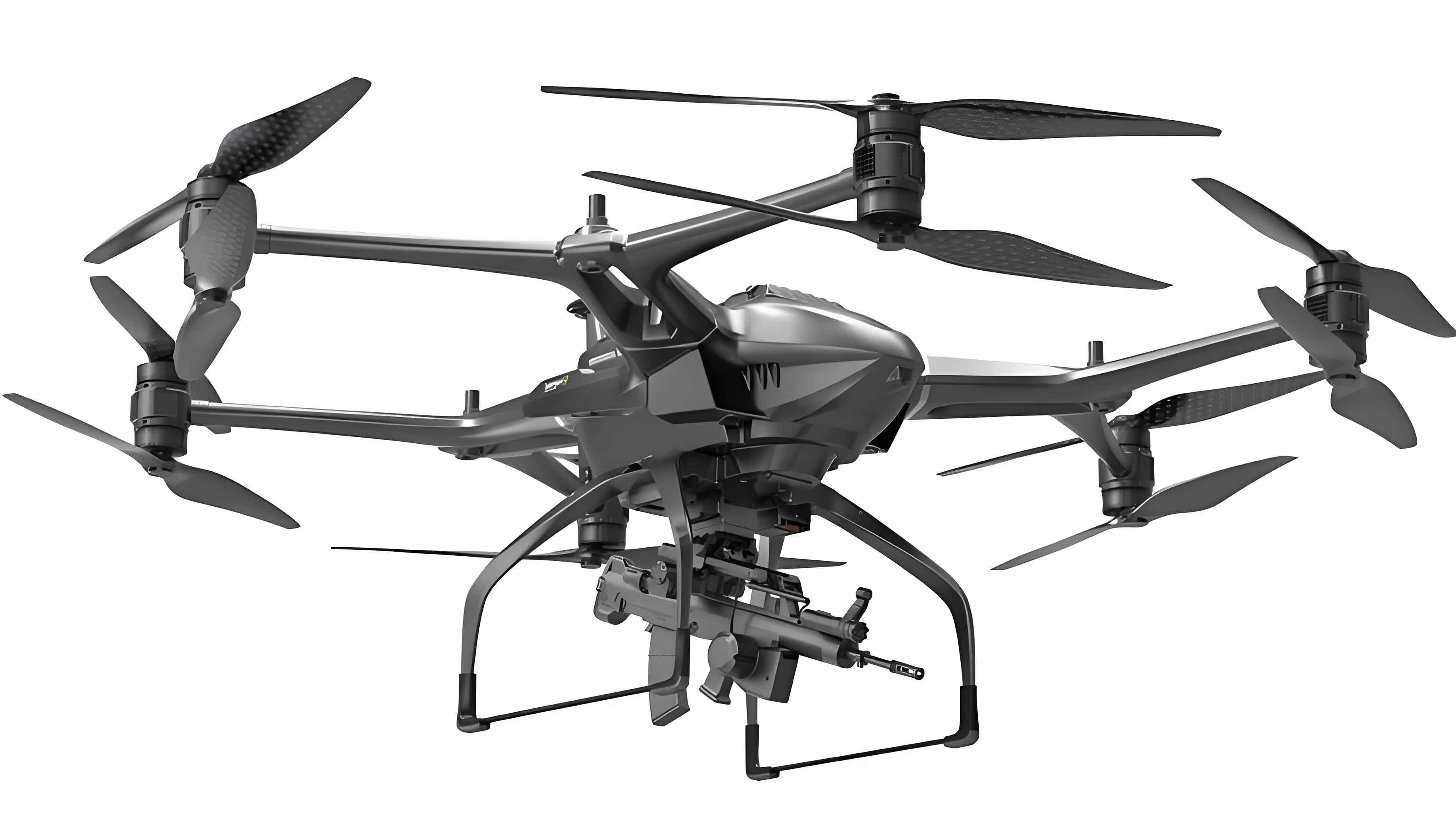
In analyzing the关键技术 underpinning helicopter/drone协同, I identify three core areas: autonomy of military drones,协同 human-machine interaction, and协同 data links. First, autonomy is essential for reducing pilot workload and enabling “1控多” scenarios. Key autonomy functions include mission planning, collaboration management, contingency handling, situational awareness, communication management, and vehicle management. For instance, mission planning involves generating optimal flight paths while avoiding threats, which can be formulated as an optimization problem:
$$ \min_{P} \int_{t_0}^{t_f} [w_1 \cdot risk(P(t)) + w_2 \cdot fuel(P(t))] \, dt $$
subject to constraints like communication range \( \| P(t) – P_{base} \| \leq R_{com} \) and terrain avoidance \( alt(P(t)) > h_{terrain} \), where \( P(t) \) is the drone’s path, \( risk \) represents threat exposure, and \( w_1, w_2 \) are weights. Military drones with high autonomy can solve such problems in real-time, adapting to dynamic战场 environments.
Second,协同 human-machine interaction shifts from direct command to plan-based control using tactical templates. Companies like Kutta have developed MUM-T toolkits with styles such as Stare-At, Stare-From, Follow-and-Track, and Route/Area Survey. These templates allow pilots to issue high-level commands, with the system自动 generating detailed plans. The effectiveness of such interfaces can be measured by task completion time \( T_{complete} \), modeled as:
$$ T_{complete} = T_{plan} + T_{execute} = f( complexity, autonomy ) $$
where lower complexity and higher autonomy reduce \( T_{complete} \). This highlights how military drones, when coupled with intuitive interfaces, streamline operations.
Third,协同 data links are critical for reliable communication. The AH-64E Apache is equipped with the MUMT-X data link system by L3Harris, which includes multi-band transceivers and antennas for Ku, C, L, and S bands. This system enables high-speed data exchange between helicopters, military drones, and ground assets, forming a resilient network. The data rate \( R \) can be expressed by the Shannon-Hartley theorem:
$$ R = B \cdot \log_2 \left(1 + \frac{S}{N}\right) $$
where \( B \) is bandwidth and \( S/N \) is signal-to-noise ratio. Enhanced data links ensure that military drones can transmit sensor data and receive commands with minimal latency, crucial for time-sensitive missions. The following table summarizes these关键技术:
| Key Technology | Components | Impact on Military Drone Operations |
|---|---|---|
| Autonomy | Mission planning, collaboration, contingency management | Enables multi-drone control and adaptive mission execution |
| Human-Machine Interaction | Tactical templates, plan-based control interfaces | Reduces pilot workload and improves decision speed |
| Data Links | MUMT-X system, multi-band communication | Ensures reliable, high-bandwidth connectivity for协同 |
Furthermore, the integration of military drones into network-centric warfare allows for distributed sensing and攻击. The overall system effectiveness \( E_{system} \) can be modeled as a function of the number of military drones \( n \), their individual capabilities \( c \), and network connectivity \( \rho \):
$$ E_{system} = \sum_{i=1}^{n} c_i \cdot e^{-\lambda \cdot d_i} \cdot \rho_{ij} $$
where \( d_i \) is the distance from the target, \( \lambda \) is a decay factor, and \( \rho_{ij} \) represents the link quality between assets. This shows how military drones, when networked, create a force multiplier effect.
In summary, the U.S. Army’s journey with helicopter/drone协同作战 over the past three decades offers valuable insights for军事 innovation. From conceptual studies to实战 deployment, the emphasis has been on leveraging military drones to enhance reconnaissance,火力打击, and survivability. The key lessons include the need for advanced autonomy to manage multiple军事 drones, intuitive human-machine interfaces for plan-based control, and robust data links for seamless integration. As we look to the future, continued research in areas like artificial intelligence and swarm technology will further elevate the capabilities of military drones in协同 scenarios. The experience underscores the importance of实战 testing to refine technologies and tactics, ensuring that military drones remain integral to modern陆军 aviation. Through this analysis, I hope to contribute to the broader understanding of MUMT and inspire further advancements in the field, always keeping in mind the transformative role of military drones in shaping the battlefield.