
The conflict between Russia and Ukraine, initiated in February 2022, has fundamentally altered the global understanding of contemporary warfare. More than a conventional clash of armies, it has served as a brutal, real-world laboratory for the pervasive integration of unmanned systems. While the term ‘military drone’ often conjures images of high-altitude, long-endurance platforms, this conflict has dramatically broadened the definition. It has showcased a heterogeneous ecosystem of aerial systems—from sophisticated military-grade platforms to commercially available quadcopters and improvised loitering munitions. This article, drawing from extensive analysis of the conflict’s evolution, examines the multifaceted roles of military drones, the tactical and strategic paradigms they have reshaped, and the critical implications for future defense planning. The conflict underscores that dominance in the next major war may not be decided solely by who has the most tanks or fighters, but by who can best integrate, protect, and counter vast networks of intelligent, affordable, and ubiquitous unmanned systems.
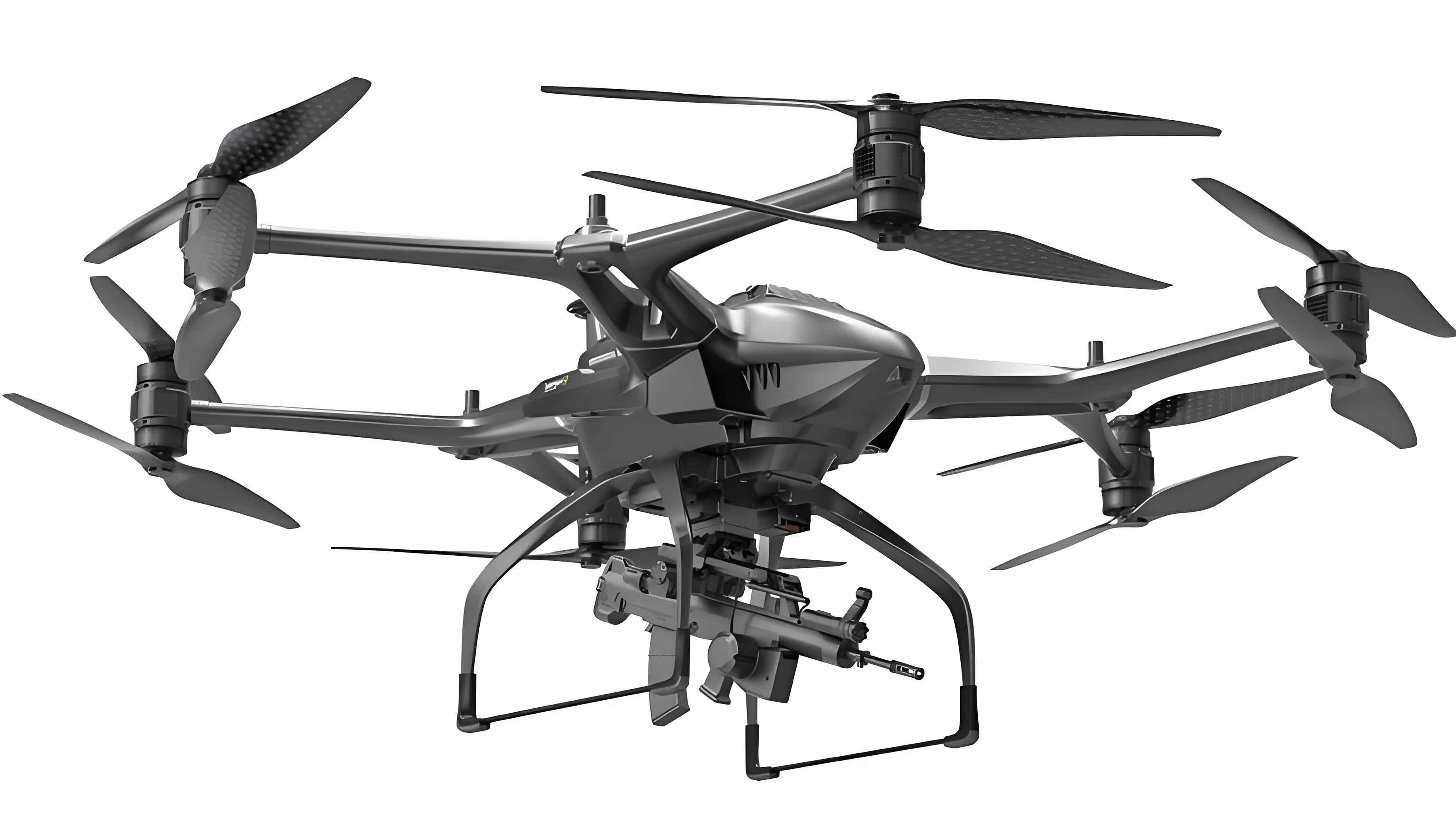
The employment of military drones in Ukraine can be segmented into distinct phases, each highlighting different aspects of their utility and the evolving countermeasures against them. The following table summarizes this evolution:
| Conflict Phase | Timeframe | Dominant Military Drone Types | Primary Roles & Tactical Impact |
|---|---|---|---|
| Initial Invasion & Defense | Feb – Apr 2022 | Medium-Altitude Long-Endurance (MALE) drones (e.g., TB-2), Tactical reconnaissance drones. | Strategic shock; successful strikes on high-value targets (columns, air defenses); morale boost for Ukraine; exposed Russian air defense gaps. |
| Artillery Duels & Attrition | May 2022 – Late 2023 | FPV (First-Person View) drones, Commercial quadcopters, Loitering munitions (e.g., Lancet-3). | Democratization of precision strike; integral to “kill chain” for artillery; high attrition of armored vehicles and personnel; pervasive ISR at company/platoon level. |
| Electronic Warfare (EW) & Counter-Drone Escalation | Ongoing, intensifying from late 2022 | EW-hardened military drones, Swarm prototypes, Lower-observable designs. | High loss rates for commercial drones; increased importance of EW protection and alternative navigation (e.g., inertial); emergence of drone-on-drone combat. |
I. The Multifunctional Battlefield Tool: Core Applications of Military Drones
The utility of the modern military drone in Ukraine extends far beyond simple surveillance. It has become a linchpin in nearly every aspect of tactical operations, creating a more transparent, faster, and deadlier battlefield.
1. Intelligence, Surveillance, and Reconnaissance (ISR): The Unblinking Eye
The primary and most transformative role of the military drone has been in ISR. By providing persistent, real-time coverage of the battlefield, drones have collapsed the traditional “sensor-to-shooter” timeline. A commander’s ability to see first and understand faster is now heavily dependent on drone coverage. The effectiveness of an ISR drone can be partially modeled by its area coverage rate. For a drone conducting a systematic search, the area coverage rate \( A_{rate} \) can be expressed as:
$$ A_{rate} = v \cdot w \cdot \eta $$
where \( v \) is the ground speed, \( w \) is the sensor swath width (a function of altitude and sensor field-of-view), and \( \eta \) is the operational efficiency factor (accounting for turns, comms loss, etc.). In Ukraine, the proliferation of cheap commercial drones has dramatically increased the total \( A_{rate} \) for both sides, making concealment extraordinarily difficult. This has led to what analysts call the “empty battlefield” syndrome, where movement during daylight is severely penalized.
2. Precision Strike and Battlefield Effects: From Observer to Killer
The line between sensor and weapon has virtually disappeared. Military drones in Ukraine fulfill strike roles across the entire spectrum:
- Direct Strike: MALE drones like the TB-2 carry laser-guided munitions to hit targets behind the front line.
- Loitering Munitions: Systems like the Russian Lancet-3 function as lethal ISR-strike hybrids. They can patrol an area for extended periods (\( t_{loiter} \)), identify a target, and then commit a suicide attack. Their probability of successful engagement \( P_{engage} \) increases with loiter time and decreases with the target’s defensive alert status.
- FPV Attack Drones: The most significant innovation. Commercial racing drones, adapted to carry RPG warheads or shaped charges, provide individual infantry units with organic, precision anti-armor capability at a cost of a few hundred dollars. The cost-exchange ratio is staggering.
The following table contrasts traditional and drone-enabled strike paradigms:
| Aspect | Traditional Artillery/Airstrike | Drone-Enabled Strike (FPV/Loitering) |
|---|---|---|
| Time from Detection to Strike | Minutes to Hours (involving multiple echelons) | Seconds to Minutes (single operator/team) |
| Cost per Engagement | Very High ($10k – $1M+) | Extremely Low ($500 – $50k) |
| Platform Risk | High (crew, expensive platform at risk) | Negligible (expendable asset) |
| Target Set | High-value, pre-planned targets | Tactical, opportunistic targets (single vehicle, mortar team, individual soldier) |
3. Electronic Warfare and the Struggle for Survival
The electromagnetic spectrum has become the primary battleground for drone supremacy. Every military drone is a node in a network, relying on communications links (\( C \)) for control and navigation signals (\( N \)), often GPS. Electronic warfare aims to disrupt these links:
$$ \text{Drone Effectiveness} = f(C, N, \text{Payload}) $$
Jamming attacks attempt to reduce \( C \) and \( N \) to zero. Russian forces deployed widespread jamming, creating “bubbles” where commercial drones using standard frequencies became inoperable. This forced rapid adaptation. Countermeasures observed include:
- Frequency Agility: Rapidly hopping communication channels.
- Navigation Resilience: Supplementing GPS with inertial navigation systems (INS), visual navigation, or alternative satellite constellations. The position error \( \epsilon_{pos} \) of an INS grows with time \( t \):
$$ \epsilon_{pos}(t) \approx \epsilon_{vel} \cdot t + \frac{1}{2} \epsilon_{accel} \cdot t^2 $$
where \( \epsilon_{vel} \) and \( \epsilon_{accel} \) are velocity and acceleration errors. This makes pure INS viable only for short-duration FPV strikes, not long-endurance reconnaissance.
4. Force Multiplication and Integrated Kill Chains
Perhaps the most profound impact is how the military drone acts as a force multiplier for legacy systems, particularly artillery. The drone completes the “kill chain” (Find, Fix, Track, Target, Engage, Assess) for artillery units. A drone locates a target (Find, Fix, Track), transmits coordinates (Target), the artillery fires (Engage), and the same drone provides Battle Damage Assessment (BDA). This loop, when efficient, makes artillery exponentially more lethal. The overall lethality \( L \) of an artillery unit can be modeled as being proportional to the probability of target acquisition \( P_{acq} \) (greatly enhanced by drones) and the speed of the engagement cycle \( T_{cycle}^{-1} \):
$$ L \propto \frac{P_{acq}}{T_{cycle}} $$
By maximizing \( P_{acq} \) and minimizing \( T_{cycle} \), drones have made artillery the king of the battlefield in Ukraine once again, but in a far more precise and deadly form.
II. Technological Diffusion and Asymmetric Innovation
The conflict has blurred the line between military and commercial technology. The widespread use of DJI Mavic and similar quadcopters by both sides demonstrates the military potential of Commercial Off-The-Shelf (COTS) technology. This has several implications:
- Democratization of Capabilities: A small infantry unit can now possess its own aerial reconnaissance and strike capability, decentralizing combat power.
- Logistical and Industrial Challenge: The high attrition rate of these cheap drones creates a demand that can be met by global commercial supply chains and decentralized, small-scale workshop production, as seen in Ukraine. This presents a new type of industrial warfare.
- Asymmetric Advantage: A technologically adept but industrially weaker force can leverage COTS drones to impose significant costs on a conventionally superior adversary.
III. Future Trajectories and Imperative Conclusions
The lessons from Ukraine are not mere tactical notes; they are strategic imperatives for future warfare.
1. The Anti-Access/Area Denial (A2/AD) Environment Gets Crowded
Future battlefields will be saturated with sensors and shooters at every tier. Surviving in this environment requires a new approach to platform design. Stealth, while still relevant for high-end systems, is less feasible for small, low-cost military drones. Instead, the focus shifts to:
- Robustness to EW: Military drones must be designed from the chip level for contested spectra.
- Swarming and Autonomy: Large numbers of simple, collaborative drones can overwhelm point defenses. The effectiveness of a swarm \( E_{swarm} \) against a point defense system with engagement rate \( \mu \) can be related to the size of the swarm \( N \) and the time required to defeat it \( T \):
$$ E_{swarm} \propto N – \mu T $$
2. The Rise of the Counter-Drone Ecosystem
Defense against military drones requires a multi-layered, integrated system. No single solution works. A future Counter-Unmanned Aerial System (C-UAS) architecture will likely involve:
| Layer | Technology/System | Target Drone Type | Key Challenge |
|---|---|---|---|
| Soft-Kill | Radio Frequency Jamming, GNSS Spoofing, Cyber Takeover | Commercial, many military drones | Avoiding friendly spectrum fratricide; keeping pace with agile comms. |
| Hard-Kill (Kinetic) | Machine Guns, Micromissiles, Nets, Interceptor Drones | FPV, loitering munitions, small drones | Cost-effectiveness; engaging very small, fast, low-altitude targets. |
| Hard-Kill (Directed Energy) | High-Power Microwaves, Lasers | Swarms, low-cost drones | Power requirements; atmospheric effects (lasers); range. |
| Detection & Tracking | Radar (including distributed), Electro-Optical/Infrared, Acoustic | All | Detecting very small, low-flying drones in cluttered environments. |
3. Organizational and Doctrinal Revolution
The technology is meaningless without the organization to wield it. Future armies will need:
- Drone-Centric Units: Dedicated formations responsible for operating large suites of military drones across all altitudes and roles.
- New Career Fields: Masses of highly trained drone pilots, data analysts, and EW specialists.
- Decentralized C2: Pushing the authority to launch strikes down to lower echelons to exploit fleeting opportunities identified by front-line drones.
- AI-Powered Processing: The sheer volume of data from thousands of daily drone flights necessitates AI for automatic target recognition, tracking, and prioritization.
Final Analysis: The conflict in Ukraine has irrevocably proven that the military drone is not a niche asset but a central component of modern combined arms warfare. It has transformed the battlefield into a transparent, high-precision, and intensely contested environment where advantage flows to the side that can best see, decide, and act. The future will not be defined by a singular, dominant military drone, but by the sophistication of the drone ecosystem—the ability to field heterogeneous swarms, protect one’s own networks while degrading the enemy’s, and harness AI to manage the chaos of robotic warfare. The lesson is clear: to prepare for the wars of tomorrow, nations must invest not just in building better drones, but in building armies that think, fight, and survive in a world where the sky is full of intelligent, watching eyes.