
As I delve into the evolution of aerial warfare, the military drone stands out as a transformative force. From humble beginnings as target practice tools to sophisticated combat assets, these unmanned systems have redefined modern battlefields. In this exploration, I will examine the current state, future trajectories, and expansive potential of military drones, weaving in analytical frameworks through tables and formulas to elucidate key concepts. The journey of the military drone is not just about technology; it’s about reshaping strategic paradigms.
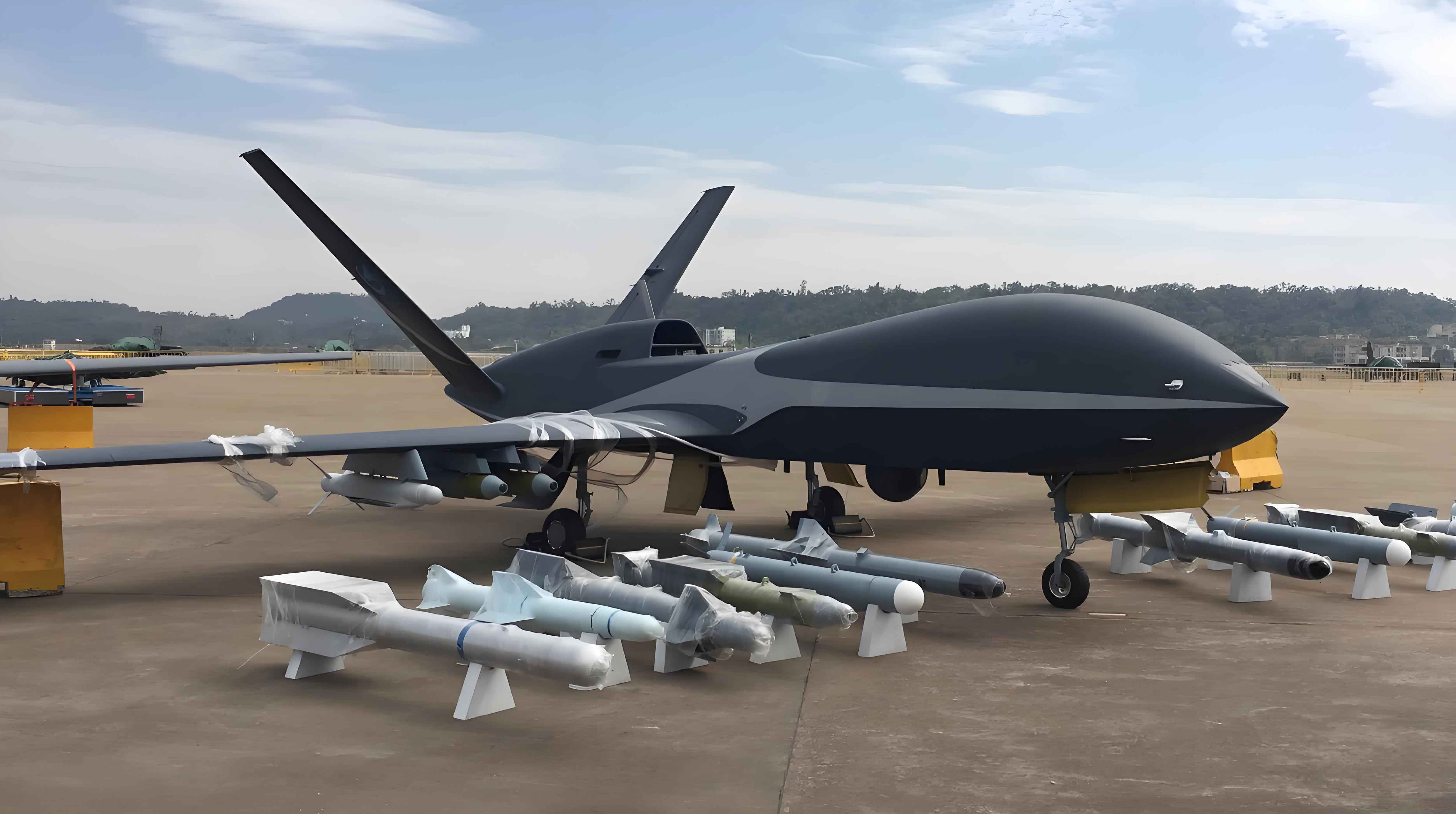
The concept of a military drone dates back over a century, but its proliferation has accelerated in recent decades. Today, we witness an era where military drones are integral to intelligence, surveillance, reconnaissance, and even strike missions. Their ability to operate in perilous environments without risking human lives makes them invaluable. As I analyze this domain, I will emphasize how military drones are evolving to meet diverse operational demands, often outperforming manned aircraft in specific niches. The term “military drone” encapsulates a broad spectrum of systems, from micro-sized scouts to high-altitude endurance platforms.
In assessing the current landscape, military drones exhibit distinct characteristics that set them apart. Structurally, they often feature simplified designs with composite materials to reduce weight and radar signature. For instance, many military drones use carbon-fiber composites, which minimize mass and enhance stealth. The radar cross-section (RCS) can be approximated by $$ \sigma = \frac{4\pi A^2}{\lambda^2} $$ where \( \sigma \) is the RCS, \( A \) is the effective area, and \( \lambda \) is the radar wavelength. By reducing \( A \) through sleek designs, military drones achieve lower detectability.
Flight performance parameters for military drones are extraordinary. Consider the following table comparing typical military drones across key metrics:
| Drone Type | Max Speed (km/h) | Service Ceiling (m) | Endurance (hours) | Typical Payload (kg) |
|---|---|---|---|---|
| High-Altitude Military Drone | 635 | 19,810 | 42 | 1,300 |
| Medium-Altitude Military Drone | 220 | 7,600 | 24 | 200 |
| Miniature Military Drone | 80 | 3,000 | 2 | 5 |
| Combat-Oriented Military Drone | 900 | 15,000 | 18 | 1,500 |
From this, it’s evident that military drones offer versatility in speed and altitude. The endurance of a military drone, often exceeding 40 hours, is modeled by $$ E = \frac{W_f}{C \cdot P} $$ where \( E \) is endurance, \( W_f \) is fuel weight, \( C \) is specific fuel consumption, and \( P \) is power required. Advancements in propulsion have pushed these limits, enabling prolonged missions.
Control mechanisms for military drones blend autonomy and remote guidance. A typical flight control system uses PID controllers, expressed as $$ u(t) = K_p e(t) + K_i \int e(t) dt + K_d \frac{de(t)}{dt} $$ where \( u(t) \) is the control output, \( e(t) \) is error, and \( K_p, K_i, K_d \) are gains. This allows precise navigation, whether via pre-programmed routes or real-time commands. Launch and recovery methods vary—from runway takeoffs to catapult launches and parachute landings—enhancing deployment flexibility for military drones in contested zones.
Mission profiles for military drones often involve high-risk scenarios. For example, in electronic warfare, a military drone might jam communications using a transmitted power density given by $$ J = \frac{P_t G_t}{4\pi R^2} $$ where \( J \) is jamming power at target, \( P_t \) is transmitter power, \( G_t \) is antenna gain, and \( R \) is range. This capability allows military drones to suppress enemy systems without exposing personnel. Similarly, in reconnaissance, the ground resolution \( \Delta x \) of a drone’s sensor can be estimated by $$ \Delta x = \frac{H \cdot \lambda}{D} $$ with \( H \) as altitude, \( \lambda \) as wavelength, and \( D \) as aperture diameter. Such formulas underscore the technical prowess embedded in modern military drones.
Looking ahead, the trajectory of military drone development is shaped by several trends. First, there is a push toward higher speeds and altitudes. The drag force \( D \) on a military drone is $$ D = \frac{1}{2} \rho v^2 S C_D $$ where \( \rho \) is air density, \( v \) is velocity, \( S \) is reference area, and \( C_D \) is drag coefficient. To achieve hypersonic speeds (e.g., Mach 10), reducing \( C_D \) through aerodynamic shaping is critical. Additionally, stealth remains a priority; the RCS reduction techniques often involve coatings with complex permeability \( \mu \) and permittivity \( \epsilon \), affecting reflection as per $$ R = \left| \frac{\sqrt{\mu/\epsilon} – \eta_0}{\sqrt{\mu/\epsilon} + \eta_0} \right|^2 $$ where \( \eta_0 \) is free-space impedance. These innovations will make future military drones more survivable.
Second, the emergence of attack-capable military drones, or unmanned combat aerial vehicles (UCAVs), is revolutionizing strike operations. Payload capacity for such military drones can be modeled by $$ W_{payload} = W_{takeoff} – (W_{empty} + W_{fuel}) $$ where \( W_{takeoff} \) is takeoff weight, \( W_{empty} \) is empty weight, and \( W_{fuel} \) is fuel weight. With advances in materials, this ratio improves, allowing military drones to carry missiles or bombs. For instance, a military drone might deploy guided munitions with a hit probability \( P_h \) given by $$ P_h = 1 – e^{-\frac{A_p}{A_t}} $$ where \( A_p \) is presented area and \( A_t \) is target area. This mathematical framework aids in optimizing armament configurations for military drones.
Third, miniaturization of military drones is progressing rapidly. Nano-drones, with masses under 100 grams, leverage scaling laws where lift generation relates to wing area \( S \) and velocity \( v \) as $$ L = \frac{1}{2} \rho v^2 S C_L $$. As size decreases, \( S \) shrinks quadratically, posing challenges but enabling covert operations. The table below highlights miniaturization trends in military drones:
| Aspect | Conventional Military Drone | Micro Military Drone | Nano Military Drone |
|---|---|---|---|
| Wingspan (cm) | 300-1000 | 15-50 | 5-10 |
| Mass (g) | 10,000-100,000 | 500-2000 | 10-100 |
| Power Source | Internal Combustion | Battery | Battery/Solar |
| Typical Range (km) | 500+ | 10-50 | 1-5 |
Fourth, cost reduction is driving wider adoption of military drones. The lifecycle cost \( C_{total} \) of a military drone system can be expressed as $$ C_{total} = C_{acquisition} + C_{operation} + C_{maintenance} $$. Through mass production and modular designs, \( C_{acquisition} \) decreases, making military drones more accessible for diverse forces. This economic aspect is crucial for scaling up deployments, ensuring that military drones become ubiquitous in defense arsenals.
Beyond these trends, the operational horizons for military drones are expanding. In communication countermeasures, a military drone could perform anti-radiation attacks on enemy radios. The effective radiated power (ERP) required for suppression is $$ ERP = P_t G_t L $$ with \( L \) as losses. By integrating seekers, military drones can home in on emissions, disrupting networks. This aligns with the broader electromagnetic spectrum dominance sought through military drones.
Another promising role for military drones is intercepting cruise missiles. The engagement dynamics involve probability of kill \( P_k \) modeled by $$ P_k = P_d \cdot P_l \cdot P_h $$ where \( P_d \) is detection probability, \( P_l \) is launch probability, and \( P_h \) is hit probability. Military drones, stationed aerially, enhance \( P_d \) due to elevated sightlines. For a cruising missile with velocity \( v_m \), the intercept time \( t \) for a military drone moving at \( v_d \) is $$ t = \frac{R_0}{v_m + v_d} $$ where \( R_0 \) is initial range. Such mathematical models guide deployment strategies for military drones in missile defense.
Space domain awareness is also a frontier for military drones. Although orbital engagements are complex, high-altitude military drones could serve as platforms for anti-satellite measures. The required delta-v for reaching low Earth orbit from a drone at altitude \( h \) is approximated by $$ \Delta v \approx \sqrt{\frac{GM}{R_e + h}} $$ where \( G \) is gravitational constant, \( M \) is Earth’s mass, and \( R_e \) is Earth’s radius. While technically demanding, this illustrates the potential of military drones to extend influence beyond the atmosphere.
Furthermore, as military drones proliferate, counter-drone tactics will evolve, including drone-on-drone combat. In such scenarios, the maneuverability of a military drone is quantified by turn rate \( \omega \) given by $$ \omega = \frac{g \sqrt{n^2 – 1}}{v} $$ where \( g \) is gravity, \( n \) is load factor, and \( v \) is speed. Superior agility, coupled with onboard sensors, could determine outcomes in aerial duels between military drones. This underscores the need for advanced autonomy in military drones, where decision-making algorithms process data in real-time.
To synthesize these points, consider the integrated performance metric \( M \) for a military drone, combining speed, stealth, and payload: $$ M = \alpha \cdot v_{norm} + \beta \cdot \sigma_{norm}^{-1} + \gamma \cdot W_{payload,norm} $$ with \( \alpha, \beta, \gamma \) as weighting factors and normalized parameters. This holistic view aids in designing balanced military drones for future conflicts.
In conclusion, the military drone ecosystem is dynamic and multifaceted. From current capabilities to future innovations, military drones are poised to dominate aerial operations. The integration of formulas and tables, as presented, clarifies the technical underpinnings. As we advance, continuous research into materials, propulsion, and AI will unlock new potentials for military drones. Ultimately, the military drone is not just a tool but a cornerstone of modern defense, promising enhanced effectiveness and reduced risk in the battlespace. The journey of the military drone is far from over; it is accelerating toward an era where unmanned systems redefine warfare itself.