
As a researcher deeply immersed in the field of unmanned aerial systems, I have witnessed the rapid transformation of military drone technology over the years. From their humble beginnings to becoming pivotal assets in modern warfare, military drones, particularly micro variants, have redefined tactical operations. In this article, I will explore the current state and future trends of military micro drones, drawing from global developments and technical insights. The term “military drone” will be frequently referenced to emphasize its centrality in defense strategies.
The concept of unmanned aerial vehicles, commonly known as military drones, dates back to the early 20th century, but it is in recent decades that they have proliferated across military domains. A military drone is defined as a radio-controlled or pre-programmed non-crewed aircraft, offering advantages such as reduced risk to human life and versatility in missions like surveillance, reconnaissance, and combat. The evolution toward miniaturization has given rise to micro drones, which are now at the forefront of military innovation. These devices, often weighing less than 5 kilograms, are designed for agility and stealth, making them indispensable in contemporary conflicts.
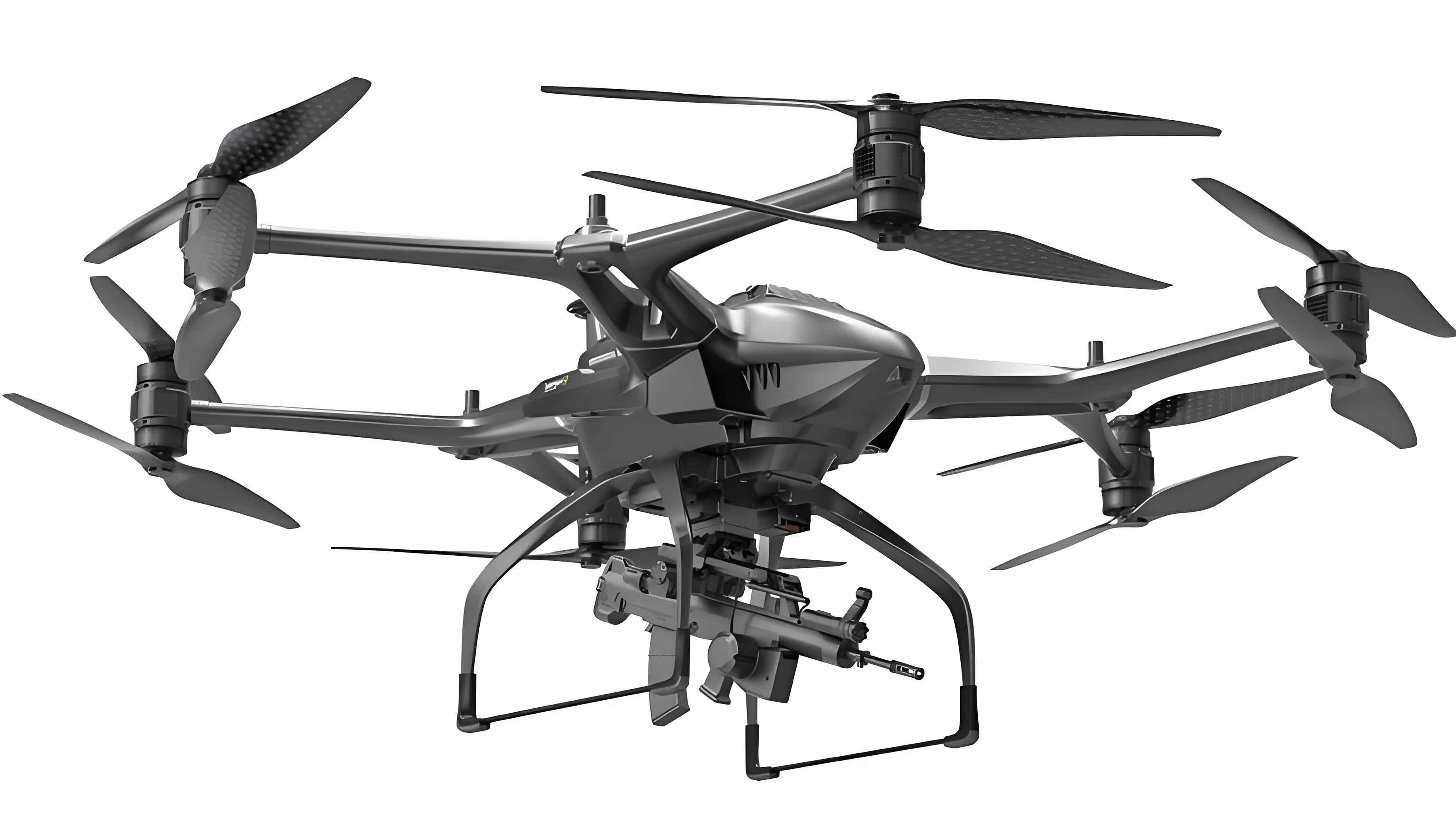
In my analysis, military micro drones exhibit distinct characteristics that set them apart from larger unmanned systems. These features are critical for their deployment in diverse environments, from urban warfare to remote battlegrounds. Below, I summarize the key attributes in a table to provide a clear overview:
| Characteristic | Description | Impact on Military Operations |
|---|---|---|
| Flexible Launch and Recovery | Supports hand-thrown, vertical take-off, or short-runway methods; requires minimal space. | Enables rapid deployment by infantry units in confined areas. |
| High Maneuverability | Small size and low noise facilitate stealthy movement through complex terrains. | Enhances reconnaissance capabilities without detection. |
| Low Cost | Manufacturing expenses range from $1,500 to $20,000, depending on sensors and integration. | Reduces financial burden and allows for expendable use in high-risk missions. |
| Ease of Transport | Compact design enables single-soldier carriage and quick assembly. | Increases operational flexibility and mobility in field conditions. |
| Advanced Sensing | Equipped with HD cameras, thermal imagers, and other sensors for real-time data collection. | Provides critical intelligence for decision-making in combat zones. |
From a technical perspective, the performance of a military drone can be quantified using various formulas. For instance, the endurance of a micro drone is often limited by its power consumption and battery capacity. The relationship can be expressed as:
$$E = \frac{C \cdot V}{P}$$
where \(E\) is the endurance in hours, \(C\) is the battery capacity in ampere-hours, \(V\) is the voltage, and \(P\) is the average power draw in watts. This formula highlights the challenge in extending flight times for micro drones, as their small size restricts battery size. Optimizing this equation is a key focus in military drone development.
Turning to global advancements, the development of military micro drones has been led by several nations, each contributing unique innovations. The United States, Israel, and China are prominent players, with extensive research and deployment programs. I have compiled a comparative table to illustrate the current landscape:
| Country | Key Military Drone Models | Specifications | Operational Use |
|---|---|---|---|
| United States | Micro-Star, Dragon Eye | Weight: 0.1-2.3 kg; Range: 5-10 km; Endurance: 0.5-1 hour. | Used in surveillance and reconnaissance in conflicts like Iraq War. |
| Israel | Skylark, Meteor | Weight: 2-5 kg; Endurance: up to 4 hours; Altitude: up to 10,000 m. | Employed by special forces and exported globally. |
| China | Various domestic and collaborative models | Focus on tactical drones; details often classified but growing rapidly. | Applied in counter-terrorism and disaster relief missions. |
The proliferation of these military drones underscores their strategic value. In the U.S., investments exceeding $20 billion since the late 1990s have fueled projects like the Micro-Star, which exemplifies miniaturization. Israel, as a leading exporter, has leveraged its expertise to produce systems like the Skylark, demonstrating how military drone technology can be commercialized. China, though a latecomer, is catching up through state-led initiatives and international partnerships, emphasizing the global race in this domain.
Looking ahead, the future trends of military micro drones are shaped by technological bottlenecks and evolving battlefield requirements. Based on my observations, three primary directions will dominate: enhancing endurance, reducing size and noise, and expanding functionality. These trends are interconnected, often governed by physical principles. For example, the noise generated by a rotary-wing military drone can be modeled using acoustic theory. The sound pressure level \(L_p\) in decibels is given by:
$$L_p = 10 \log_{10}\left(\frac{p^2}{p_0^2}\right)$$
where \(p\) is the root-mean-square sound pressure and \(p_0\) is the reference pressure. Minimizing this noise is crucial for stealth, requiring aerodynamic optimizations.
To delve deeper, I present a table summarizing the anticipated advancements and associated challenges:
| Trend | Technical Goals | Potential Solutions | Impact on Military Drone Design |
|---|---|---|---|
| Extended Endurance | Achieve flight times >3 hours and ranges >10 km. | Improve battery energy density; optimize propulsion efficiency using $$ \eta = \frac{T \cdot v}{P_{in}} $$ where \(\eta\) is efficiency, \(T\) is thrust, \(v\) is velocity, and \(P_{in}\) is input power. | Enables longer missions for persistent surveillance. |
| Miniaturization | Reduce dimensions to <15 cm in all axes while maintaining performance. | Advance micro-electromechanical systems (MEMS) and lightweight materials. | Enhances portability and reduces detectability. |
| Multifunctionality | Integrate sensors for diverse environments (e.g., night vision, signals intelligence). | Develop modular payload systems and AI-driven autonomy. | Broadens applications from reconnaissance to electronic warfare. |
| Increased Autonomy | Reduce reliance on pre-programming; enable real-time adaptive flight. | Implement machine learning algorithms for obstacle avoidance and decision-making. | Improves responsiveness in dynamic combat scenarios. |
The integration of artificial intelligence is particularly pivotal for the next generation of military drones. Autonomous navigation can be formulated as a path-planning problem, where a drone minimizes a cost function \(J\) over a trajectory:
$$J = \int_{0}^{T} \left( \| \mathbf{x}(t) – \mathbf{x}_{goal} \|^2 + \lambda \cdot \text{noise}(t) \right) dt$$
Here, \(\mathbf{x}(t)\) represents the drone’s position, \(\mathbf{x}_{goal}\) is the target, and \(\lambda\) weights noise reduction. Such formulations drive research into smarter military drones capable of operating in swarms or under jamming conditions.
In addition to technological aspects, the operational deployment of military micro drones raises logistical considerations. The lifecycle cost of a military drone system includes development, production, maintenance, and training. A simplified cost model can be expressed as:
$$C_{total} = N \cdot (C_{unit} + C_{op} \cdot t_{life})$$
where \(N\) is the number of units, \(C_{unit}\) is the unit cost, \(C_{op}\) is the operational cost per hour, and \(t_{life}\) is the service life. This economic perspective influences procurement strategies, especially for resource-constrained forces.
The global market for military drones is expanding, with projections indicating increased investment in micro variants. From my analysis, nations are prioritizing these systems for asymmetric warfare, where their small size and low cost provide a tactical edge. The military drone ecosystem is also fostering dual-use technologies, blurring lines between defense and civilian applications. For instance, advancements in battery efficiency from military drone research can benefit commercial drones, and vice versa.
Environmental factors further shape military drone development. High-altitude operations require considerations of air density \(\rho\), which affects lift generation according to the lift equation:
$$L = \frac{1}{2} \rho v^2 S C_L$$
where \(L\) is lift, \(v\) is airspeed, \(S\) is wing area, and \(C_L\) is the lift coefficient. For micro drones operating in varied climates, adaptive designs are necessary to maintain performance, highlighting the interdisciplinary nature of this field.
In conclusion, the trajectory of military micro drones points toward greater integration into defense architectures. As these systems evolve, they will likely become more autonomous, resilient, and multifunctional, reshaping modern warfare. The military drone, in its micro form, is not just a tool but a transformative element in military strategy. My assessment suggests that continued innovation in materials, propulsion, and AI will unlock new capabilities, solidifying the role of military drones in future conflicts. The journey from early prototypes to sophisticated networks of micro drones underscores a dynamic era in military technology, one that demands ongoing research and ethical considerations.
To encapsulate, the development of military micro drones is a testament to human ingenuity in leveraging technology for security. Through tables and formulas, I have aimed to provide a comprehensive view of their current state and future potential. As I reflect on this rapidly evolving domain, it is clear that the military drone will remain a cornerstone of defense systems worldwide, driving advancements that extend far beyond the battlefield.