
The integration of large military drones with submerged launch platforms, such as attack submarines or large unmanned underwater vehicles (UUVs), represents a paradigm shift in naval warfare. This fusion creates a versatile, unmanned combat system capable of operating from the clandestine environment of the deep sea to the contested domains of air and space. A military drone launched from a submarine inherits the platform’s inherent stealth and strategic reach, transforming it into a multi-role asset for persistent intelligence, surveillance, and reconnaissance (ISR), over-the-horizon targeting, communications relay, kinetic strike, and battle damage assessment. The core technological enabler for this capability is a reliable, covert, and structurally feasible vertical launch system (VLS). This article delves into the technical intricacies, challenges, and potential solutions for vertically launching large military drones from submerged platforms.
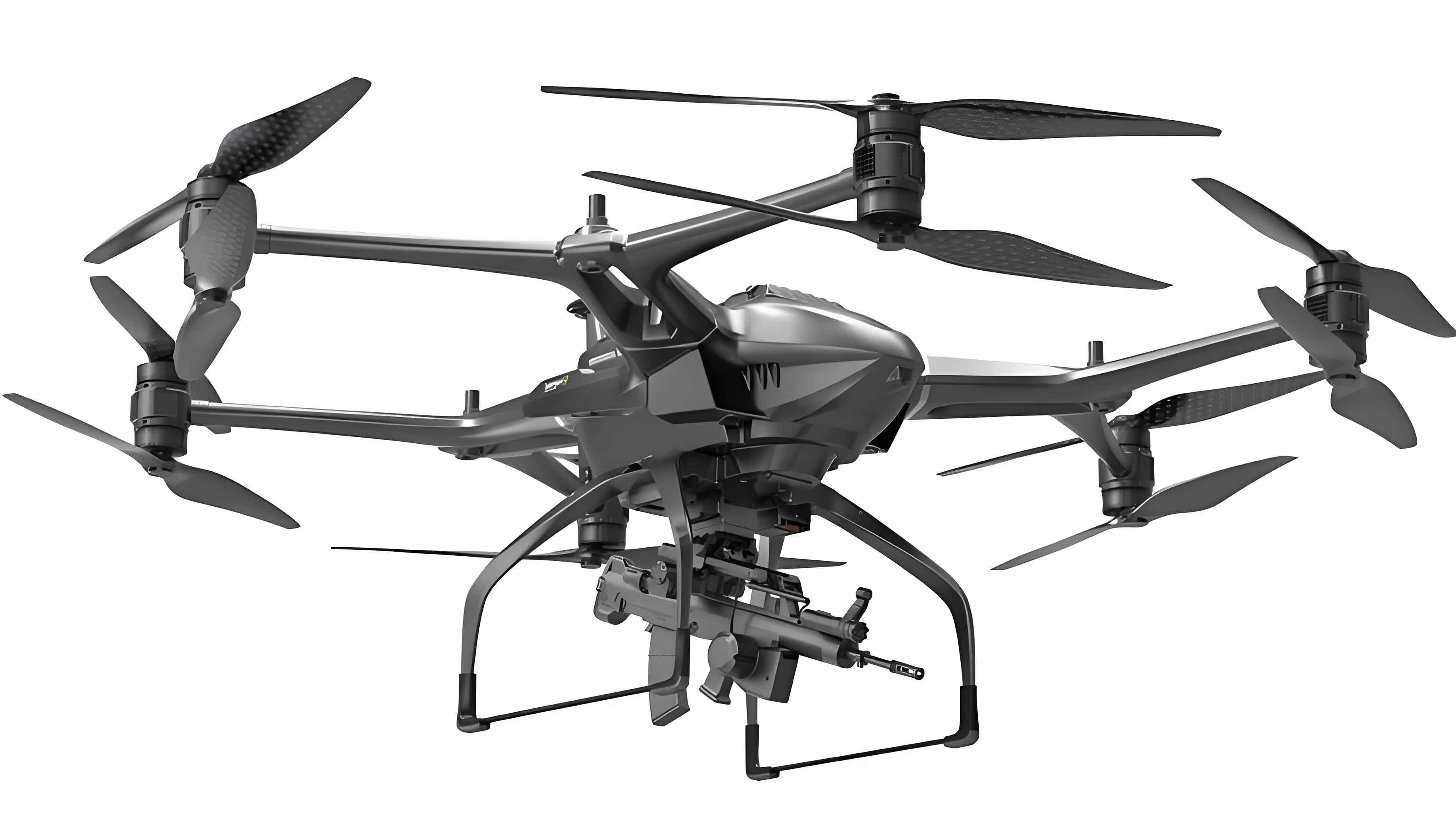
The operational advantage of a submarine-launched military drone is profound. It extends the submarine’s sensor and influence horizon far beyond the range of its own periscopes or sonar arrays without compromising its position. A military drone can provide real-time imagery and data-link capabilities, acting as a forward node for network-centric warfare. For strike missions, a military drone can be deployed to engage time-sensitive targets identified by the submarine, offering a stand-off capability that was previously the sole domain of surface ships or aircraft. The development of such a system, however, is fraught with engineering challenges centered on the launch phase itself.
1. Defining Requirements for Submerged Vertical Launch
The launch of a large military drone from a submarine is not merely an adaptation of existing missile launch technology. The unique characteristics of a military drone—such as fixed or folding wings, air-breathing engines (e.g., turbojet, turbofan), and potentially delicate payloads—impose specific constraints. The primary technical requirements for the launch system can be summarized as follows:
- Structural and Spatial Compatibility: The system must fit within the geometric confines of the host submarine. Modern submarines have limited large-diameter openings, typically the ballistic or cruise missile launch tubes (with diameters often exceeding 2 meters). The launch system, including the military drone, its protective capsule or canister, and any launch assist mechanism, must be designed to utilize this existing infrastructure without major hull modifications.
- Covert and Silent Operation: The cardinal rule of submarine operations is that detection equates to vulnerability. The launch event must minimize acoustic, hydrodynamic, and thermal signatures. A loud, bubbly, or violent launch could reveal the submarine’s location, negating the tactical advantage of deploying the military drone.
- Adaptability and Commonality: Ideally, the launch system should be “plug-and-play” with existing VLS tubes, allowing a submarine to carry a mixed payload of missiles and military drones. This commonality reduces logistical complexity and increases operational flexibility.
- High Reliability and Safety: The sequence from tube egress to stable aerial flight is complex and must occur reliably in the harsh marine environment. The system must ensure the military drone’s integrity during launch, water exit, and engine start.
2. Taxonomy of Vertical Launch Technologies for Military Drones
The launch methodology can be categorized along three principal axes: the launch location relative to the submarine, the drone’s exposure to seawater during launch, and the primary source of launch energy.
2.1 Classification by Launch Location
- Internal Tube Launch: The military drone is stored and launched directly from a large-diameter vertical launch tube within the submarine’s pressure hull (e.g., a repurposed ballistic missile tube). This offers the best protection for the drone and aligns with the commonality requirement.
- External Pod/Canister Launch: The military drone is housed in a specialized pod attached externally to the submarine’s hull or within a conformal superstructure. While this may save internal volume, it increases drag, complicates maintenance, and poses greater risks from underwater collisions or depth charges.
- Mast-Based Launch: The drone is launched from a retractable mast, requiring the submarine to be at periscope depth. This is only suitable for very small drones due to mast size and stability limitations and negates the ability for deep-submergence launch.
2.2 Classification by Exposure to Seawater: Dry vs. Wet Launch
This is a critical distinction that fundamentally shapes the design of both the military drone and its launch system.
| Feature | Dry Launch | Wet Launch |
|---|---|---|
| Concept | The military drone is encapsulated within a sealed, buoyant canister or capsule. It remains dry throughout the underwater phase. | The military drone is exposed to seawater. It is either launched “naked” or from a flooded tube. |
| Drone Design Impact | Drone must be foldable to fit in canister. Less stringent pressure hull requirements for the drone itself. | Drone requires full pressure hull, corrosion protection, and waterproofing for all systems (engines, avionics). Wings may be fixed. |
| Launch Sequence | 1. Canister is ejected/rises. 2. Canister breaches surface. 3. Canister opens/ drone is elevated. 4. Drone engine starts and takes off. | 1. Tube is flooded/hatch opens. 2. Drone is propelled out. 3. Drone rises through water column. 4. Breaches surface and initiates takeoff. |
| Advantages | Better protection for drone. Potentially quieter (buoyant ascent). Simplified drone design (no need for full ocean-pressure rating). | Potentially simpler launch mechanism. No need for complex canister separation. Higher volumetric efficiency in the tube. |
| Disadvantages | Added complexity and mass of canister. Requires canister separation/jettison. Volume efficiency reduced by canister walls. | Extreme engineering challenge for drone survivability. Risk of water ingestion in engines. Greater acoustic signature during water exit. |
2.3 Classification by Launch Energy Source
- Buoyant Ascent (Passive): The launch vehicle (drone+canister or the drone itself) has a net positive buoyancy. It is released and floats quietly to the surface. This is the stealthiest option. The buoyancy force $F_b$ is given by Archimedes’ principle:
$$F_b = \rho_{sw} \cdot g \cdot V_{disp}$$
where $\rho_{sw}$ is seawater density, $g$ is gravity, and $V_{disp}$ is the displaced volume. The ascent velocity $v_{ascent}$ can be modeled as a balance between buoyancy, gravity, and drag $F_d$:
$$m \frac{dv}{dt} = F_b – mg – F_d, \quad \text{where } F_d = \frac{1}{2} C_d \rho_{sw} A v^2$$
Here, $m$ is mass, $C_d$ is the drag coefficient, and $A$ is the cross-sectional area. - External Impulse (Active): An external force propels the drone out of the tube. This includes:
- Gas Generator/Piston: High-pressure gas (from a gas generator or compressed air) acts on a piston to push the drone out. This is a “cold launch.”
- Steam/Ejector: Similar to traditional torpedo launches, using a pulse of water or steam.
- Electromagnetic Catapult (EMCAT): Using pulsed power to accelerate a sled carrying the drone. The force principle is based on Lorentz force: $F = I(L \times B)$.
These methods provide positive control over exit velocity but generate significant acoustic and potentially thermal signatures.
- Self-Powered Ascent (Rocket Assisted): The drone or its capsule uses a solid or hybrid rocket motor to propel itself out of the water. While effective, this is the least covert option, creating a large acoustic and infrared signature both underwater and on the surface.
3. Technical Challenges and Analysis
Launching a large military drone vertically from a submerged platform presents a unique set of intertwined challenges.
3.1 Hydrodynamic and Aero-Hydrodynamic Transitions
The most critical phase is water exit. As the military drone or its capsule pierces the water surface, it transitions from a fully submerged object to a free-flying or floating one. This involves complex interactions between water, air, and the vehicle structure.
The phenomenon of “water slamming” imposes severe transient loads. The peak pressure $P_{slam}$ during water entry/exit can be approximated by:
$$P_{slam} \approx \frac{1}{2} \rho_{sw} C_p v_n^2$$
where $C_p$ is a pressure coefficient and $v_n$ is the velocity normal to the water surface. For a vehicle exiting at an angle, asymmetric slamming can induce large pitching moments, potentially destabilizing the military drone. Computational Fluid Dynamics (CFD) coupled with Finite Element Analysis (FEA) is essential to model this event and design structures accordingly.
3.2 Launch Dynamics and Stability
Ensuring stable orientation during the underwater ascent and at surface breach is paramount. For a buoyantly ascending capsule containing a military drone, the center of buoyancy ($CB$) must be above the center of gravity ($CG$) to provide a righting moment. The metacentric height $GM$ is a key stability metric:
$$GM = BM + KB – KG$$
where $BM$ is the distance from the center of buoyancy to the metacenter, $KB$ is the height of the center of buoyancy, and $KG$ is the height of the center of gravity. A positive $GM$ indicates stability. For an actively launched, un-capsuled military drone, hydrodynamic fins or controlled thrust vectoring may be necessary to maintain attitude during the underwater trajectory.
3.3 Structural Integration and Packaging
A large military drone must be packaged to fit within a cylindrical tube of fixed diameter, typically necessitating folding wings and tail surfaces. The deployment mechanism for these surfaces must be extremely reliable and rapid upon reaching the surface or after launch. The structural weight penalty for folding joints, waterproof seals (for wet launch), and a pressure-resistant canopy must be meticulously traded against payload and fuel capacity. The table below summarizes key packaging and deployment considerations.
| Subsystem | Dry Launch (Capsuled) | Wet Launch (Exposed) | Common Challenges |
|---|---|---|---|
| Wing/Tail Storage | Folded within capsule. Deployment after capsule breach. | May be fixed or folded. If folded, deployment mechanism must be waterproof and pressure-resistant. | Deployment reliability under all weather/seastate conditions. Minimizing deployment time. |
| Propulsion System | Protected in capsule. Engine start after exposure to air. | Must be sealed. Risk of water ingestion during surface breach. May require pre-start purging. | Ensuring reliable “cold” start after extended dormancy in a marine environment. |
| Payload Bay | Sealed within drone’s fuselage. | Requires independent, high-integrity pressure seal. | Maintaining sensor calibration and functionality despite launch shocks and environmental exposure. |
| Canister/Capsule | Must be buoyant, structurally sound, and feature a reliable opening mechanism (e.g., explosive bolts, pneumatic). Adds non-recurring mass. | Not applicable. | N/A |
3.4 Stealth (Signature Management)
The launch event is a vulnerable moment. A buoyant ascent offers the lowest acoustic signature. Active launch methods require careful design to mitigate noise. Gas bubbles from any source create a detectable acoustic and potentially visible trail. The launch must also manage its electromagnetic signature, particularly if an electromagnetic catapult is used.
4. Analysis of a Notional System: A Buoyant Canister Dry Launch
Based on an analysis of historical programs and technical feasibility, a buoyant canister-based dry launch appears to be a prudent development path for a first-generation large military drone capability. Let’s construct a simplified technical model.
System Description: The military drone is stored in a folded configuration within a slender, buoyant, cylindrical canister. The canister is housed in a submarine’s large-diameter VLS tube. The canister’s buoyancy is carefully tuned to provide a controlled, quiet ascent.
Launch Sequence & Physics:
- Tube Ejection: The canister is initially held at the bottom of the tube. A low-pressure gas generator provides a gentle impulse to overcome static friction and initiate movement, establishing a positive upward velocity $v_0$ without creating excessive noise.
$$ \text{Impulse } J = \int F_{gas} \, dt = m v_0 $$ - Buoyant Ascent: Once clear of the tube, buoyancy becomes the dominant force. The equation of motion (simplified, ignoring variable drag for illustration):
$$ m \frac{dv}{dt} = \rho_{sw} g V_{disp} – mg – \beta v $$
Assuming a linear drag term $\beta v$ for near-terminal velocity estimation. Terminal velocity $v_t$ is:
$$ v_t = \frac{(\rho_{sw} V_{disp} – m)g}{\beta} $$
Design goal: a low $v_t$ (e.g., 2-4 m/s) for low acoustic noise and stable surface approach. - Surface Stabilization and Canister Opening: Upon breaching the surface, the canister must stabilize in the wave field. Its waterplane area $A_{wp}$ and $GM$ determine seakeeping behavior. After stabilization, the canister’s nose cone is jettisoned, and an internal elevator raises the military drone to a launch position.
- Drone Engine Start and Takeoff: The military drone’s turbojet or turbofan engine is started. For a “zero-length” launch from the canister, a short-duration Jet Assisted Takeoff (JATO) rocket may be used to ensure clean separation and initial climb, especially in high sea states. The required JATO thrust $T_{JATO}$ must provide a minimum acceleration $a_{min}$:
$$ T_{JATO} + T_{engine} = m_{drone} \cdot a_{min} + D + m_{drone}g \sin(\theta) $$
where $D$ is aerodynamic drag and $\theta$ is the launch rail angle (near vertical).
Mass Budget Example: A critical trade-off. Assume a target military drone launch mass of $m_{drone} = 4000$ kg. The canister system mass $m_{can}$ must be added.
$$ m_{total} = m_{drone} + m_{can} $$
For buoyancy: $ \rho_{sw} V_{disp} \geq m_{total} $. If $ \rho_{sw} \approx 1025 \, \text{kg/m}^3$, then the minimum displaced volume is:
$$ V_{disp, min} = \frac{m_{total}}{1025} \, \text{m}^3 $$
If the canister is cylindrical with diameter $D_{can}$ (constrained by tube diameter, e.g., 2.1m) and length $L_{can}$, then $V_{disp} = \pi (D_{can}/2)^2 L_{can}$. This equation sets the relationship between canister length, drone mass, and canister mass, driving lightweight composite material choices for the canister.
5. Comparative Assessment and Future Directions
The evolution of this technology will likely follow a path of increasing integration and performance. The following table assesses the maturity and potential of different concepts.
| Launch Concept | Technical Maturity | Stealth Rating | Drone Design Complexity | Potential Evolution |
|---|---|---|---|---|
| Buoyant Canister (Dry) | Medium-High (based on legacy SLBM/decoy concepts) | Excellent | Medium (folding mechanisms required) | Integration with multi-purpose VLS; Recoverable/reusable canister. |
| Wet Launch (Exposed Drone) | Low (significant materials/engineering hurdles) | Medium (dependent on launch method) | Very High (full pressure hull, corrosion proofing) | Long-term goal for maximum volumetric efficiency and rapid launch. |
| Electromagnetic Catapult (Dry or Wet) | Low-Medium (technology developing) | Good (potentially low acoustic signature) | High (requires drone to withstand high G launch) | Future standard for rapid, controlled launches from various platforms. |
| Integrated Rocket Boost (Self-Powered) | High (similar to ASROC/VLA) | Poor | Medium (requires integral booster) | Likely limited to non-stealthy or urgent scenarios. |
Future Directions: Research will focus on multi-domain optimization. Advanced composite materials will reduce canister weight. Machine learning algorithms could optimize the buoyant ascent path in real-time based on ocean current data. The ultimate goal is a fully integrated “Fly-by-Wire/Depth” system where the submarine’s combat management system seamlessly plans and executes the launch, ascent, and mission of the military drone, treating it as another organic sensor and effector. Furthermore, the concept of underwater recovery, though immensely challenging, remains a tantalizing goal for creating a truly reusable, carrier-based military drone system for submarines.
6. Conclusion
The vertical launch of a large military drone from a submerged platform is one of the most complex integration challenges in modern naval engineering. It sits at the intersection of hydrodynamics, structural mechanics, propulsion, and stealth technology. While the wet launch of an exposed military drone offers theoretical advantages in packing density, the current technological hurdles related to pressure hull design, corrosion, and water exit dynamics are formidable. Therefore, a dry launch system utilizing a buoyant canister emerges as a more tractable and lower-risk development pathway. This approach leverages known principles of underwater launch and provides a protective environment for the sensitive military drone until the moment of aerial deployment. Success in this endeavor will hinge on meticulous systems engineering, rigorous modeling and simulation of the water-exit transition, and relentless focus on minimizing all aspects of launch signature. The nation that successfully fields a reliable and covert submarine-launched military drone system will gain a significant and enduring asymmetric advantage in the undersea and aerial domains, making the military drone a true extension of the submarine’s reach and power.