
As military operations evolve, the strategic deployment of military drones has transitioned from supplementary roles to core operational pillars. Statistical data reveals a paradigm shift: manned aircraft sorties for strike missions decreased by 15.8% annually, while training programs for military UAV operators now exceed those for fighter pilots. This transformation stems from the unique capabilities of unmanned systems to perform in high-risk environments while reducing human exposure. The versatility of modern military drones enables exponential expansion beyond traditional reconnaissance and strike missions, as demonstrated by three revolutionary applications:
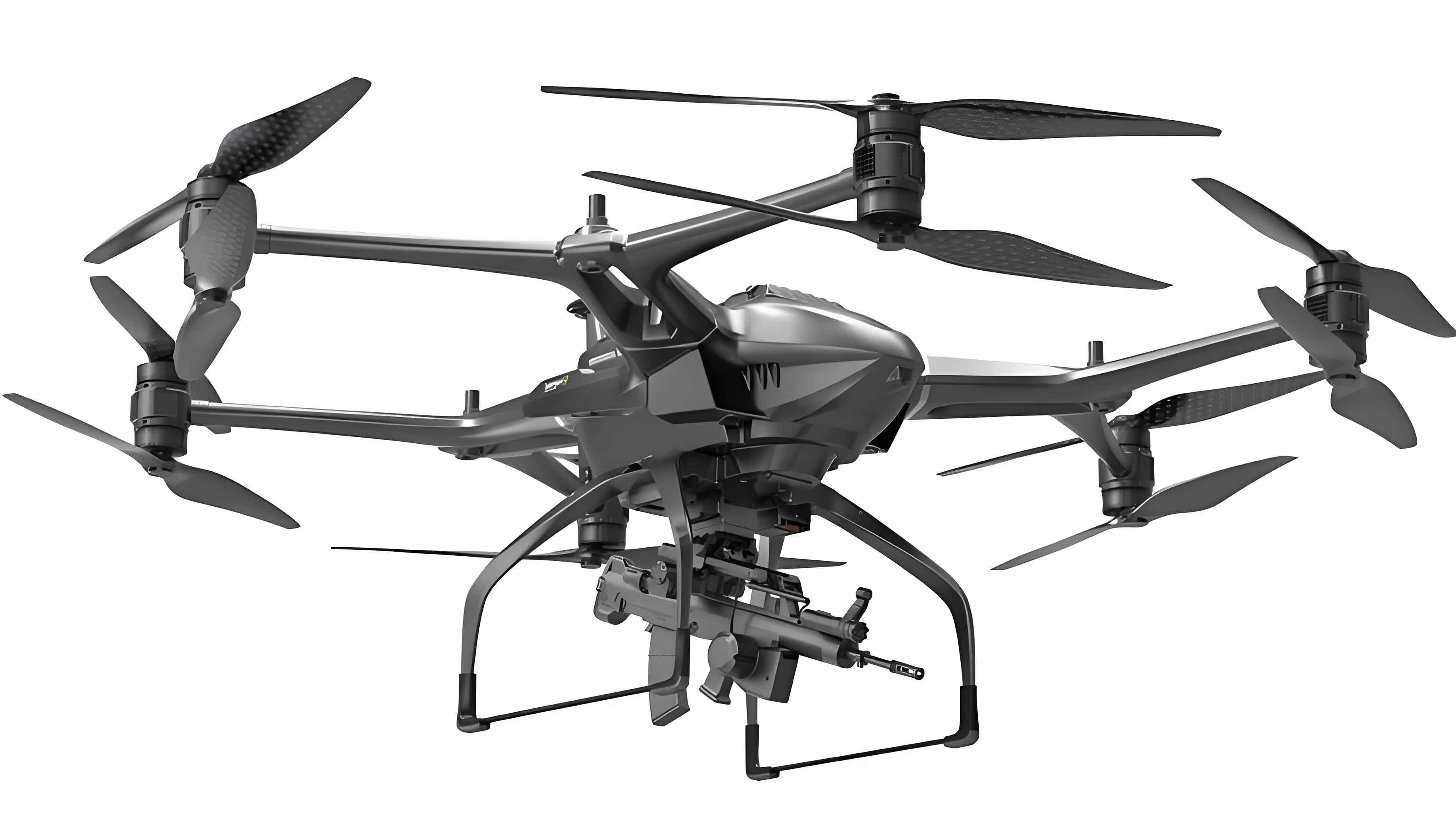
Battlefield Logistics Revolution
Unmanned systems now fulfill critical resupply functions through advanced cargo military UAV platforms. Unlike conventional methods, these systems operate independently of terrain constraints with vertical takeoff/landing capabilities. Performance metrics for leading models demonstrate their operational impact:
| UAV Model | Payload Capacity | Range (km) | Endurance (hrs) | Deployment Method |
|---|---|---|---|---|
| Heavy Lift Rotary | 3.5 t | 400 | – | GPS-guided sling operations |
| Fixed-Wing Cargo | 270 kg | 942 | 20 | Air-drop/ground launch |
| Modular Transport | 6×45 kg modules | – | – | Direct landing delivery |
The operational efficiency of cargo military drones is quantified by the payload-range equation, where maximum operational radius \( R \) depends on fuel fraction \( f \) and lift-to-drag ratio \( \frac{L}{D} \):
$$ R = \frac{V}{C_t} \cdot \frac{L}{D} \cdot \ln \left( \frac{W_0}{W_1} \right) $$
where \( V \) = cruise velocity, \( C_t \) = thrust-specific fuel consumption, \( W_0 \) = takeoff weight, and \( W_1 \) = weight after fuel burn. This enables continuous resupply in contested environments without risking personnel.
Anti-Submarine Warfare Transformation
Maritime patrol military UAV systems now conduct autonomous submarine detection through integrated sensor packages. These platforms carry specialized equipment including:
- Magnetic anomaly detectors
- Directional frequency analysis recorders
- Sonobuoy deployment systems (A/G types)
- Anti-submarine torpedoes
The sonar detection probability \( P_d \) for a military drone depends on sonobuoy density \( \rho \) and detection range \( r \):
$$ P_d = 1 – e^{-\lambda \pi r^2 \rho} $$
where \( \lambda \) represents submarine detection probability per unit area. Modern systems deploy 10-20 sonobuoys with 20-hour endurance, creating persistent detection grids. Comparative performance against manned platforms:
| Parameter | Unmanned ASW Platform | Manned ASW Aircraft |
|---|---|---|
| Endurance | >24 hours | <12 hours |
| Operational Radius | 1,850 km+ | <1,500 km |
| Risk Profile | No crew endangerment | High-risk missions |
When integrated with manned aircraft, military UAV systems increase area coverage by 300% while reducing crew fatigue limitations.
Aerial Refueling Capabilities
Carrier-based military drones now address critical tanker shortages through specialized unmanned tankers. The MQ-25 platform demonstrates how military UAV technology extends fighter capabilities with these performance characteristics:
| Capability | Specification |
|---|---|
| Fuel Transfer Capacity | 6,800 kg |
| Receiver Aircraft Supported | 4-6 fighters |
| Radius Extension | +470 km per fighter |
| Stealth Features | Embedded engines, faceted fuselage |
The combat radius enhancement \( \Delta R \) provided by a tanker military drone follows the Breguet range equation modification:
$$ \Delta R = \frac{V}{C} \cdot \ln \left(1 + \frac{W_f}{W_e}\right) $$
where \( V \) = velocity, \( C \) = specific fuel consumption, \( W_f \) = transferred fuel weight, and \( W_e \) = receiver empty weight. This enables 72 unmanned tankers to release 20-30% of carrier air wings from auxiliary duties.
Future Trajectory
The advancement curve for military UAV systems follows Moore’s Law adaptation for defense systems, where capability \( C \) doubles every \( T \) years while cost \( K \) decreases:
$$ C(t) = C_0 \cdot 2^{t/T} \quad \text{and} \quad K(t) = K_0 \cdot 2^{-t/T} $$
Current R&D focuses on swarming algorithms enabling cooperative engagement where \( n \) drones achieve coordinated strike efficiency:
$$ E_s = \frac{n}{1 + k(n-1)} $$
with \( k \) representing coordination efficiency (0.2-0.5). As autonomy improves, future military drones will incorporate AI-driven mission adaptation, quantum navigation, and hypersonic platforms – fundamentally reshaping warfare paradigms while reducing human risk exposure across all combat domains.