
In recent years, the proliferation of military drones has transformed the security landscape in the Middle East, becoming a pivotal element in regional conflicts. As I analyze this phenomenon, I recognize that military drones combine the dual characteristics of “low cost” and “high threat,” reshaping warfare and geopolitical dynamics. This article explores the development of military drones in the region, their strategic value, and the profound implications for regional security. I will use tables and formulas to summarize key points, ensuring a comprehensive understanding of how military drones are influencing the Middle East.
The strategic value of military drones lies in their ability to offer significant advantages at reduced costs. From an economic perspective, the cost-effectiveness of military drones can be represented by a simple formula: $$C_{ratio} = \frac{B}{C_e + C_l + C_p}$$ where \(C_{ratio}\) is the cost-benefit ratio, \(B\) represents the strategic benefits, \(C_e\) is the economic cost, \(C_l\) is the life cost (e.g., pilot casualties), and \(C_p\) is the political cost. Military drones typically exhibit a high \(C_{ratio}\) due to their lower expenses compared to manned aircraft. For instance, while an F-35 fighter jet costs around $100 million with annual maintenance exceeding $10 million, a top-tier military drone like the MQ-9 Reaper costs approximately $20 million with $5 million in yearly upkeep. This affordability has democratized access to advanced aerial capabilities, allowing even non-state actors to deploy military drones in conflicts.
Moreover, the threat posed by military drones can be quantified using a threat index formula: $$T_{index} = \alpha \cdot \frac{1}{C_e} + \beta \cdot Cap + \gamma \cdot Diff$$ where \(T_{index}\) is the threat index, \(C_e\) is the economic cost (lower cost increases threat), \(Cap\) represents capabilities (e.g., payload, range), \(Diff\) is the difficulty of detection and countermeasures, and \(\alpha, \beta, \gamma\) are weighting factors. Military drones often score high on this index due to their ease of proliferation and adaptability. The low entry barrier for acquiring military drones has enabled various actors to challenge traditional air superiority, leading to increased insecurity.
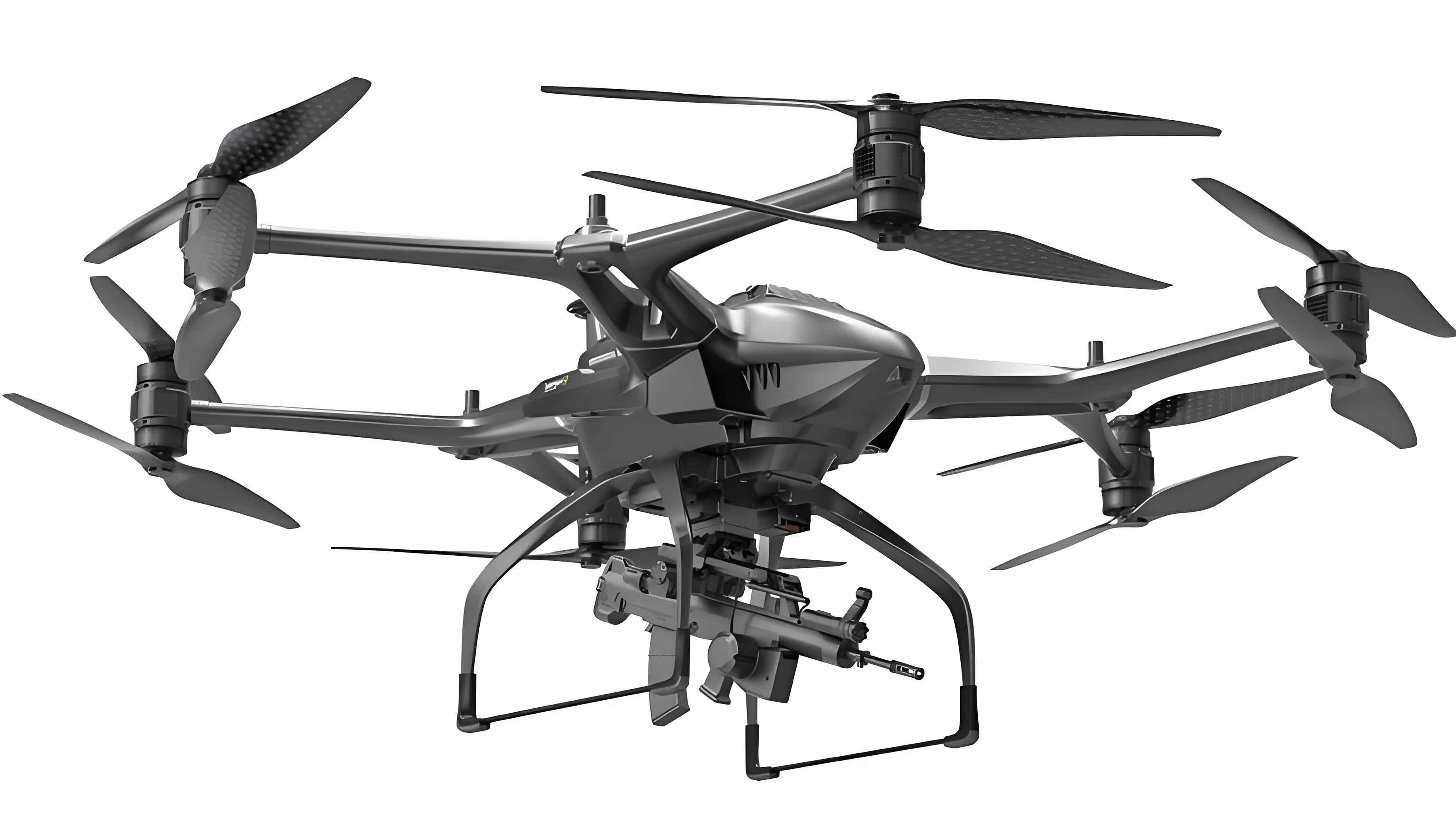
The development of military drones in the Middle East has evolved from a monopoly by the United States and Israel to a competitive multi-actor environment. Below, I present a table summarizing the drone capabilities of key regional players, based on my analysis of their研发 (R&D), usage, and export activities.
| Tier | Countries | R&D Capability | Usage Experience | Export Status |
|---|---|---|---|---|
| 1 | Israel | High, with world-leading technology | Extensive, since 1974 | Major exporter globally |
| 2 | Turkey, Iran | Strong, capable of producing high-end drones | Substantial, with combat experience since 2015 | Export to regional allies |
| 3 | Egypt, Saudi Arabia, UAE | Moderate, focusing on localization | Limited, but growing in conflicts like Yemen | Minimal exports |
| 4 | Iraq, Jordan, Tunisia | Low, reliant on imports | Emerging, e.g., against ISIS | No exports |
This table illustrates how military drones have proliferated across tiers, with Israel remaining a dominant force, while Turkey and Iran have rapidly advanced their indigenous programs. The demand for military drones in the Middle East stems from ongoing conflicts, such as counter-terrorism operations and regional rivalries. For example, Turkey’s development of military drones like the Bayraktar TB2 was driven by domestic needs against the PKK, but it has since exported these systems to bolster its geopolitical influence. Similarly, Iran has leveraged military drones to empower proxies like Hezbollah and the Houthis, enhancing asymmetric warfare capabilities.
To further analyze the cost dynamics, consider the following formula for the total cost of ownership (TCO) of a military drone fleet: $$TCO = N \cdot (P + M \cdot t)$$ where \(N\) is the number of drones, \(P\) is the purchase price per drone, \(M\) is the annual maintenance cost, and \(t\) is the time in years. For a fleet of 10 military drones like the TB2 (costing $5 million each with $1 million annual maintenance over 5 years), the TCO would be: $$TCO = 10 \cdot (5 + 1 \cdot 5) = 100 \text{ million dollars}$$ This is significantly lower than equivalent manned aircraft fleets, underscoring why military drones are attractive for budget 军事 forces.
The impact of military drones on regional security is multifaceted. Firstly, they have empowered non-state actors, fragmenting the security environment. Groups like Hezbollah and the Houthis now use military drones for surveillance, attacks, and propaganda, challenging state monopolies on air power. The proliferation of military drones among such actors can be modeled using a diffusion equation: $$\frac{dD}{dt} = r \cdot D \cdot (1 – \frac{D}{K}) – c \cdot D$$ where \(D\) is the number of military drones in non-state hands, \(r\) is the proliferation rate, \(K\) is the carrying capacity (e.g., resource limits), and \(c\) is the counter-proliferation efforts. This shows how military drones spread rapidly in permissive environments, exacerbating instability.
Secondly, military drones have become tools for targeted killings and political assassinations, lowering the threshold for using lethal force. The ethical implications here involve a risk-reward calculus: $$R_{score} = \frac{E \cdot A}{C_c}$$ where \(R_{score}\) is the risk score, \(E\) is the effectiveness in eliminating targets, \(A\) is the accuracy, and \(C_c\) is the collateral damage (e.g., civilian casualties). While proponents argue military drones reduce civilian harm, critics point to instances where misuse has led to extrajudicial killings, as seen in U.S. operations in Yemen and Pakistan. The lack of international regulations for military drones exacerbates these concerns, making them a destabilizing factor.
Thirdly, military drones are fueling a regional arms race. As countries like Saudi Arabia and the UAE seek to catch up with Turkey and Iran, they invest in both imports and local production of military drones. This competition can be expressed through a game-theoretic model: $$U_i = \sum_{j} (B_{ij} – C_{ij})$$ where \(U_i\) is the utility for country \(i\), \(B_{ij}\) is the benefit from acquiring military drones relative to rival \(j\), and \(C_{ij}\) is the cost. The Nash equilibrium often leads to over-investment in military drones, diverting resources from other security needs. For instance, the UAE’s purchase of Chinese and Turkish military drones reflects this dynamic, aiming to counter Iranian influence.
To illustrate the operational impact, I present another table comparing the use of military drones by major actors in the Middle East, based on my assessment of their strategies and outcomes.
| Actor | Primary Motives | Sales Policy | Usage Tactics | Regional Security Impact |
|---|---|---|---|---|
| United States | Counter-terrorism, political assassinations | Restricted, to allies only | Frequent, low authorization level | High, due to civilian casualties and precedent |
| Israel | Targeting non-state groups (e.g., Hezbollah) | Cautious, to friendly states | Mainly near borders | Moderate, focused on deterrence |
| Turkey | Domestic counter-insurgency, regional influence | Liberal, for export and diplomacy | Cross-border strikes | High, reshaping conflicts in Syria and Libya |
| Iran | Monitoring U.S. forces, supporting proxies | Liberal, via aid to allies | Used by proxies extensively | High, enhancing asymmetric threats |
| Arab States | Counter-terrorism, prestige | Limited sales | Cautious, in specific theaters | Moderate, but growing with localization |
This table highlights how military drones serve diverse purposes, from internal security to power projection. The cumulative effect is a more volatile security landscape, where military drones lower the costs of engagement and enable persistent threats. For example, in the Yemen conflict, Houthi forces have used Iranian-supplied military drones to attack Saudi oil infrastructure, causing economic damage despite Saudi Arabia’s superior conventional forces. This asymmetry is captured by the formula: $$A_{index} = \frac{T_{drone}}{D_{defense}}$$ where \(A_{index}\) is the asymmetry index, \(T_{drone}\) is the threat from military drones, and \(D_{defense}\) is the defensive capacity. A high \(A_{index}\) indicates that military drones can bypass traditional defenses, as seen in these attacks.
Looking ahead, the future of military drones in the Middle East involves technological advancements such as AI integration and swarm tactics. The effectiveness of drone swarms can be modeled using Lanchester’s laws for modern combat: $$\frac{dR}{dt} = -k_b \cdot B \cdot R$$ $$\frac{dB}{dt} = -k_r \cdot R \cdot B$$ where \(R\) and \(B\) represent the forces of two sides, and \(k\) coefficients account for the potency of military drones. Swarms of military drones could overwhelm air defenses, leading to new forms of warfare. Additionally, the development of counter-drone technologies, like electronic warfare and laser systems, is becoming a priority, but it often lags behind the proliferation of military drones.
In conclusion, military drones have become a cornerstone of Middle Eastern security dynamics, offering low-cost, high-threat capabilities that reshape conflicts. From my analysis, the proliferation of military drones has empowered non-state actors, facilitated targeted killings, and intensified arms races, contributing to regional fragmentation. While military drones provide tactical advantages in counter-terrorism, their unregulated use poses significant risks to stability. I urge the international community to establish robust frameworks for controlling the spread of military drones, ensuring they are used responsibly. As military drone technology evolves, continuous assessment will be vital to mitigate their disruptive impact on the Middle East’s already fragile security environment.
To summarize key points mathematically, the overall impact of military drones on regional security can be expressed as: $$I_{total} = \sum_{i=1}^{n} (W_i \cdot F_i)$$ where \(I_{total}\) is the total impact score, \(W_i\) are weights for factors like proliferation, threat level, and regulatory gaps, and \(F_i\) are the corresponding metrics derived from data on military drone usage. This holistic approach underscores the need for balanced policies that harness the benefits of military drones while addressing their dangers. As I reflect on this topic, it is clear that military drones will remain a critical factor in Middle Eastern geopolitics, demanding vigilant oversight and cooperation to prevent escalation.