
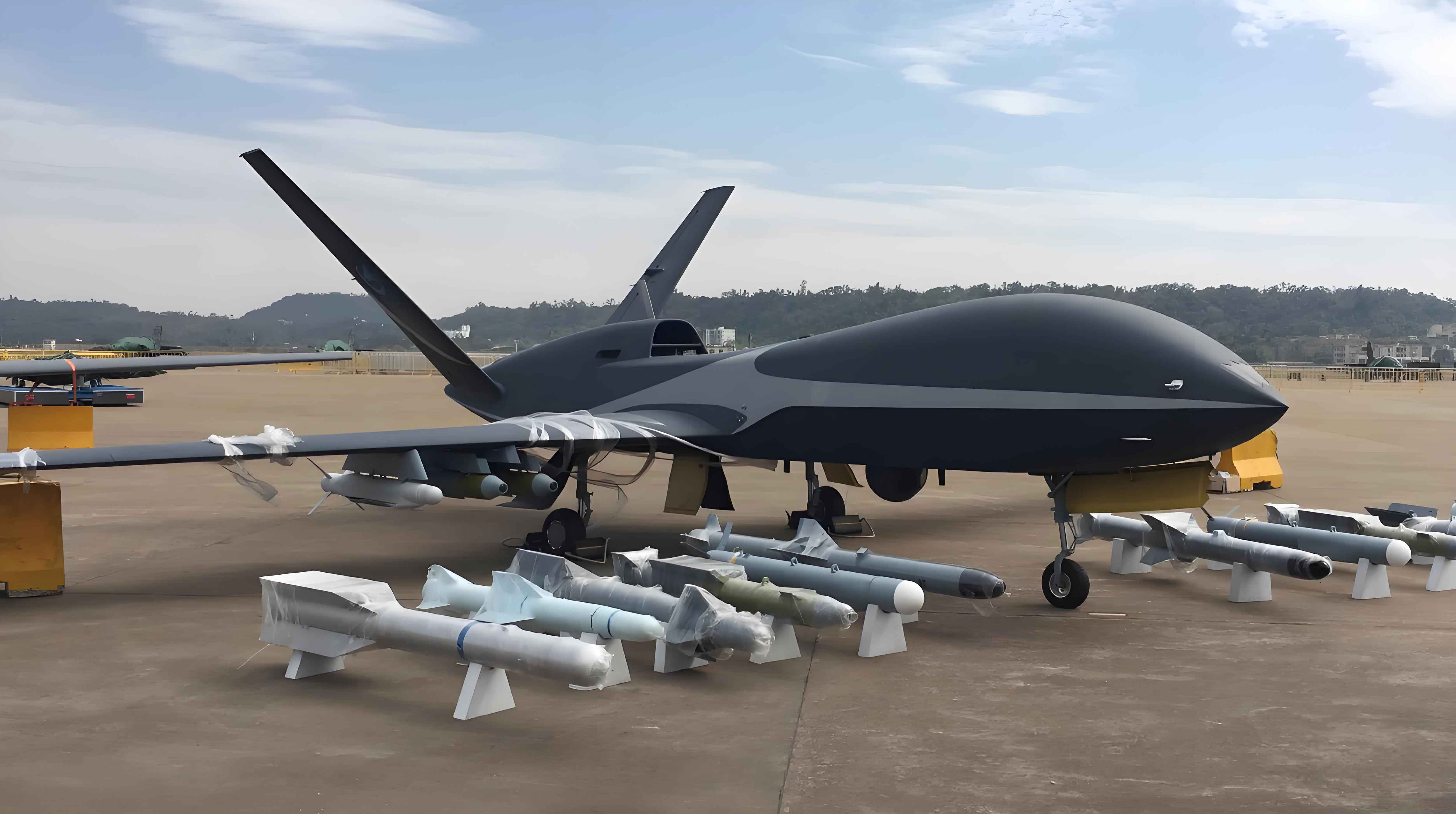
Military drones have become indispensable assets in modern warfare, extensively deployed for intelligence reconnaissance, command decision-making, and precision strikes across global conflict zones. The operational effectiveness of these military UAVs critically depends on human operators, particularly during manual control phases. Current evaluation models often oversimplify battlefield complexity by focusing on isolated performance metrics while neglecting environmental uncertainties. This study addresses these limitations by introducing a Fuzzy Analytic Hierarchy Process (FAHP)-based assessment framework to quantify military UAV operator competency through multi-dimensional analysis.
Evaluation Index System for Military UAV Operators
The competency assessment framework comprises four primary dimensions (A-level) decomposed into 15 sub-criteria (B-level):
| Target Layer | Criteria Layer (A) | Weight | Indicator Layer (B) | Weight |
|---|---|---|---|---|
| Military UAV Operator Competency Assessment | Flight Skills (A₁) | 0.449 | Vertical Maneuvers (B₁) | 0.286 |
| Orbital Patterns (B₂) | 0.104 | |||
| Dive/Climb Maneuvers (B₃) | 0.162 | |||
| Roll Maneuvers (B₄) | 0.151 | |||
| Tactical Operations (B₅) | 0.167 | |||
| Loop Maneuvers (B₆) | 0.130 | |||
| Flight Theory (A₂) | 0.080 | Aircraft Systems (B₇) | 0.376 | |
| Safety Protocols (B₈) | 0.263 | |||
| Control Theory (B₉) | 0.361 | |||
| Maintenance Skills (A₃) | 0.370 | Preventive Maintenance (B₁₀) | 0.362 | |
| Corrective Maintenance (B₁₁) | 0.362 | |||
| Systematic Maintenance (B₁₂) | 0.275 | |||
| Psychological Quality (A₄) | 0.101 | Mental Resilience (B₁₃) | 0.302 | |
| Emotional Stability (B₁₄) | 0.302 | |||
| Crisis Response (B₁₅) | 0.397 |
Weight Determination via FAHP
Factor weights are calculated using pairwise comparison matrices validated through consistency checks. The consistency ratio (CR) must satisfy CR < 0.1 for acceptance. Weights are derived as follows:
Step 1: Construct judgment matrix A for n factors using Saaty’s 1-9 scale:
$$ A = \begin{bmatrix} a_{11} & a_{12} & \cdots & a_{1n} \\ a_{21} & a_{22} & \cdots & a_{2n} \\ \vdots & \vdots & \ddots & \vdots \\ a_{n1} & a_{n2} & \cdots & a_{nn} \end{bmatrix} \quad \text{where} \quad a_{ij} = \frac{1}{a_{ji}}, a_{ii} = 1 $$
Step 2: Calculate weight vector W using the geometric mean method:
$$ \overline{w}_i = \sqrt[n]{\prod_{j=1}^{n} a_{ij}} \quad \text{(for } i = 1, 2, \ldots, n\text{)} $$
$$ w_i = \frac{\overline{w}_i}{\sum_{k=1}^{n} \overline{w}_k} $$
Step 3: Validate consistency with maximum eigenvalue (λₘₐₓ):
$$ \lambda_{max} = \frac{1}{n} \sum_{i=1}^{n} \frac{(AW)_i}{w_i} $$
$$ CI = \frac{\lambda_{max} – n}{n – 1}, \quad CR = \frac{CI}{RI} $$
where RI is the random index:
| Matrix Order | 1 | 2 | 3 | 4 | 5 | 6 | 7 | 8 | 9 |
|---|---|---|---|---|---|---|---|---|---|
| RI | 0 | 0 | 0.58 | 0.90 | 1.12 | 1.24 | 1.32 | 1.41 | 1.45 |
Fuzzy Comprehensive Evaluation Algorithm
Operator competency is quantified using multi-level fuzzy evaluation:
1. Comment Set Definition:
$$ V = \{v_1, v_2, v_3, v_4\} = \{\text{Excellent (90)}, \text{Good (75)}, \text{Average (60)}, \text{Poor (45)}\} $$
2. Membership Matrix Construction: For each sub-criterion Bᵢ, membership degrees to V are derived from expert ratings, forming matrix R:
$$ R_k = \begin{bmatrix} r_{11} & r_{12} & \cdots & r_{1m} \\ r_{21} & r_{22} & \cdots & r_{2m} \\ \vdots & \vdots & \ddots & \vdots \\ r_{p1} & r_{p2} & \cdots & r_{pm} \end{bmatrix} $$
3. Hierarchical Fuzzy Operations:
$$ S_i = W_i \circ R_i = [s_{i1}, s_{i2}, s_{i3}, s_{i4}] $$
$$ S = W \circ \begin{bmatrix} S_1 \\ S_2 \\ S_3 \\ S_4 \end{bmatrix}, \quad F = S \cdot V^T $$
where F is the final competency score.
Case Study: Military UAV Operator Assessment
A military drone trainee underwent evaluation with membership degrees derived from expert ratings:
| Sub-Criterion | Excellent | Good | Average | Poor |
|---|---|---|---|---|
| B₁ | 0.385 | 0.615 | 0.000 | 0.000 |
| B₂ | 0.308 | 0.692 | 0.000 | 0.000 |
| B₅ | 0.000 | 0.077 | 0.846 | 0.077 |
| B₁₀ | 0.077 | 0.308 | 0.077 | 0.000 |
| B₁₅ | 0.000 | 0.692 | 0.308 | 0.000 |
Fuzzy Evaluation Output:
$$ S_{\text{Flight Skills}} = [0.155, 0.441, 0.342, 0.063] $$
$$ S_{\text{Maintenance}} = [0.223, 0.314, 0.337, 0.126] $$
$$ S = [0.206, 0.418, 0.299, 0.077] $$
$$ F = [0.206, 0.418, 0.299, 0.077] \cdot \begin{bmatrix} 90 \\ 75 \\ 60 \\ 45 \end{bmatrix} = 71.28 $$
The operator’s military UAV competency score of 71.28 indicates “Good” proficiency, with maintenance skills identified as the critical improvement area (membership to “Average” = 0.337).
Conclusions
This research establishes a robust FAHP framework for evaluating military drone operator competency, integrating flight skills (44.9% weight), maintenance proficiency (37.0%), psychological resilience (10.1%), and theoretical knowledge (8.0%). Vertical maneuvers (28.6% under flight skills) and crisis response (39.7% under psychological quality) are identified as pivotal sub-criteria. The model’s efficacy is validated through empirical scoring, providing militaries with a scientifically-grounded tool for enhancing military UAV operational readiness. Future work will expand validation across diverse military drone platforms and conflict scenarios.