
The emergence of the SULSA unmanned aerial vehicle in 2011 marked a paradigm shift in drone manufacturing. As the first fully 3D-printed drone, this 3-meter wingspan aircraft demonstrated unprecedented agility: assembly completion within minutes without tools, facilitated by snap-fit connections rather than traditional fasteners. This breakthrough highlighted additive manufacturing’s capacity to compress development cycles from months to days while enabling radical design freedom. The drone manufacturer sector now leverages this synergy to overcome traditional production constraints.
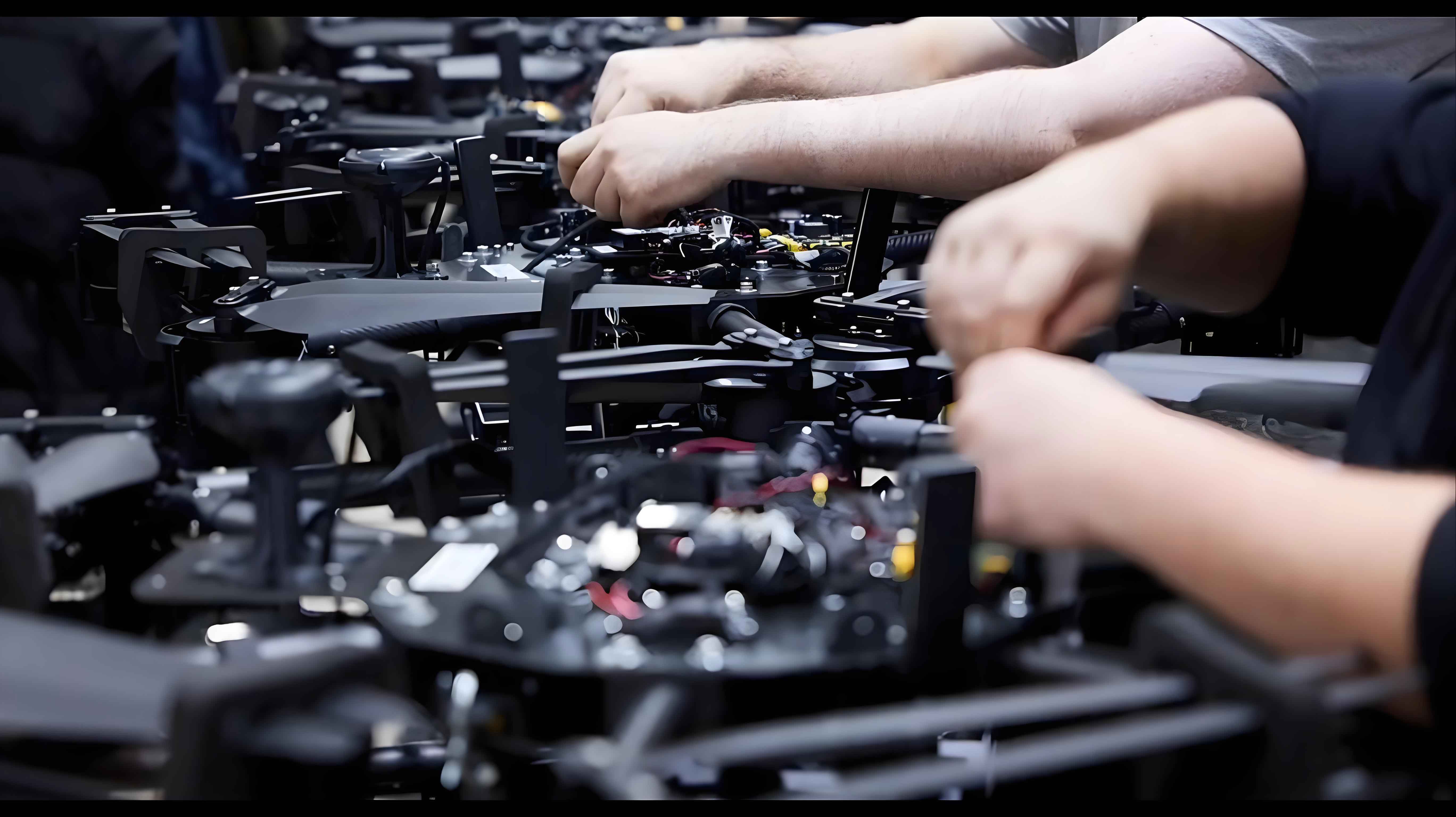
Modern UAVs comprise five core systems: airframe, propulsion, control, payload, and data-link. Their strategic value stems from exceptional operational capabilities quantified by:
$$ \text{Operational Efficiency} = \frac{\text{Endurance} \times \text{Payload Capacity}}{\text{Production Cost} \times \text{Development Time}} $$
Additive manufacturing elevates this metric through six transformative advantages:
| Advantage | Impact Metric | Traditional Manufacturing | 3D Printing |
|---|---|---|---|
| Complex Geometry | Structure Weight Reduction | 15-25% | 40-60% |
| Material Utilization | Waste Percentage | 60-85% | 3-8% |
| Production Lead Time | Prototype Development | 2-6 months | 24-72 hours |
| Customization | Unit Cost Variance | +300-500% | +15-30% |
The material efficiency equation demonstrates why drone manufacturers adopt additive processes:
$$ \eta_m = \frac{M_{\text{final}}}{M_{\text{raw}}} \times 100\% $$
Where traditional aerospace manufacturing achieves ηm ≈ 15%, laser sintering elevates this to ηm > 90%. This directly impacts fuel economy through the flight mass equation:
$$ \Delta F = k \cdot \Delta M \cdot R $$
Where ΔF represents fuel savings, k is the airframe-specific constant (typically 45,000 L/kg for midsize UAVs), ΔM denotes mass reduction, and R is operational range. A 500g component reduction in a surveillance drone thus yields:
$$ \Delta F = 45,000 \times 0.5 \times 1,000 = 22.5 \times 10^6 \text{ L} $$
Additive manufacturing enables complex geometries unattainable through subtractive methods. Internal lattice structures inspired by the Vickers Wellington bomber’s geodesic airframe now feature in printed drones without tooling investments. The drone manufacturer community particularly benefits from:
- Composites Integration: Continuous fiber embedding in thermoplastic matrices achieves specific strength ratios of:
$$ \frac{\sigma}{\rho} > 1.2 \times 10^6 \text{ N·m/kg} $$ - Functional Grading: Material properties transition spatially within single components:
$$ E(x,y,z) = E_0 + \nabla E \cdot \mathbf{r} $$ - Conformal Systems: Electronics printed within structures via surface metallization:
$$ C_{\text{integration}} = 1 – \frac{N_{\text{fasteners}}}{N_{\text{components}}} $$
Current implementations demonstrate the drone manufacturer evolution:
- Monolithic Airframes: The US Navy’s X-47B features 90% printed structural mass with wing-fuselage integration
- Propulsion Systems: GE Additive’s turbine combustors withstand 2,500°C through generative cooling channels
- Field Repairability: Forward-deployed systems reduce logistics mass via:
$$ L_{\text{mass}} = k_p \cdot M_{\text{spares}} \cdot e^{-t/\tau} $$
Leading drone manufacturer facilities report production transformations:
| Parameter | Conventional | Additive | Improvement |
|---|---|---|---|
| Tooling Cost | $250k-$1.2M | $0 | 100% |
| Part Consolidation | 120 components | 3-7 components | 18-40x |
| Iteration Cycle | 6-12 weeks | 12-48 hours | 98% faster |
The technology roadmap reveals three evolutionary vectors:
- Multi-Material Printing: Simultaneous deposition of dielectrics, conductors, and structural materials:
$$ \nabla \mu = \sum_{i=1}^{n} \alpha_i \nabla \mu_i $$ - In-Process Monitoring: Melt-pool spectroscopy for real-time quality assurance:
$$ Q_{\text{index}} = \int \lambda \cdot I(\lambda, T) d\lambda $$ - AI-Driven Topology: Generative design algorithms optimizing for flight regimes:
$$ \min_{x} \left[ M(x) + \omega \cdot \max \left(0, \sigma_{\text{VM}} – \sigma_y \right) \right] $$
As drone manufacturer capabilities advance, the airframe complexity index rises exponentially with additive adoption:
$$ \Gamma_{\text{complexity}} = A \cdot e^{B \cdot P_{\text{adoption}}} $$
Where A and B are industry-specific constants, and Padoption represents additive manufacturing utilization percentage. This progression positions drone manufacturers to achieve unprecedented performance matrices while fundamentally transforming aerospace logistics.